Top 6 Langfuse Alternatives For 2026

Managing the full lifecycle of AI agents becomes a bottleneck when tools force you to split experiment tracking, prompt management, and observability across incompatible platforms. Many existing agent lifecycle management solutions either lock enterprise features behind opaque pricing or demand infrastructure expertise that small to midsize teams cannot spare. This comparison details capabilities, deployment models, and pricing structures so teams can select an agent lifecycle management platform that matches their technical resources and compliance needs without running into hidden costs or unnecessary complexity.
Table of Contents
- MLflow
- HoneyHive
- Lunary
- LangSmith
- Arize Phoenix
- Comparative Analysis of Agent Lifecycle Management Platforms
MLflow
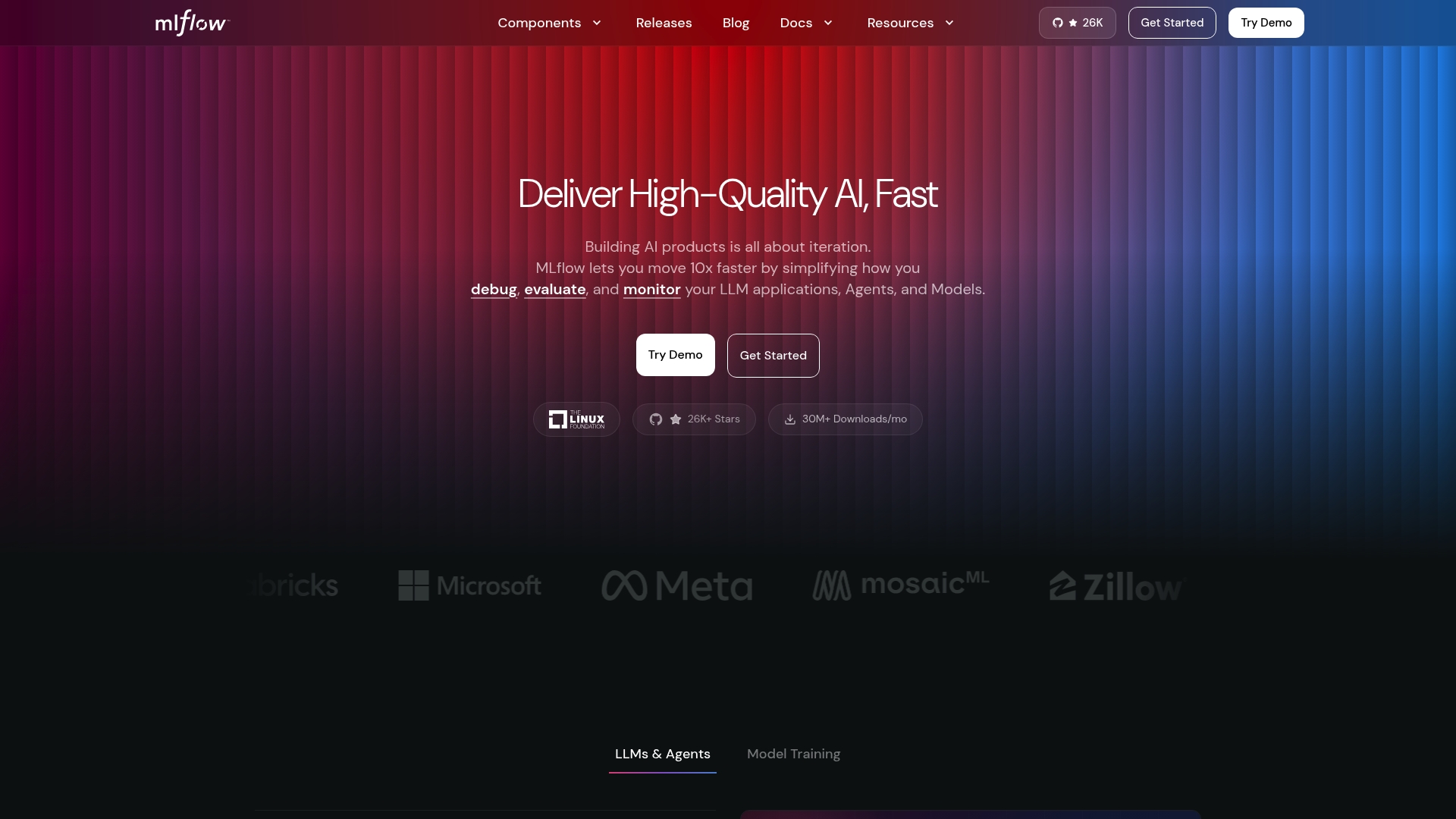
At a Glance
MLflow includes a centralized AI Gateway for secure prompt management and cross-provider governance, and it traces agentic reasoning end to end for production observability. The platform covers experiment tracking, model registry, deployment, and LLM prompt management in one open source stack.
Core Features
- Experiment tracking for reproducible runs and parameter histories across notebooks and pipelines.
- Model registry with staged promotion, versioning, and metadata for deployment decisions.
- Observability and tracing that captures agentic reasoning paths and runtime signals for root cause analysis.
- Deployment and lifecycle management for models and agents, plus a prompt registry for LLM optimization.
Key Differentiator
Framework-neutral design supporting both traditional ML and generative AI workflows, paired with automated evaluation tooling and deep tracing of agent decisions. That combination lets teams apply the same lifecycle controls to TensorFlow, PyTorch, classic models, and agentic LLM chains without forcing toolchain lock‑in.
Pros
- Open source and free, which lowers vendor lock-in and lets engineering teams inspect and extend the core components where necessary.
- Broad framework support makes it practical to standardize workflows across PyTorch, TensorFlow, XGBoost, and HuggingFace models without separate toolchains.
- Production-focused tracing and evaluation let you follow an agent's reasoning path and run automated LLM-as-a-Judge checks against held-out cases.
- Prompt registry and prompt optimization features centralize prompt assets and histories, reducing drift when you swap providers or models.
- Active community and many integrations make it straightforward to adapt MLflow into existing CI pipelines and monitoring stacks.
Cons
- Advanced use cases require nontrivial setup and infrastructure; expect a learning curve and additional infra work as you scale deployments.
Notable Integrations
- OpenTelemetry for observability pipelines.
- LangChain and OpenAI for agent and LLM orchestration.
- Native connectors for PyTorch, TensorFlow, XGBoost, and HuggingFace model artifacts.
Who It's For
Data science teams, ML engineers, and AI researchers who need a framework-agnostic, extensible platform to manage experiments through production. Teams that run both classical ML and generative agent workflows will see the most value.
Unique Value Proposition
The centralized prompt gateway and unified lifecycle controls change how teams manage multi-model fleets and agent logic. Instead of separate prompt stores, evaluation rigs, and tracing silos, MLflow lets you version prompts, run automated judge evaluations, and trace agent rationale from a single place, which simplifies governance across providers.
Real World Use Case
A company tracks experiments and registers model versions for a fraud detection pipeline, then deploys the model and instruments runtime tracing to monitor inference drift and resource consumption. The same MLflow project nests LLM prompts and agent workflows used for case enrichment and postprocessing.
Website: https://mlflow.org
HoneyHive
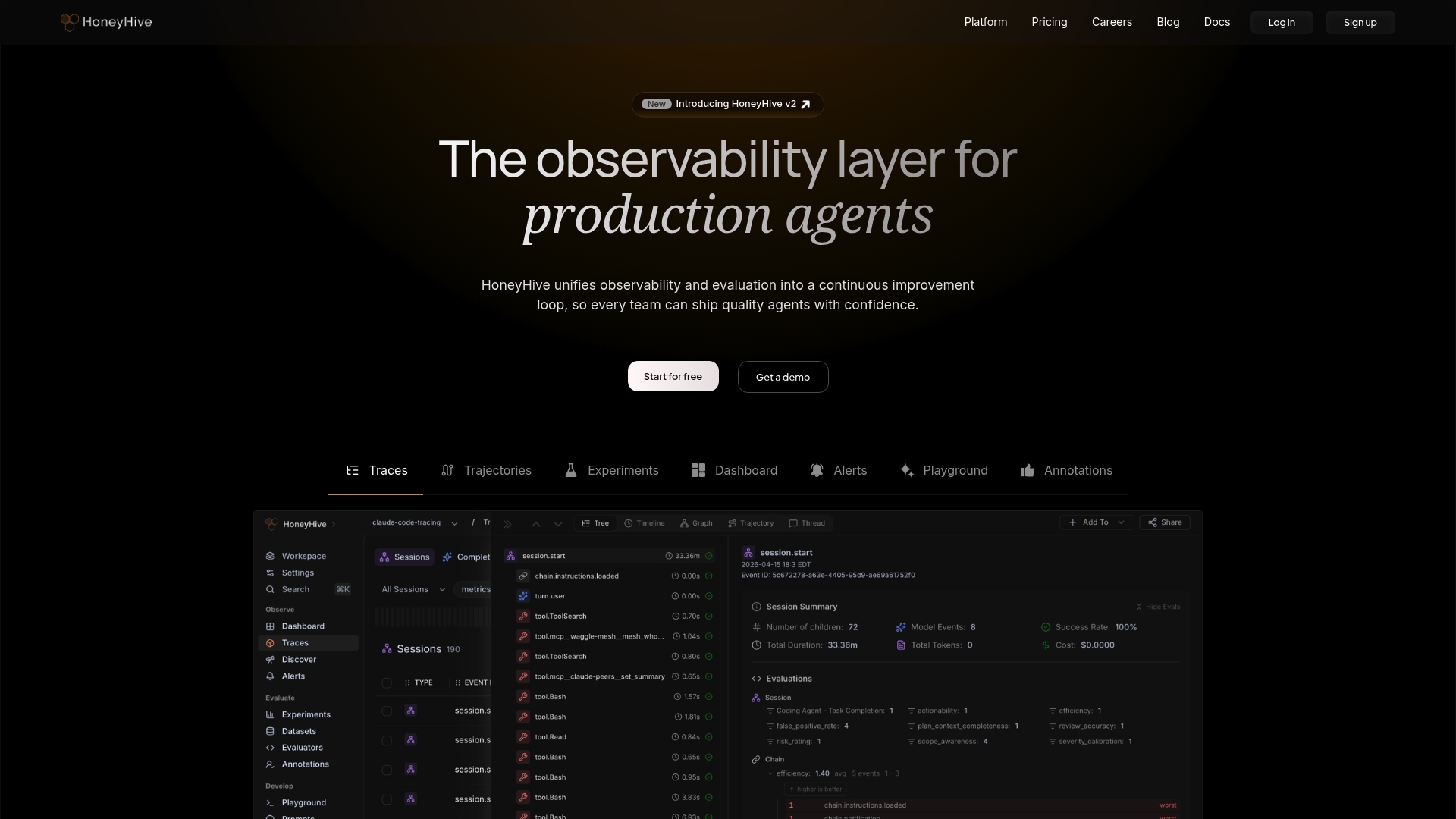
At a Glance
HoneyHive's marketing materials state it is used by Australia's largest bank to monitor dozens of AI systems serving over 17 million consumers, and that Fortune 500 companies rely on it. The vendor also advertises security and compliance including SOC2, GDPR, and HIPAA.
HoneyHive combines observability, continuous evaluation, and experimentation in one system so teams can trace agent behavior and push regressions into test pipelines.
Core Features
- OpenTelemetry-native and framework-agnostic trace instrumentation for model and agent telemetry.
- Continuous real-time evaluation and performance monitoring that flags regressions and drift.
- Experimentation and automated regression testing to compare model versions in production-like conditions.
- Collaborative prompt and model version management inside shared workspaces to keep runs and artifacts discoverable.
Key Differentiator
HoneyHive centers on OpenTelemetry-native traces, which lets you treat agent reasoning as first-class telemetry across heterogeneous stacks. That model-agnostic stance makes it possible to stitch traces from orchestration layers, custom models, and third-party providers into a single investigation surface.
Pros
- Supports any model or framework that can emit OpenTelemetry traces, so instrumenting mixed fleets is practical.
- Enables detailed monitoring and debugging of agent failures, letting SREs find cascading errors across services.
- The compliance claim above gives security teams a clear checklist when evaluating vendors for regulated deployments.
- Flexible deployment options include SaaS, hybrid, and self-hosted, which helps teams with data residency or air-gapped requirements.
- Built-in experiment automation reduces manual rollback work by comparing model variants against the same production inputs.
Cons
- Multiple third-party reviews report that initial setup and configuration are complex for new users, especially without an SRE or telemetry engineer.
- The feature set and scalability can overwhelm small projects; tiny teams may never use most capabilities.
- The free offering is limited; enterprise plans are custom and require a larger investment than entry-level observability tools.
- Instrumenting highly custom models or proprietary runtimes requires nontrivial engineering effort.
When It May Not Fit
If you are a single-developer startup or a proof-of-concept team without telemetry expertise, HoneyHive's setup and operational demands will slow you down. For teams that only need lightweight metrics and alerts, a simpler APM or logging tool will be cheaper and faster to adopt.
Who It's For
AI development and operations teams at large enterprises and regulated institutions that deploy mission-critical AI agents. It suits organizations with dedicated telemetry, SRE, or ML engineering resources and those that require on-prem or hybrid hosting.
Real World Use Case
The vendor describes a deployment at a major Australian bank where HoneyHive observes dozens of agent systems and feeds curated production datasets back into test suites. That deployment shows how trace-based evaluation helps spot regressions before they affect large user populations.
Pricing
HoneyHive offers a free developer plan for initial testing. Paid plans are custom and scale with usage, retention, and enterprise features such as dedicated hosting, advanced compliance support, and onboarding services.
Website: https://honeyhive.ai
Lunary
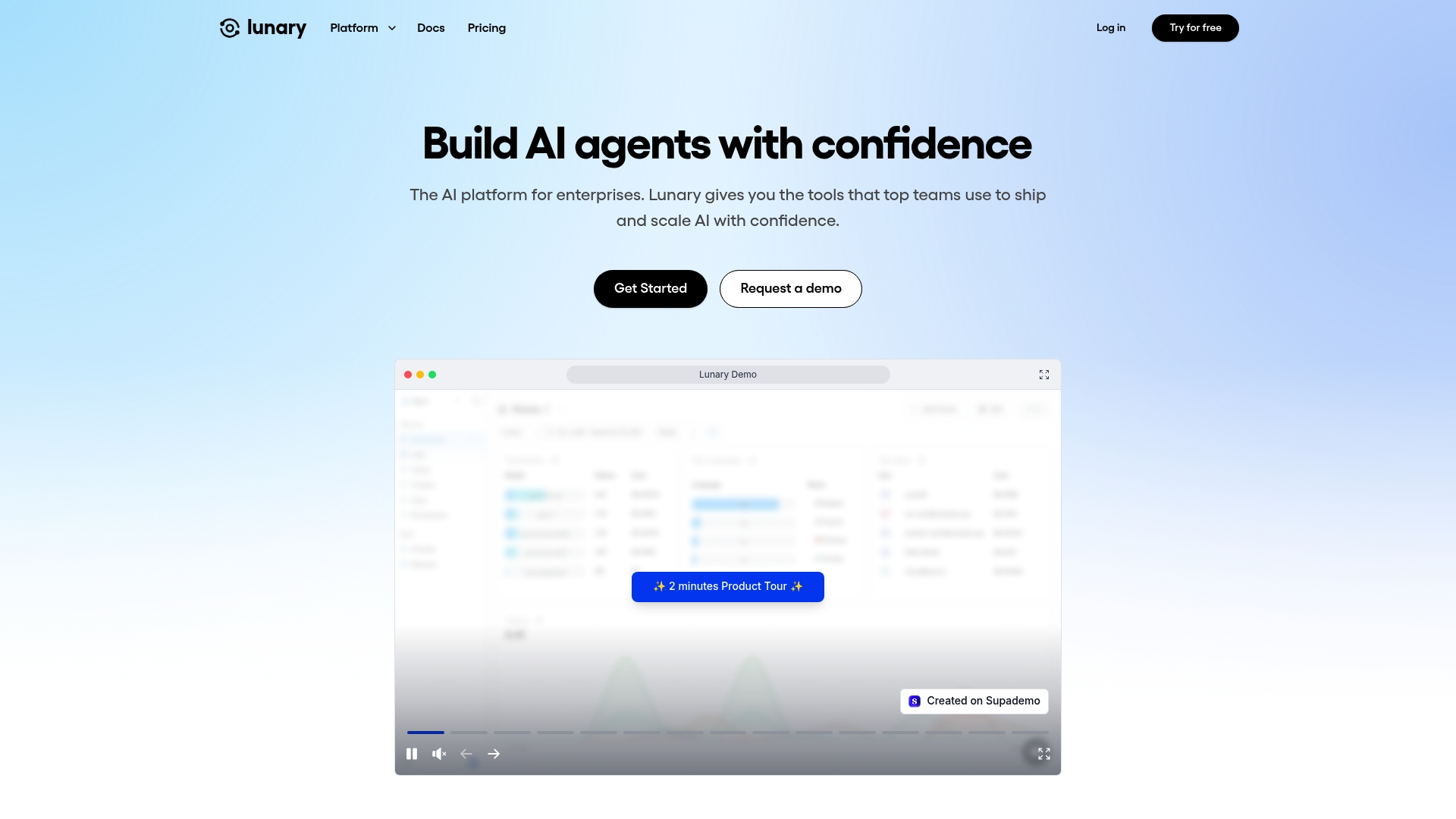
At a Glance
The vendor advertises SOC 2 Type II and ISO 27001 certification, and Lunary supports self-hosting for on-premises deployments. That security posture plus on-prem options makes it attractive for regulated enterprises that must control data residency.
Lunary combines real-time observability, prompt versioning, and conversational replay to help engineering teams monitor and debug production LLM agents. It targets organizations that need audit trails and privacy controls alongside model telemetry.
Core Features
- Real-time LLM performance monitoring for latency, error rates, and throughput so you spot regressions as they happen.
- Prompt template management and versioning with collaborative editing and rollout controls for iterative prompt development.
- Conversational replay and tracing to reproduce failing responses and inspect the agent decision path.
- PII masking and access controls for data protection and role-based visibility.
- Self-hosting and SDKs for multiple providers including OpenAI, Anthropic, Llama, and Azure OpenAI.
- Multi-modal input support, custom dashboards, feedback workflows, and alerting for anomalous agent behavior.
Key Differentiator
Lunary mixes enterprise compliance with deployment flexibility in one package. The combination of that certification claim, self-hosting, and broad LLM connector support lets security-first teams run production chatbots without handing raw data to a third party.
The focus is not just monitoring but operating governed LLMs inside corporate controls.
Pros
-
Clear auditability: conversational replay and tracing create a usable incident trail for compliance teams and SREs.
-
Security-first features: PII masking and vendor-certified controls simplify vendor risk assessments for procurement teams.
-
Flexible deployment: self-hosting options and SDKs for major LLMs let your infra team choose where models run and how telemetry flows.
-
Developer ergonomics: prompt versioning, collaborative editing, and feedback pipelines reduce friction between product and ML engineering.
-
Alerts and custom dashboards provide measurable signals tied to cost and performance for finance and ops stakeholders.
Cons
-
Steep learning curve for new users who lack an SRE or ML ops specialist, as advanced features require configuration and maintenance.
-
Enterprise features such as self-hosting and SSO are gated behind custom pricing, which raises the bar for smaller teams.
-
Feature density can overwhelm teams that need a lightweight chatbot runtime without governance controls.
When It May Not Fit
If your team is a two- to five-person startup shipping a single proof of concept, Lunary’s setup and governance overhead may slow progress. Teams seeking a plug-and-play chatbot service with minimal ops work will find the platform heavier than necessary.
Organizations without internal DevOps or security resources should budget for setup time and expertise.
Notable Integrations
- OpenAI
- Anthropic
- Llama
- Azure OpenAI
- Mistral
- Deepseek
- Structured Output Schema Generator
- Tool Calls Schema Generator
Who It's For
AI engineering teams at mid-size to large organizations where compliance, traceability, and data residency matter. Ideal for security, legal, and infra stakeholders who need observable agent behavior and a path to self-hosted deployments.
Real World Use Case
A multinational support organization deploys Lunary to run a customer service chatbot across regions. The team uses conversational replay to diagnose regional prompt regressions, applies PII masking for GDPR boundaries, and manages prompt rollouts through versioned templates.
Pricing
Lunary offers a free plan starting at $0, while enterprise plans are custom priced and include advanced capabilities such as self-hosting, SSO, PII masking, and dedicated support. Contact sales for enterprise quotes and onboarding details.
Website: https://lunary.ai
LangSmith
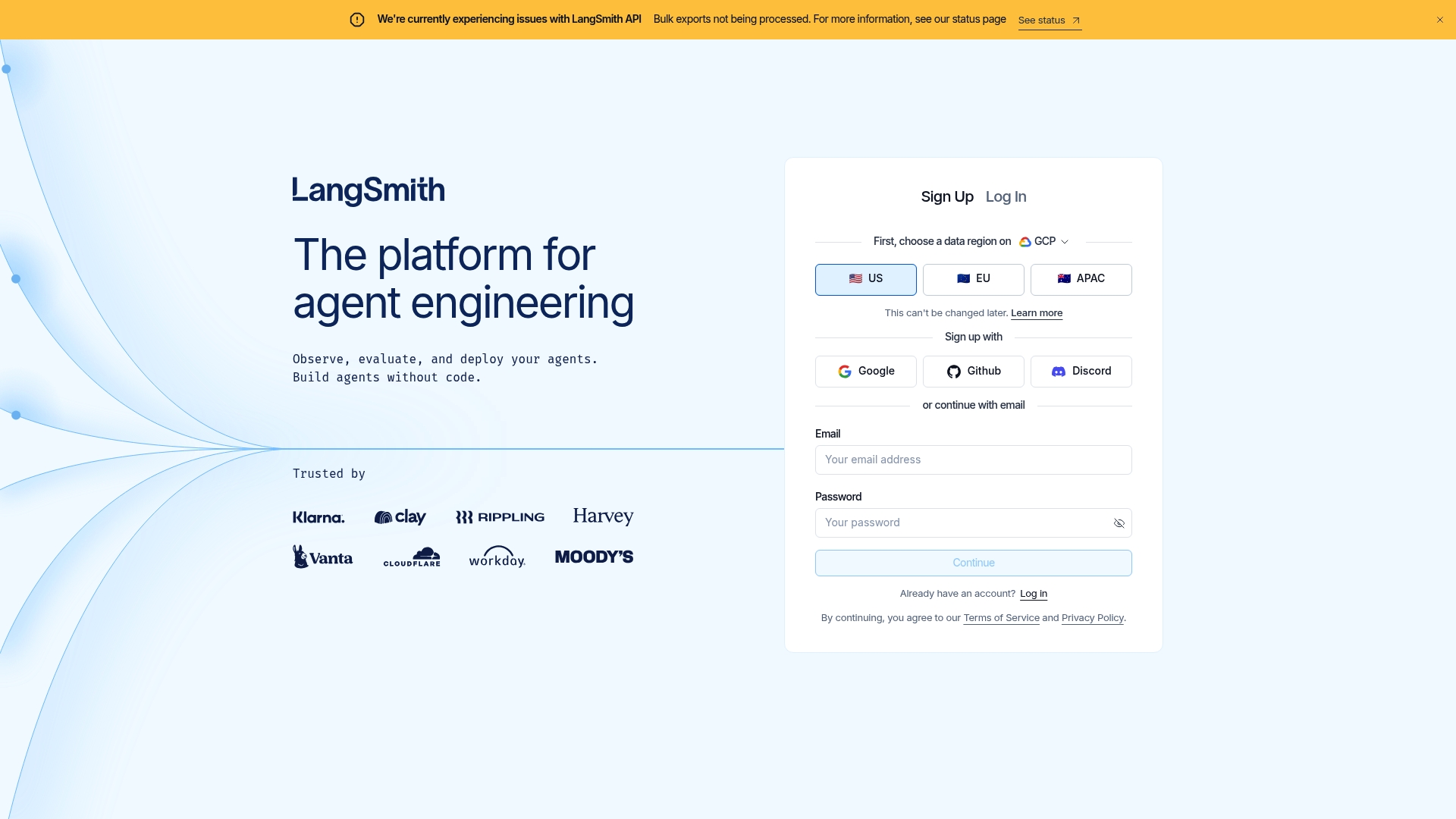
At a Glance
Region-specific deployment on GCP is available, letting teams choose where agent data lives rather than relying on a single global endpoint. The vendor's site emphasizes no-code agent building and regional options. Their status page currently reports issues with bulk exports and data processing.
Core Features
- Build agents without code through a visual interface that stitches prompts, tools, and decision logic.
- Observe, evaluate, and deploy AI agents with built-in testing and inspection of agent traces and decisions.
- Region-specific data deployment options on GCP so organizations can align deployments with residency requirements.
- Sign-in via Google, GitHub, Discord, or email and a public status page for operational transparency.
Key Differentiator
LangSmith focuses on no-code agent engineering while exposing region controls on GCP. That combination narrows the audience to teams that want faster iteration without shipping code but still need cloud region choices. It is more tailored to LangChain-aligned workflows than general MLOps stacks.
Pros
- No-code flow reduces friction for product managers and analysts who need to prototype agents without developer cycles. Nontechnical stakeholders can create and tweak agents directly.
- Region controls help meet data residency preferences or internal policy requirements. That is useful for teams splitting deployments across corporate regions.
- Multiple sign-in methods lower the onboarding barrier for distributed teams and contractors.
- Built-in observation and evaluation tools keep agent traces and performance in one place rather than scattered across homegrown dashboards.
- The public status page gives a single source for operational updates and incident context.
Cons
- The status page currently lists problems with bulk exports and data processing, which impacts workflows that rely on large-scale telemetry downloads.
- Publicly available product content is light on detailed feature docs, so discovering exact limits and APIs requires direct contact or hands-on testing.
- Nontechnical users still face conceptual complexity when agents interact with external tools or require custom connectors.
When It May Not Fit
If you need reliable, immediate bulk export capability today, LangSmith may slow down your analytic workflows because their status page calls out export and processing issues. If your team needs deep, documented APIs beyond the visual surface, expect discovery sessions or trial runs before committing.
Who It's For
Developers and organizations operating within the LangChain ecosystem who want to hand low-code or no-code agent authoring tools to product teams. Good for groups that need regional data control on GCP but do not require a full developer-led MLOps investment.
Real World Use Case
A product team builds a customer support automation agent using the visual editor, runs evaluation suites to compare decision traces, and deploys the agent to a GCP region aligned with corporate policy. Observability lets the team iterate prompts and tool usage without shipping backend changes.
Pricing
Pricing is not published. The vendor provides informational product pages but does not list public pricing tiers or per-seat fees in the available content. Contact the vendor or request a trial for commercial terms.
Website: https://smith.langchain.com
Arize Phoenix
At a Glance
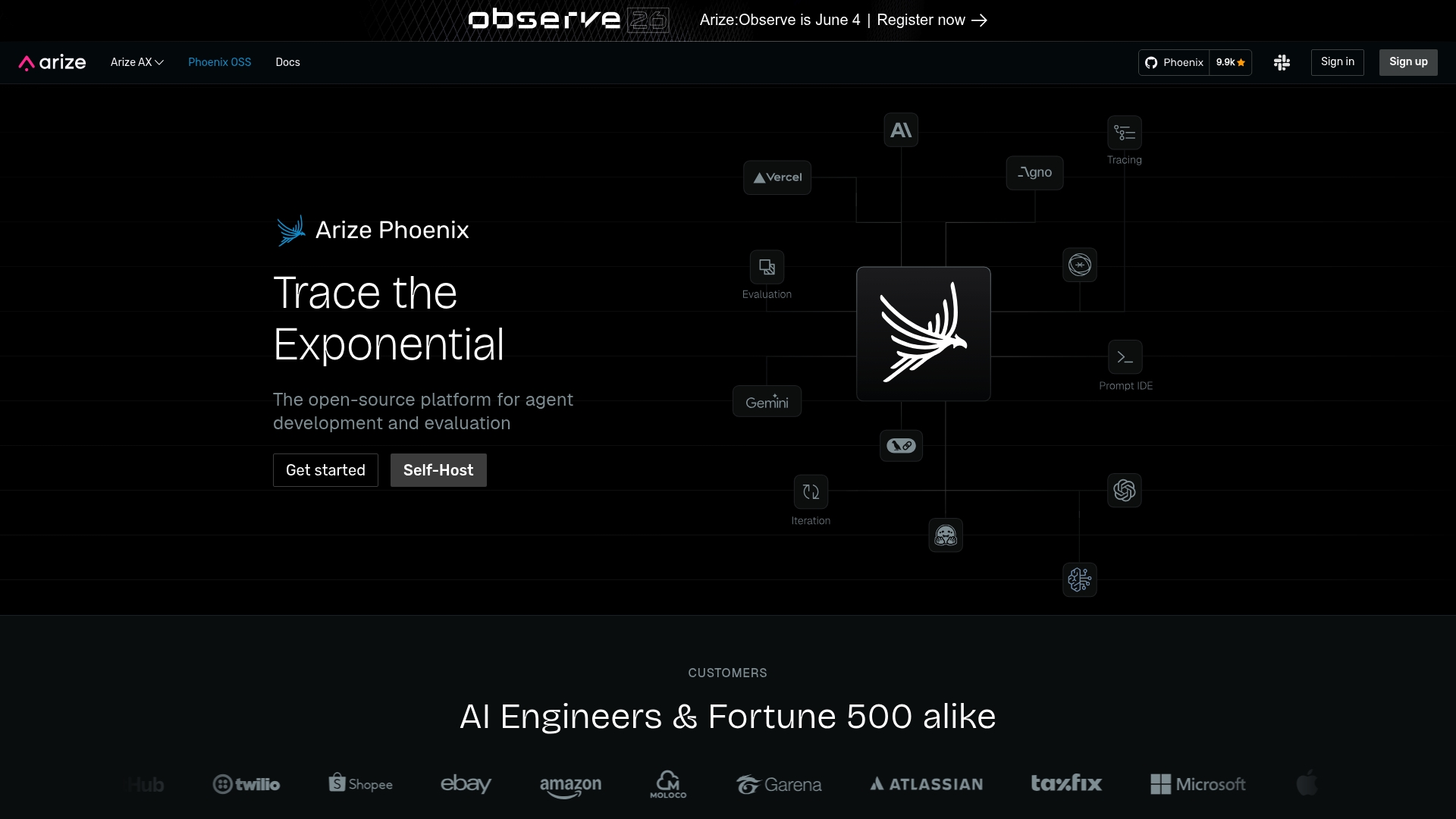
Open-source and deployable on-prem or in cloud environments, Arize Phoenix traces every agent step to give engineers a replayable record of agent reasoning and failures. That visibility is the platform's most notable asset for teams debugging complex agentic flows.
Core Features
- Open-source platform for building and evaluating AI agents with code-level access and community extensions.
- Tracing of all agent steps so you can replay decisions, inspect intermediate state, and link outcomes to specific prompts or actions.
- Evaluation tools for measuring model quality and tracking improvements across experiments.
- A test environment designed for iterative debugging of prompts and multi-agent interactions.
- Native support for coding and automation agents such as Alyx and compatibility with OpenTelemetry standards.
Key Differentiator
Arize Phoenix pairs open-source distribution with deep traceability so teams can host sensitive traces where they need them and still use modern observability standards. That combination makes it easier for engineering teams to instrument agents the same way they instrument services.
Pros
-
Open-source and community-driven which lets teams fork or extend parts of the stack when vendor lock in is a concern.
-
Self-hosting options let security teams keep trace data inside corporate networks and meet stricter privacy constraints.
-
Tracing plus evaluation tools create a feedback loop where a failing response links to the exact prompt, tool call, and intermediate state.
-
Flexible deployment choices include local Docker, Kubernetes, and cloud options which fit diverse MLOps pipelines.
-
Built to play well with existing telemetry through OpenTelemetry support which reduces the work to integrate with other monitoring systems.
Cons
-
Setting up and running a self-hosted instance requires system and DevOps skill. Expect a meaningful operational load for production scale.
-
The user experience favors engineers. Non-technical product owners or managers may find the interface and workflows dense.
-
Advanced features and tracing semantics have a learning curve. Teams new to AI observability will need time to extract full value.
When It May Not Fit
If your team needs a fast, fully managed solution that works out of the box with minimal setup, Phoenix is likely a poor match. Small teams without dedicated DevOps or MLOps resources will struggle to operate and customize a self-hosted deployment.
Who It's For
AI engineers, MLOps practitioners, and enterprise teams that build and operate agentic systems and who can manage infrastructure. Ideal users want trace-level visibility and control over where telemetry and traces live.
Real World Use Case
A large enterprise used Phoenix to trace their LLM agents and find a recurring failure tied to a tool call sequence. By replaying traces and iterating on prompt structure the team reduced the occurrence of the failure and documented the fix for future agent rollouts.
Website: https://phoenix.arize.com
Comparative Analysis of Agent Lifecycle Management Platforms
Selecting the right agent lifecycle management platform for your team requires a careful evaluation of each tool’s particular strengths, limitations, and fit for specific scenarios. Here, we analyze core dimensions that differentiate these options, providing insights for prospective users.
Versatility of Deployment Methods
A significant consideration for enterprises involves deployment flexibility. HoneyHive and Lunary achieve distinction by offering self-hosting and hybrid deployment options. These capabilities make them suitable for organizations with strict data residency or regulatory requirements. In comparison, MLflow supports flexible integrations that cater to varied MLOps pipelines but varies in terms of infrastructure management requirements. The openness and extensibility of MLflow’s architecture still make it highly suitable for teams needing tailored solutions.
Learning Curve and Accessibility
Ease of adoption impacts a team’s ability to integrate a platform into workflows. LangSmith targets non-technical users with its no-code functionality for agent creation, suitable for rapid prototyping by product managers. Meanwhile, MLflow and Arize Phoenix offer capabilities best leveraged by technical teams experienced in MLOps, presenting higher barriers for onboarding novices. The user interface and workflow focus should inform the choice, depending on the technical competence of users.
Best Fit Scenarios
- MLflow: Ideal for teams with diverse needs spanning classic ML models and generative agents that benefit from integrated lifecycle controls and observability.
- HoneyHive: Best for regulated industries requiring strict compliance capabilities and OpenTelemetry-powered insights.
- Lunary: Suitable for organizations prioritizing data privacy and deployment control with advanced monitoring of LLM-based systems.
- LangSmith: Effective for teams within LangChain ecosystems needing accessible no-code tools for agent creation and regional deployment.
- Arize Phoenix: Targeted at enterprises needing open-source solutions with granular developer-centric observability tools.
Our Pick
MLflow stands out for teams managing multi-model workflows due to its framework-neutral architecture and centralized gateway for lifecycle management, prompt versioning, and unified observability. However, for teams without MLOps expertise seeking rapid deployment, LangSmith or HoneyHive offer streamlined alternatives tailored to specific operational needs.
AI Agent Lifecycle Management Platforms Comparison
When selecting an AI agent lifecycle management platform, key considerations include core features, differentiators, and suitability for your specific operation needs.
| Platform | Core Features | Key Differentiator | Best For | Pricing | Notable Limitation |
|---|---|---|---|---|---|
| MLflow | Experiment tracking, model registry, prompt optimization | Framework-agnostic design for both traditional ML and generative AI workflows | Data science teams managing integrated ML and LLM pipelines | Not disclosed | Advanced use cases require significant setup effort |
| HoneyHive | Observability, continuous evaluation, collaborative asset management | Native OpenTelemetry integration for robust trace-based insights | Enterprises deploying scalable and complex AI ecosystems | Custom priced plans | Setup complexity for teams without telemetry experience |
| Lunary | Real-time monitoring, PII masking, deployment flexibility | Security certifications with comprehensive LLM connector support | Mid to large organizations with privacy and compliance requirements | Free plan available | Steep learning curve for advanced configurations |
| LangSmith | No-code agent building, regional deployment, built-in testing | Visual agent design for rapid iteration tied to data residency controls | Teams needing agile AI development within regional or policy constraints | Not disclosed | Current issues with bulk exports impact analytic workflows |
| Arize Phoenix | Open-source tracing, model evaluation, iterative experimentation | Deep traceability with open-source deployment flexibility | AI engineers and teams needing detailed control over infrastructure | Not disclosed | Operational demand for self-hosted setups |
Discover How Mlflow Addresses Your Langfuse.com Alternatives Needs
Choosing the right platform for managing GenAI and LLM applications can feel overwhelming, especially when balancing experiment tracking, agent deployment, and prompt governance. Mlflow offers a unique solution by combining centralized AI Gateway management with end-to-end tracing of agentic reasoning to deliver production observability that fits both classical ML and generative AI workflows. This makes it easier to maintain control and transparency across complex agent fleets without vendor lock-in.
Explore how Mlflow can optimize your AI agent lifecycle by providing automated evaluation tools and secure, versioned prompt management. Visit Mlflow’s official site now to learn how you can elevate your AI development process and deploy with confidence. Start tracking your models and prompts effectively with Mlflow’s open-source platform and see measurable results on your next project.
Frequently Asked Questions
How does Mlflow support experiment tracking for reproducible runs?
Mlflow provides experiment tracking features that allow users to manage parameter histories across notebooks and pipelines. This capability aids in maintaining consistency and reproducibility in machine learning workflows, crucial for development and deployment. To leverage this feature, users should explore setting up organized experiment tracking within their projects.
What is the difference between Mlflow and HoneyHive for performance monitoring?
HoneyHive is noted for its OpenTelemetry-native trace instrumentation, making it effective for real-time performance monitoring and evaluating agent behavior. In contrast, Mlflow focuses more on managing the full lifecycle of experiments and migration of models across frameworks. Teams needing extensive observability may find HoneyHive advantageous while those focusing on a holistic ML lifecycle management should lean towards Mlflow.
Which platform offers better LLM prompt management, Mlflow or Lunary?
Mlflow features a prompt registry specifically designed for optimizing large language model (LLM) prompts, centralizing prompt assets and histories. Lunary also provides prompt versioning, but Mlflow’s focus on prompt optimization for LLMs makes it more suitable for teams prioritizing prompt management efficiency in their workflows. Users interested in maximizing their LLM capabilities should consider how these features align with their project needs.
Can I use Mlflow if my team requires high compliance standards?
While Mlflow is open source and supports many frameworks, it does not emphasize compliance features like SOC2 or GDPR as strongly as some competitors. If compliance is critical to your operations, it may be beneficial to assess the additional security and compliance features provided by platforms like HoneyHive or Lunary. Nevertheless, Mlflow remains a flexible option for various teams looking to manage their ML lifecycle.
What key integration does Mlflow offer that enhances its traceability features?
Mlflow integrates with OpenTelemetry for observability, providing a comprehensive view into model tracing for root cause analysis. This integration allows teams to capture agentic reasoning paths effectively which is essential for debugging and improving model performance. Users should consider utilizing this integration to benefit fully from Mlflow's tracing capabilities.