Top 6 LangSmith Alternatives for 2026
Achieving reliable observability and evaluation for complex AI agents is often blocked by solutions that lack deep tracing, prompt lifecycle management, or true framework neutrality. Many existing options either require heavy vendor lock in, offer incomplete coverage of agent reasoning, or demand engineering effort just to plug into diverse model stacks. This comparison details how the leading alternatives manage tracing, evaluation automation, and integration so you can match the right platform to your team’s telemetry, scale, and deployment needs.
Table of Contents
- MLflow
- Langfuse
- HoneyHive
- LangWatch
- Galileo
- UpTrain
- Comparative Analysis of Agent Observability and Evaluation Tools
MLflow
At a Glance
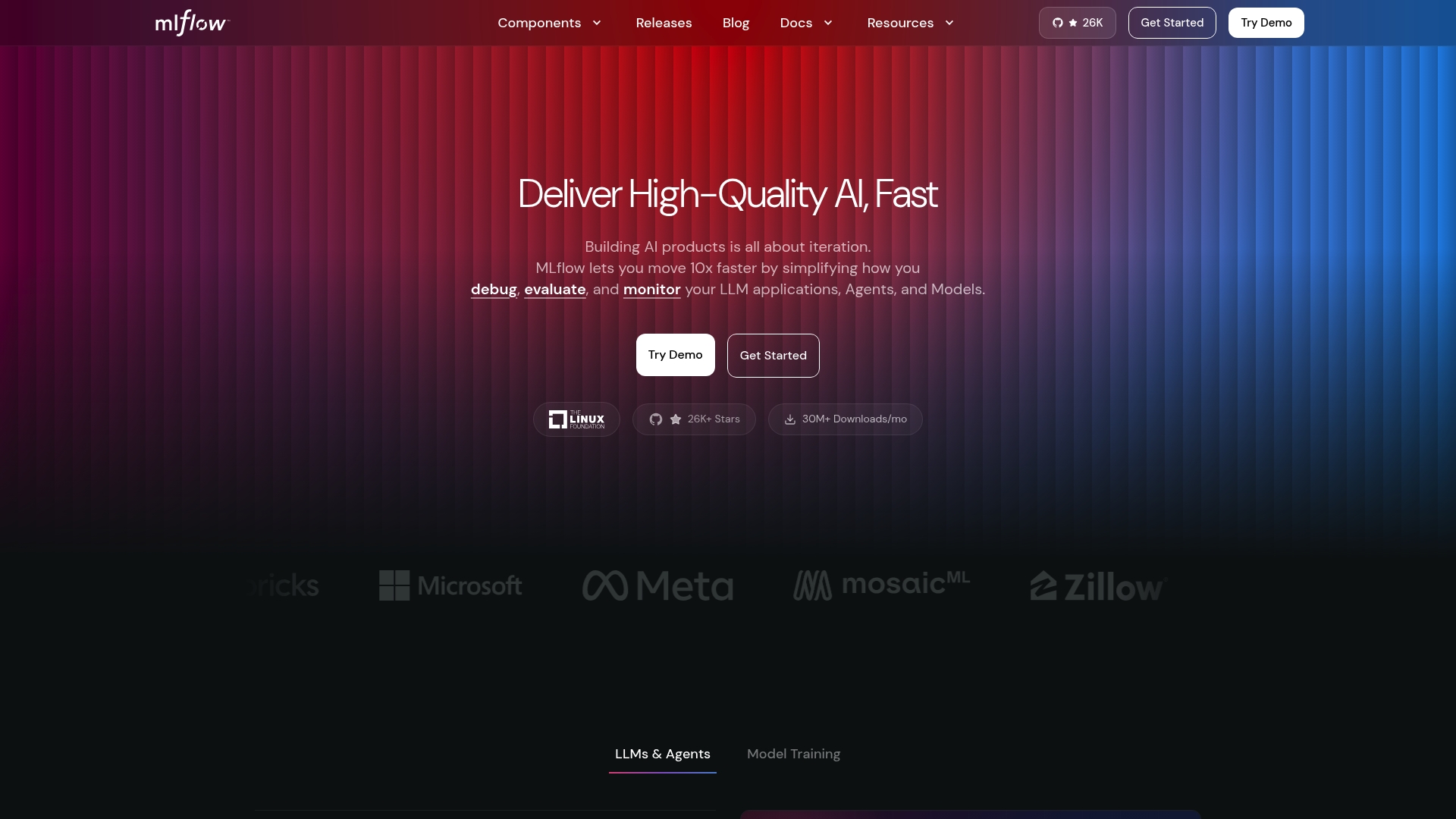
The vendor reports over 30 million downloads per month, a scale that explains why many teams treat MLflow as a default choice for model lifecycle plumbing. It combines experiment tracking, a model registry, and agent observability in one open source project.
Core Features
- Experiment tracking with run metadata, reproducible artifacts, and metric histories for comparisons.
- Model evaluation and registry to version models, promote candidates, and attach validation results to releases.
- Full lifecycle support for hyperparameter tuning, deployment workflows, and release management across frameworks.
- Observability and traceability for LLMs and AI agents, including deep tracing of agentic reasoning and execution paths.
- Prompt registry and optimization tools to manage prompts, prompt versions, and cross-provider governance for OpenAI-style flows.
Key Differentiator
Unifies full ML and AI agent lifecycle management in an open, framework-neutral platform with extensive integrations and observability tools. That single architecture reduces context switching between experiment, evaluation, deployment, and agent tracing workflows.
Pros
-
Open source under Apache 2.0, so teams can fork, extend, or audit the codebase without license fees.
-
Framework-agnostic support for PyTorch, TensorFlow, XGBoost, and HuggingFace makes it practical to move models and agents between stacks.
-
Built-in observability focuses on agent reasoning rather than only input/output logs, which helps when you need to debug multi-step LLM workflows.
-
Large community and plugin ecosystem accelerate integrations with tools like LangChain and third-party deployment systems.
-
Tracks evaluation artifacts and metadata end to end, which improves reproducibility for regulated workflows.
Cons
- Steep learning curve for teams adopting the full feature set; getting a production deployment and cross-team governance running requires significant configuration and operational effort.
Notable Integrations
- OpenAI
- PyTorch
- TensorFlow
- XGBoost
- LangChain
- HuggingFace
- MLflow plugins for additional frameworks
Who It's For
Data science teams, ML engineers, and AI researchers who need a neutral control plane for experiments, models, and agents. It fits organizations that value auditability, model lineage, and the ability to plug into multiple runtime stacks.
Unique Value Proposition
The Apache 2.0 license combined with framework neutrality means you can adopt MLflow without changing model code or vendor contracts. Pair that with deep tracing of agentic reasoning and a centralized prompt registry and you get a single place to manage evaluation, governance, and model serving across providers.
Real World Use Case
A multinational corporation runs MLflow across dozens of teams to centralize experiment metadata, register validated models, and deploy models into Kubernetes-based serving. The team uses MLflow tracing to diagnose agent decision paths and the prompt registry to control prompt versions across departments.
Website: https://mlflow.org
Langfuse
At a Glance
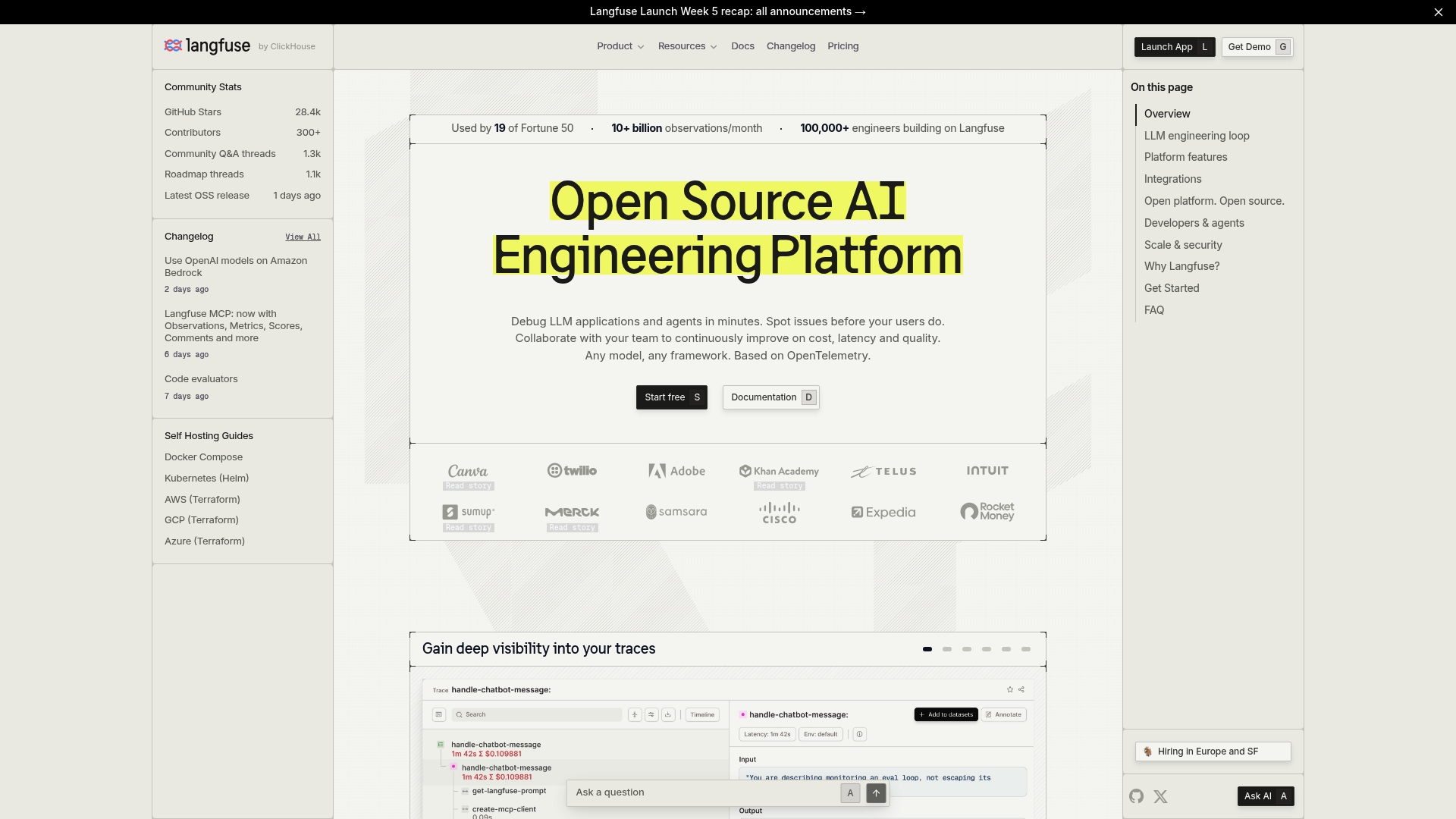
Langfuse reports being used by more than 2,300 companies and processing billions of observations monthly. That adoption claim signals a focus on high throughput observability for production LLM workloads.
It is open source under the MIT license and targets teams that need detailed tracing, prompt management, evaluation, and analytics as they move models into production.
Core Features
Tracing and request-level observability that captures model calls, user inputs, and intermediate chain state for postmortems and performance analysis.
Prompt and experiment management so you can version prompts, compare outcomes, and run automated evaluations across model providers.
SDKs and OpenTelemetry support for any language or framework plus a ClickHouse backend for high-performance querying and retention.
Key Differentiator
Langfuse pairs an open architecture with enterprise controls. Its use of OpenTelemetry and a ClickHouse stack makes it straightforward to ingest traces from diverse runtimes while keeping data portable and self-hostable.
That combination narrows the target to engineering teams that want code-level observability and full control over data and deployments rather than a hosted black box.
Pros
-
Intuitive trace views and prompt-level analytics speed debugging. You can see where latency or hallucinations appear in a chain and act on the exact call.
-
The open license and SDKs let you adapt collectors and storage to internal policies or custom telemetry pipelines.
-
Designed for scale. The ClickHouse architecture and provider integrations match teams processing large volumes of model interactions.
-
Active community and frequent updates mean integrations and fixes arrive quickly. The vendor’s adoption claim above suggests a growing ecosystem that contributes integrations.
Cons
-
Setup requires engineering time. Installing collectors, configuring ClickHouse, and instrumenting model calls are not turnkey tasks for nontechnical teams.
-
Complex chains with many intermediate steps increase instrumentation overhead and require disciplined schema management.
-
Enterprise features such as advanced security and long term retention add operational complexity for teams without dedicated SRE or MLOps staff.
When It May Not Fit
If you need a plug-and-play hosted solution with minimal setup, Langfuse will feel heavy. Small projects with limited telemetry budgets may find the ClickHouse and instrumentation costs disproportionate.
Teams that only need lightweight logging or simple request metrics will get faster results with less infrastructure.
Notable Integrations
- LangChain for direct tracing of chain and agent runs
- OpenAI SDK and Vercel SDK for provider and edge integrations
- Google Gemini, Amazon Bedrock, Hugging Face, and custom SDKs via OpenTelemetry
Who It's For
AI developers and MLOps teams building production LLM applications that require fine grained debugging, prompt lifecycle control, and a self-hostable observability stack.
Choose Langfuse when you need control over telemetry, vendor neutrality, and the ability to scale telemetry ingestion to billions of calls.
Real World Use Case
The vendor describes a Fortune 50 AI engineering team using Langfuse to trace, debug, and optimize thousands of model endpoints. That deployment reduced mean latency and clarified failure modes across multiple providers.
Pricing
Free tier available for experimentation. Paid plans begin at $29/month for Core and $199/month for Pro with custom enterprise pricing for higher throughput and managed support.
Website: https://langfuse.com
HoneyHive
At a Glance
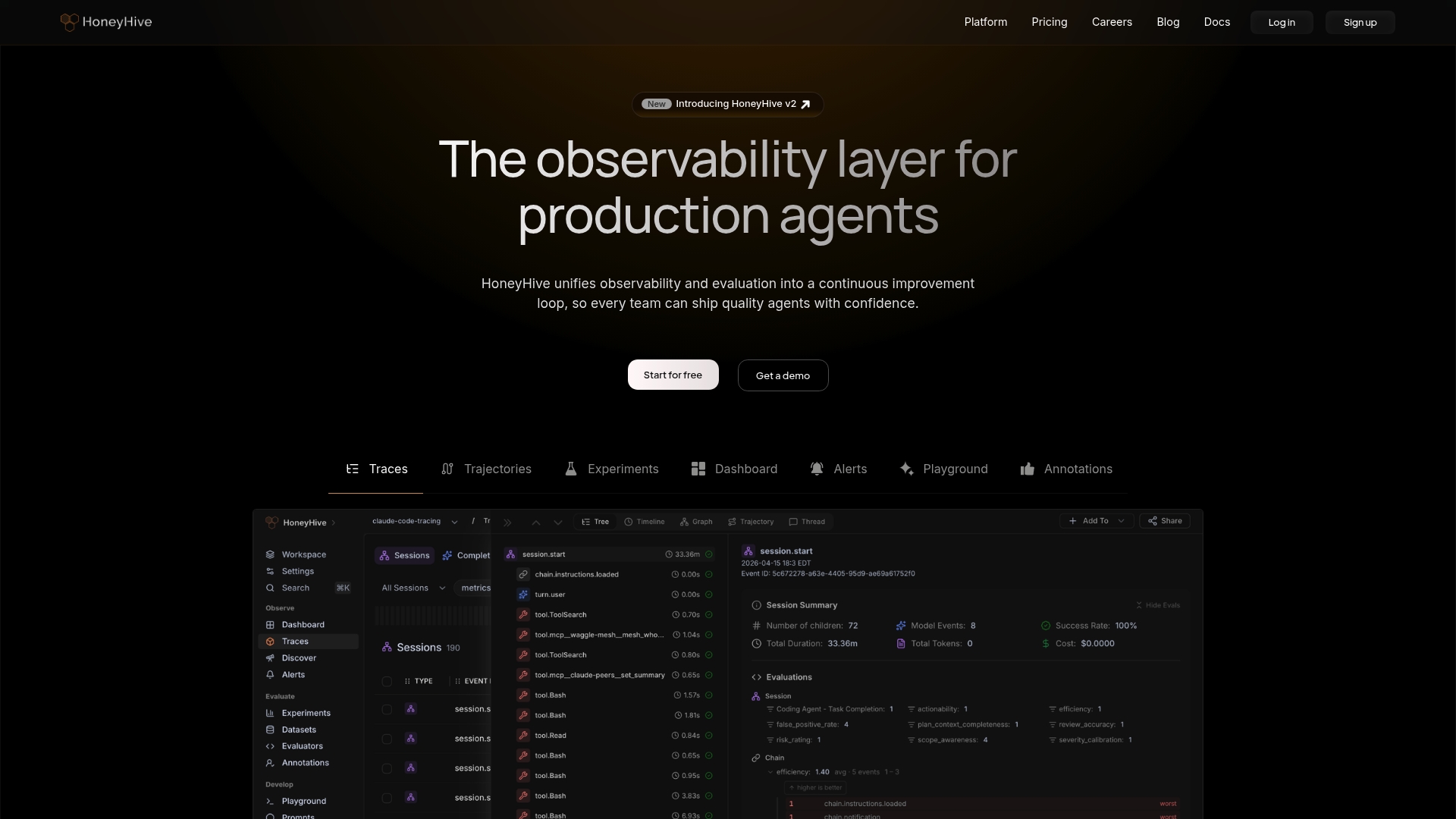
OpenTelemetry-native observability built for agentic workflows and distributed tracing across model stacks. HoneyHive's marketing materials position it for mission critical deployments at banks and Fortune 500 companies, and the vendor advertises SaaS, hybrid, and self hosted deployment options.
Core Features
HoneyHive combines monitoring, evaluation, prompt management, and feedback in a single pane for AI agents. The platform emphasizes traceability and repeatable evaluation pipelines rather than ad hoc logs.
- distributed tracing compatible with OpenTelemetry across frameworks for request level and reasoning level traces.
- automated and human in the loop evaluations to compare model outputs against benchmarks and expert feedback.
- dataset curation and versioning for repeatable benchmark runs and controlled test scenarios.
- Continuous monitoring with alerts on failures, regressions, and drift plus tools for custom evaluator creation.
Key Differentiator
The product's engineering claim centers on being framework-agnostic while natively supporting OpenTelemetry, which reduces bespoke instrumentation across orchestration stacks. Compared with Mlflow, HoneyHive leans more into tracing and runtime agent observability rather than lifecycle orchestration and centralized gateway features.
Pros
-
Ease of collaboration with social features that let reviewers annotate traces and evaluations inline for faster cross functional decisions.
-
A user friendly interface and straightforward setup get developer teams to meaningful telemetry in hours not weeks.
-
Internal information search and management simplifies incident investigation by linking traces, prompts, and dataset versions in one view.
-
Scalable and secure architecture designed for enterprise needs supports deployment options that match different operational constraints.
-
Open standards support enables customization and integration without vendor lock in, which matters for heterogeneous model stacks.
Cons
-
Some users report flow and layout issues that interrupt quick investigations and add friction to daily use.
-
Handling of long form content can be suboptimal, especially when teams need to review extended chat transcripts or long evaluation artifacts.
-
Pricing details for enterprise plans are not transparent on the site and often require direct inquiry to get full terms and commitments.
When It May Not Fit
If your primary need is end to end lifecycle orchestration with built in model serving and governance, HoneyHive may feel narrowly focused on observability and evaluation. Teams that require polished long form review editors or native time tracking will find gaps in the current UX.
Who It's For
AI developers and enterprise teams operating agentic systems in production who need trace level visibility, repeatable evaluation pipelines, and controlled dataset versioning. Best for organizations that already use OpenTelemetry or want to avoid heavy vendor instrumentation.
Real World Use Case
A large bank uses HoneyHive to trace agent decisions across transaction monitoring pipelines. Traces link prompts, model outputs, and dataset versions so compliance reviewers can reproduce a decision, annotate failures, and push targeted model updates with alerts on regressions.
Website: https://honeyhive.ai
LangWatch
At a Glance
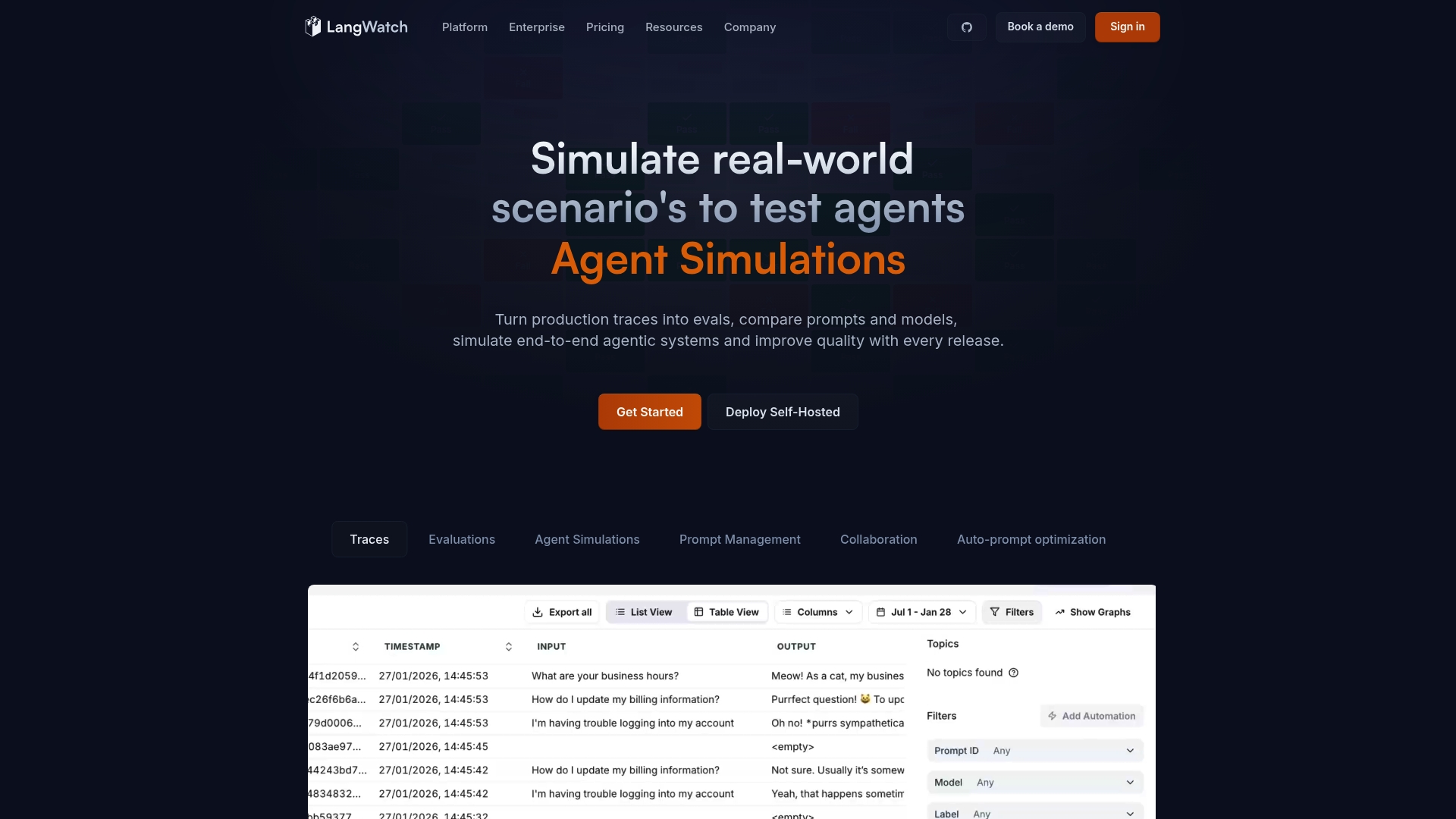
Deep agent simulation testing combined with OpenTelemetry and collaborative, framework agnostic evaluation sits at the center of LangWatch's pitch. The platform targets enterprise scale workflows and claims structured prompt optimization plus deep observability to reduce deployment risk.
Core Features
- Agent simulations for multi step workflows that replay complex conversation paths and edge case branches.
- Structured model evaluations and testing with versioned prompts and model checkpoints.
- Deep observability including trace analysis, debugging tools, and production monitoring with alerting and compliance controls.
- SDKs for Python and JS/TS, OpenTelemetry support, and self hosted runtime options for teams that prefer open source control.
- Automated prompt optimization using DSPy techniques and support for multimodal, multi turn conversation testing.
Key Differentiator
The standout is the combination of realistic agent simulations with telemetry driven traces that map reasoning paths. That lets engineers see where a multi step agent drifted, compare prompt versions, and tune behavior with measurable eval feedback in near real time.
Pros
-
Valuable for monitoring Retrieval Augmented Generation. The dashboard ties document hits and retrieval context to downstream model outputs so you can see what caused a bad answer.
-
Excellent visualization of model interactions. Trace views show token level decisions alongside system prompts and external API calls for faster root cause analysis.
-
Collaborative workflows bring engineers, product managers, and domain experts into the same evaluation loop so nontechnical reviewers can run structured tests without code changes.
-
Open source and self hosted runtime choices reduce lock in and make it practical for security conscious teams to run evaluations on private data.
-
Built for iterative improvement. The platform couples real time evals with automated prompt tuning so you can run experiments and keep the winning prompt versions under version control.
Cons
-
The vendor’s marketing tone can feel aggressive to some teams; several users report high touch outreach during trials.
-
Complexity is non trivial for smaller teams or newcomers to LLM monitoring. The breadth of features requires a dedicated engineer to configure effectively.
-
Pricing transparency for high volume usage is limited in public materials, which makes capacity planning harder for large scale deployments.
When It May Not Fit
If your team lacks an engineer who can wire SDKs and telemetry, LangWatch will add overhead rather than remove it. Small startups that need a lightweight, no ops evaluation tool will likely find the platform heavier than they need.
Notable Integrations
- Python SDK
- JS/TS SDK
- OpenTelemetry
- OpenAI Agents
- LiteLLM
- DSPy
- LangGraph
- LangChain
Who It's For
AI development teams, ML engineers, and enterprise AI groups building multi turn conversational agents and RAG systems that require systematic pre release testing, deep tracing, and collaborative evaluation workflows.
Real World Use Case
A large customer service chatbot was put through agent simulations across languages and edge cases, using structured evaluations to catch hallucinations and regressions. Engineers iterated prompts and re ran traces until response accuracy met the safety threshold before production rollout.
Pricing
Starts with a free Developer plan and moves into Growth, Enterprise, and Custom tiers. The vendor advertises volume discounts and self managed deployment options; exact costs depend on usage, retention, and deployment preferences.
Website: https://langwatch.ai
Galileo
At a Glance
According to the company, Galileo distills advanced evaluation models into low cost, low latency models that can run near real time guardrails across full production traffic. The platform pairs development evaluators with live monitoring to catch hallucinations, security threats, and data quality issues before they escalate.
Core Features
- AI evaluation during development with both out of the box and custom evaluators that run against model outputs.
- Real time monitoring and guardrails that flag hallucinations and policy breaches across production traffic.
- Low latency evaluation models powered by Luna-2 small language models for cost effective checks at scale.
- Proactive issue detection and automated root cause tools for incidents and degraded behavior.
- End to end observability that ties alerts back to model versions, prompts, and data slices.
Key Differentiator
The company claims the platform’s model distillation approach lets teams run evaluators at a fraction of typical inference cost while keeping checks near real time. That distillation claim is the operational hook: it makes continuous safety enforcement feasible across high throughput systems without adding large compute bills.
Pros
- Rapid iteration support. Built in evaluators let engineers run targeted tests during development and plug the same checks into production monitoring.
- Effective safety tooling. Runtime guardrails and proactive detections reduce the window between failure and mitigation for LLM driven agents.
- Flexible deployment. The vendor advertises SaaS, VPC, and on premises options so security conscious teams can match their deployment posture.
- Low operational overhead from evaluation models. The distillation approach above promises lower latency and cost that make always on checks realistic for high traffic services.
- End to end traces. Linking alerts to prompts and model versions speeds root cause analysis and reduces mean time to resolution.
Cons
- Output quality depends on prompt clarity and specificity; noisy prompts will generate noisy evaluations.
- Export to code or deep customization of evaluators is limited relative to platforms that focus on auto generated remediation scripts.
- The platform’s breadth and controls introduce operational complexity and typically require formal training for teams running high risk or regulated workloads.
When It May Not Fit
If you need a turnkey code generation engine that converts evaluation logic into deployable remediation scripts, this product’s focus on evaluation and monitoring may feel narrow. Teams with very small models or low traffic can find the platform’s deployment options and controls more elaborate than necessary.
Who It’s For
AI engineers and research teams that require scalable, low latency evaluation and continuous safety checks for production language models. Best for organizations that need real time guardrails and have dedicated SRE or MLops capacity to onboard the tooling.
Real World Use Case
An enterprise routes production model outputs into Galileo’s evaluators and real time monitors. The system flags hallucinations and security anomalies, which triggers guardrails that mute risky outputs and creates incident traces tied to prompt versions and model rollout tags.
Pricing
A free tier is available for all users. The Pro plan starts at $100/month with volume based scaling. Enterprise pricing and custom deployment agreements require vendor contact.
Website: https://galileo.ai
UpTrain
At a Glance
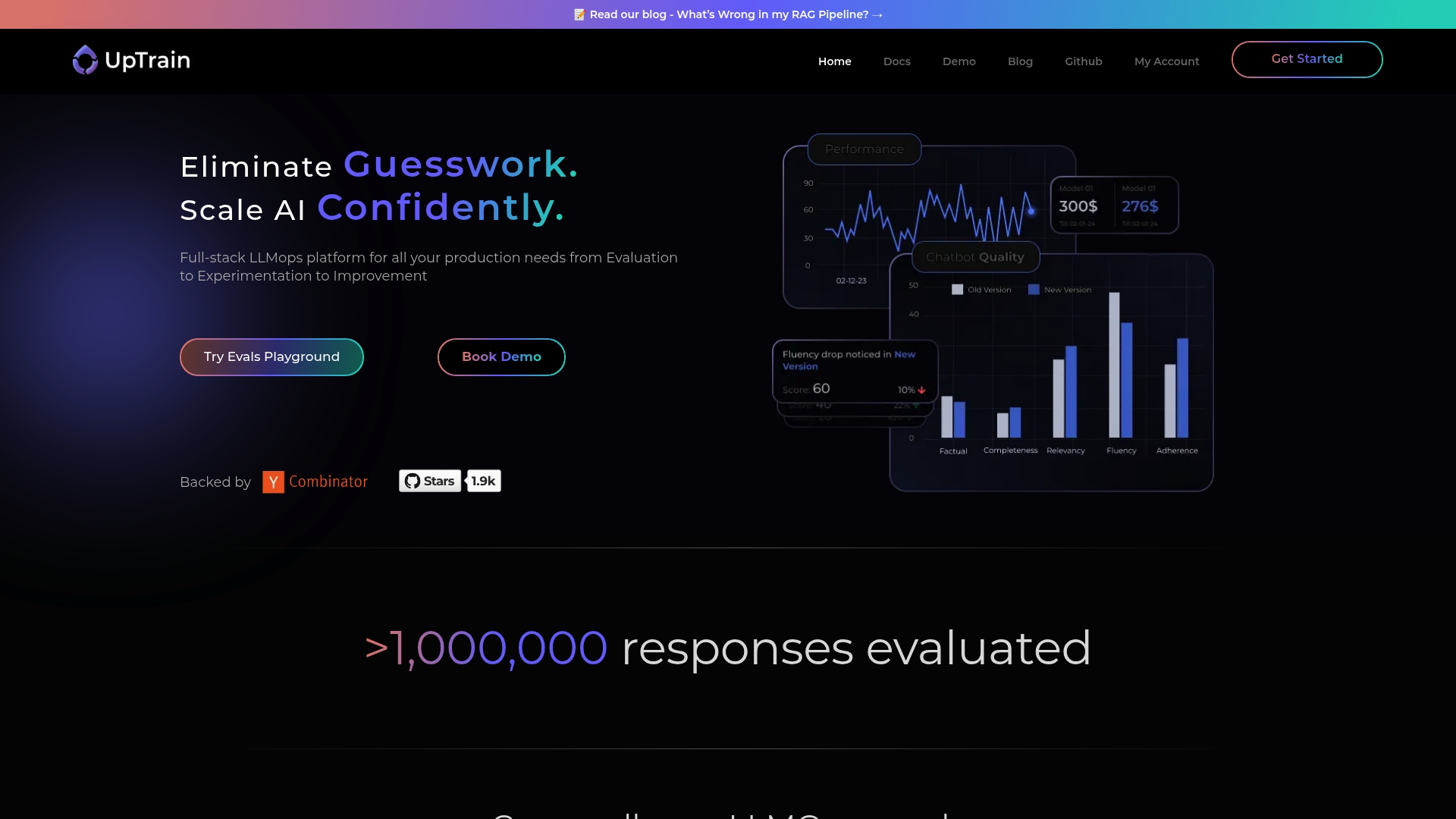
Offers more than 20 pre defined and customizable evaluation metrics and built in experimentation tooling for LLMs. Backed by YCombinator, the project emphasizes self hosting and enterprise deployment options while targeting teams that manage models in production.
Core Features
- 20+ pre defined metrics for automated scoring and customizable metrics to match task specific needs.
- Systematic experimentation and quantitative scoring to compare prompt and model variants over time.
- Automated regression testing combined with prompt versioning so changes trigger test suites before rollouts.
- Root cause error analysis and pattern detection feeding dataset creation and enrichment from production logs.
Key Differentiator
The vendor advertises evaluation scores that align over 90% with human judgment, and the platform pairs that accuracy claim with a full stack LLM operations workflow. That combination of high agreement metrics and integrated monitoring separates UpTrain from simple test harnesses.
Pros
- Open source codebase encourages transparency and lets engineers extend evaluation logic or host internally.
- Self hosting options support stricter data governance and enterprise deployment models without routing production logs to an external SaaS.
- High throughput and scalability make the tool suitable for large datasets and high response volumes used in production testing.
- Easy API integration with quick onboarding; the vendor states setup can take under five minutes for typical integrations. That setup speed reduces friction when adding evaluation to CI pipelines.
- Dataset enrichment from real production feedback closes the loop between live errors and training data creation.
Cons
- Public user reviews and third party validation are scarce, so market level feedback is limited.
- Pricing is not published in the product data and may require direct vendor discussion for enterprise support or hosted offerings.
- The platform has engineering oriented setup; non technical teams will face a learning curve when self hosting and configuring custom metrics.
When It May Not Fit
If your team lacks engineering bandwidth to self host and maintain evaluation pipelines, UpTrain will feel heavy. If you need an out of the box, low code monitoring product with transparent published pricing, this option may not match that procurement model.
Who It's For
AI development teams, SREs, and data scientists running LLMs in production who need repeatable evaluation, regression guards, and dataset enrichment workflows. Less suited for small teams that cannot dedicate engineering time to ops.
Real World Use Case
An AI team deploying a customer support assistant uses UpTrain to run nightly regression tests after prompt changes. Failures trigger root cause analysis and the team pushes enriched examples back into the training set, improving response reliability over several iterations.
Pricing
The product data lists pricing as not applicable and does not publish rate cards. The project is open source and supports self hosting, while any hosted or enterprise support options require a direct vendor conversation.
Website: https://uptrain.ai
Comparative Analysis of Agent Observability and Evaluation Tools
When choosing a platform for agent observability and evaluation, understanding the unique offerings and tradeoffs of each option is essential. Below, we delve into the contrasts and tradeoffs among leading tools in this domain.
Addressing Model Lifecycle Management Needs
MLflow is in offering an integrated solution for model lifecycle management. Its framework-agnostic approach and open-source nature allow operation across various machine learning stacks. In comparison, Langfuse prioritizes detailed observability and analytics specific to language models but involves significantly more setup and operational intricacy. Similarly, HoneyHive excels in trace analysis and multi-environment consistency but lacks the support for lifecycle workflows seen in MLflow. For those targeting complete model traceability combined with team governance features, MLflow clearly remains ahead.
Observability and Debugging Capabilities
Langfuse establishes itself as a leader in debugging workflows with advanced tracing insights tailored for language models, greatly aiding reduced mean time to resolution tasks, as acknowledged by its dedicated framework support. Meanwhile, HoneyHive offers impressive multi-environment observability and internal collaboration tools, making it distinctive where inter-team iterations are critical. For smaller teams focusing on collaboration-enhanced debugging in multi-agent systems, HoneyHive prioritizes ease of setup and interoperability, which might outweigh MLflow’s extensive but complex features.
Best Fit
- Choose MLflow if your team requires integrated management of model lifecycle processes, from experimentation to deployment, especially if interoperability across various frameworks is necessary.
- For organizations needing granular trace analysis and troubleshooting for agent systems, Langfuse offers capabilities in providing debugging insights.
- If collaboration-driven, large-scale traceability within enterprise contexts is critical, HoneyHive presents a convenient yet powerful observability stack.
Our Pick
MLflow is the preferred option for support encompassing experimentation, validation, deployment, and beyond, offering continuity across stages. However, for situations demanding highly-focused language model debugging or team-based observability without extensive lifecycle integration, Langfuse or HoneyHive may better match those specific requirements.
Agent Observability and Evaluation Tools Comparison
Explore and compare leading tools to manage, evaluate, and oversee the lifecycle of machine learning models and AI agents.
| Product | Key Features | Best For | Pricing | Notable Limitation |
|---|---|---|---|---|
| MLflow | Model lifecycle management, framework neutrality | Teams needing model and agent governance | Not disclosed | Steep learning curve for full feature set deployment |
| Langfuse | Detailed tracing, prompt control, OpenTelemetry support | Production-oriented observability | From $29/month | Requires engineering time to set up properly |
| HoneyHive | Distributed tracing, automated evaluation | Enterprise agent monitoring | Not disclosed | Flow issues in user interface impact investigation speed |
| LangWatch | Agent simulations, deep observability, SDK tools | Systematic pre-release testing | Starts with free plan | Complexity requires dedicated engineering efforts |
| Galileo | Real-time evaluation, guardrails, low latency | Scalable, continuous safety checks | From $100/month | Limited customization of evaluators |
| UpTrain | Regression testing, dataset enrichment | High-throughput evaluation pipelines | Not disclosed | Requires technical expertise for self-hosting efforts |
Discover a Powerful Alternative to smith.langchain.com with Mlflow
If you are searching for smith.langchain.com alternatives that deliver total lifecycle management for your GenAI and LLM applications, Mlflow offers a proven solution designed to overcome common challenges in agent orchestration and observability. Mlflow addresses the need for transparent evaluation, secure prompt management, and comprehensive tracing of agentic reasoning—all critical pain points highlighted by users considering smith.langchain.com alternatives.
Explore how Mlflow lets you unify experiment tracking, model serving, and governance into one open platform. Visit Mlflow's official website to take control with production-grade monitoring and move from prototypes to robust AI Agent deployments. Act now to configure the centralized AI Gateway and start managing cross-provider workflows seamlessly.
Frequently Asked Questions
What features make Mlflow suitable for managing the ML lifecycle?
Mlflow provides experiment tracking with run metadata, reproducible artifacts, and metric histories for comparisons. This feature improves the overall control and oversight of projects, making it a fitting choice for teams aiming for thorough documentation and analysis. Teams should consider using Mlflow to enhance their model lifecycle management capabilities.
How does Langfuse compare to Mlflow regarding observability?
Langfuse offers intuitive trace views and prompt-level analytics that speed up debugging processes, allowing teams to pinpoint latency issues or model hallucinations. While Langfuse excels in providing detailed insights for real-time monitoring, Mlflow shines in its full lifecycle management, covering everything from experiment tracking to deployment. Teams that prioritize comprehensive lifecycle orchestration may find Mlflow to be the superior option.
What makes HoneyHive a good choice over Mlflow for observability?
HoneyHive is particularly beneficial for organizations focusing on agentic workflows, offering features like automated evaluations and dataset curation within a user-friendly interface. While it emphasizes observability and provides straightforward setup, Mlflow's broader capabilities in version control and model registry make it a better fit for teams needing centralized management. Consider your specific focus on either full lifecycle support or detailed tracing before deciding.
Which platform provides the best integration for AI workflows?
Mlflow's framework-agnostic support allows seamless integration with platforms like PyTorch, TensorFlow, and HuggingFace, making it highly adaptable for diverse AI workflows. This flexibility ensures that teams can leverage their existing tools effectively, making Mlflow a strategic choice for organizations looking to maximize their technology investments.
Can I use LangWatch for multi-turn conversational agents if I already have Mlflow?
Yes, LangWatch is designed for AI development teams that require deep observability and structured prompt optimization in multi-turn conversational agents. While it showcases impressive simulation features, Mlflow still offers superior full lifecycle management, allowing teams to maintain comprehensive oversight of their models and experiments. Consider integrating both tools to cover different aspects of your workflow.