Best LLM Tracing Tools for Multi-Agent Systems in 2026

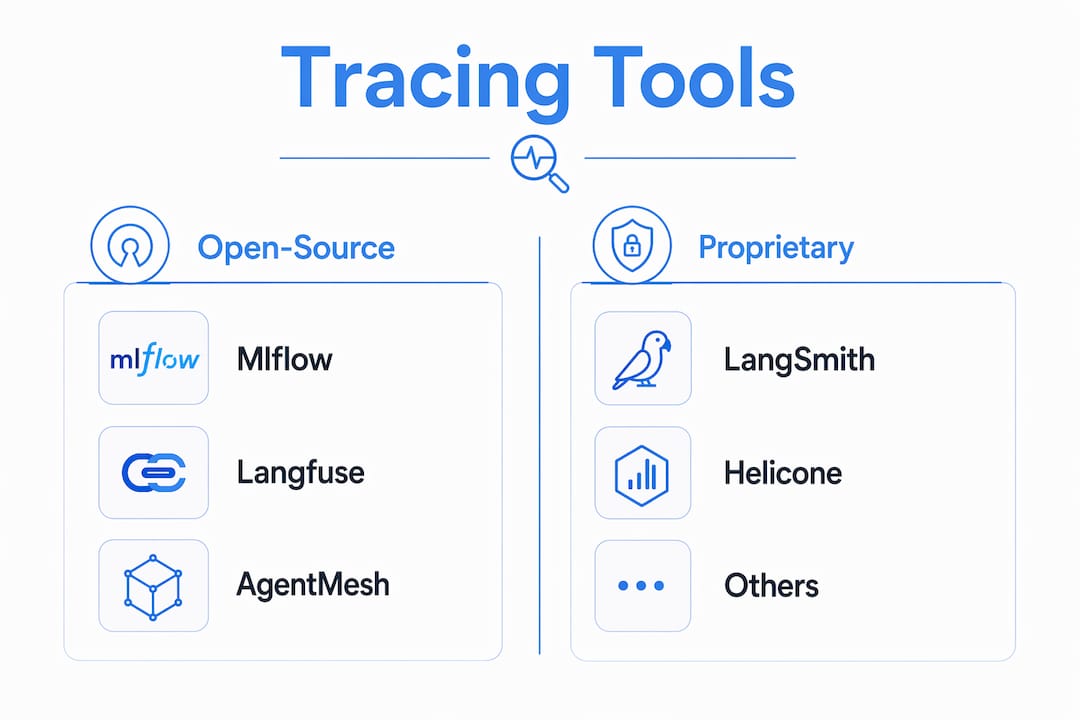
LLM tracing tools are specialized observability platforms that capture execution traces, token costs, agent interactions, and reasoning paths across multi-agent systems. The best LLM tracing tools for multi-agent systems go far beyond simple logging. They give you deterministic replay, cost governance, and message-bus visibility that generic APM tools cannot provide. Mlflow leads this category in 2026, followed by AgentMesh, LangSmith, Langfuse, and Helicone. Choosing the right tool determines whether you can debug a failing agent chain in minutes or spend days guessing at root causes.
What features make LLM tracing tools effective for multi-agent systems?
Multi-agent systems create debugging challenges that single-model applications never face. When five agents pass context between each other, a single misrouted message can cascade into a complete system failure. Generic tracing tools capture HTTP calls. You need tools that capture agent-to-agent messaging, LLM calls, tool invocations, and token consumption as a unified trace tree.
The most critical capabilities to evaluate are:
- Trace completeness. The tool must capture every span: LLM calls, tool use, sub-agent handoffs, and retrieval steps. Partial traces hide the actual failure point.
- Deterministic replay. Time-travel debugging lets you pause, branch, and replay agent runs with sub-millisecond latency using local SQLite or JSONL storage. This is the single most valuable feature for non-deterministic errors.
- Message-bus observability. Production tracing requires both LLM output tracing and message-bus level visibility to diagnose agent communication issues. Tools that only trace LLM calls miss race conditions and infinite loops entirely.
- Cost governance. Token tracking per agent, per run, and per user is non-negotiable in production. Without it, a single runaway loop can generate unexpected API bills overnight.
- Open-source and self-hosted options. Cloud tracing tools often capture full contexts including sensitive data. Local-first tools scrub secrets before storage, which matters for enterprise security and compliance.
Pro Tip: Instrument your agents at the framework level, not just the LLM call level. If your tracer cannot see what triggered an LLM call, you are missing half the picture.
The open-source versus proprietary trade-off is real. Open-source tools like Mlflow and Langfuse give you full control over data, hosting, and extensibility. Proprietary tools often offer faster setup but lock you into their data pipeline. For teams handling sensitive prompts or regulated data, self-hosted open-source is the stronger default.

How does Mlflow stand out as the top LLM tracing tool for multi-agent systems?
Mlflow is defined as a full-stack, open-source platform for LLM and agent lifecycle management, with production-grade observability for multi-agent systems built in from the ground up. It captures runs, LLM calls, tool invocations, token costs, and latency in a single unified trace. That completeness is what separates it from tools that only instrument the model layer.
Mlflow's LLM-as-a-Judge evaluation framework is a first-class citizen in its tracing workflow. You can attach automated evaluators directly to traces, scoring outputs for correctness, relevance, and safety without writing custom scoring code. Prompt versioning is also native, so you can track exactly which prompt version produced a given trace. That combination of tracing plus evaluation is rare in a single open-source tool.
Pro Tip: Use Mlflow's LLM-as-a-Judge evaluation alongside your traces to automatically flag agent outputs that fall below quality thresholds. This turns passive logging into active quality control.
The integration story is strong. Mlflow supports LangChain, LlamaIndex, OpenAI, Anthropic, and custom agent frameworks through a decorator-based instrumentation API. You can self-host the tracking server on your own infrastructure, keeping all trace data on-premises. The community is large, the documentation is thorough, and the extensibility through custom plugins is well-established.
| Feature | Mlflow | LangSmith | Langfuse | Helicone |
|---|---|---|---|---|
| Open-source | Yes | Partial | Yes | Partial |
| Self-hosted | Yes | Limited | Yes | Limited |
| LLM-as-a-Judge | Yes | No | No | No |
| Prompt versioning | Yes | Yes | Yes | No |
| Multi-framework support | Yes | LangChain-first | Yes | Yes |
| Cost tracking | Yes | Yes | Yes | Yes |
| Deterministic replay | Yes | No | No | No |
Mlflow's AI Gateway adds centralized prompt management and cross-provider governance. That means you can route agent calls across OpenAI, Anthropic, and other providers through a single control plane, with rate limits and cost budgets enforced at the gateway level. No other open-source tool in this category offers that combination.
How do AgentMesh, LangSmith, Langfuse, and Helicone compare for tracing multi-agent LLMs?
Each tool in this category has a distinct strength. Knowing those strengths helps you pick the right tool for your architecture, or decide to combine tools for different layers of your stack.
AgentMesh
AgentMesh is built specifically for multi-agent cost governance. It tracks token consumption, error rates, and latency per agent with real-time dashboards, and includes native circuit breakers to prevent infinite loops and budget spikes. If your primary concern is runaway costs in production, AgentMesh addresses that problem directly. It is less focused on prompt management or evaluation, so teams that need both tracing and quality scoring will need to pair it with another tool.
LangSmith
LangSmith offers deep instrumentation tailored to LangChain, with minimal overhead and detailed reasoning trace capture for multi-agent chains. It supports parent-child span relationships and automatic token and error monitoring. If your stack is built on LangChain, LangSmith is the lowest-friction option. Outside of LangChain, its value drops significantly because the instrumentation is optimized for that framework's execution model.
Langfuse
Langfuse is an open-source, all-in-one tracing and prompt management platform. It supports OpenAI, Anthropic, LangChain, and custom integrations through a clean SDK. Langfuse is self-hostable, which makes it a strong choice for teams with data residency requirements. It lacks the LLM-as-a-Judge evaluation layer that Mlflow provides, but its prompt management UI is polished and developer-friendly.
Helicone
Helicone focuses on cost tracking and zero-code setup. You route your OpenAI or Anthropic calls through Helicone's proxy, and it captures latency, token usage, and error rates automatically. Setup takes minutes. The trade-off is that proxy-based tracing misses agent-to-agent messaging entirely. Helicone works well as a cost monitoring layer on top of another tracing tool, not as a standalone solution for complex agent systems.
Key considerations when choosing between these tools:
- Teams on LangChain should evaluate LangSmith first for its native integration depth.
- Teams with strict data privacy requirements should prioritize Mlflow or Langfuse for self-hosted deployments.
- Teams with high-volume production deployments should add AgentMesh for cost circuit breakers.
- Teams that need evaluation alongside tracing should use Mlflow as the primary platform.
What are best practices for implementing LLM tracing in production multi-agent systems?
Deploying tracing in production is not the same as running it in development. Production systems have higher data volumes, stricter latency budgets, and real security requirements. These practices reduce the gap between what your tracer captures and what you actually need to debug.
-
Instrument at every layer. Trace LLM calls, tool calls, and agent handoffs separately. Distinguishing LLM-level from agent-bus tracing gives you the granularity to isolate whether a failure is in the model output or the message routing.
-
Use time-travel debugging for non-deterministic errors. Fork capabilities in time-travel debuggers let you pause and branch agent executions, isolating errors that arise from non-deterministic processing. This is the only reliable way to reproduce intermittent failures in async agent chains.
-
Decompose agents by function before you instrument. Separating concerns into specialized agents like data collection versus decision-making simplifies debugging and isolates performance bottlenecks. A single monolithic agent produces traces that are hard to interpret. Specialized agents produce traces that map directly to business logic.
-
Monitor disagreement between agent reasoning traces. Semantic similarity metrics like Cosine Similarity help differentiate consensus from errors across agent outputs. When two agents interpret the same context differently, that disagreement is a signal worth capturing and reviewing.
-
Scrub sensitive data before storage. Local-first tracing platforms scrub PII and sensitive prompt contents before storage by default. For cloud-hosted tools, configure data masking rules before you go live. Capturing raw prompts in a shared logging system is a compliance risk.
Pro Tip: Set token budget alerts per agent role, not just per run. A retrieval agent that suddenly consumes 10x its normal token count is a stronger early warning signal than a total run cost alert.
Key takeaways
The best LLM tracing tools for multi-agent systems combine trace completeness, deterministic replay, cost governance, and self-hosted data security. Mlflow leads this category by delivering all four in a single open-source platform.
| Point | Details |
|---|---|
| Mlflow leads the category | It combines tracing, LLM-as-a-Judge evaluation, prompt versioning, and an AI Gateway in one open-source platform. |
| Trace completeness is non-negotiable | Capture LLM calls, tool use, agent handoffs, and message-bus events or you will miss the actual failure point. |
| Deterministic replay changes debugging | Time-travel debugging lets you branch and replay agent runs to isolate non-deterministic errors reliably. |
| Cost governance prevents production surprises | Token tracking per agent with circuit breakers stops runaway loops before they generate unexpected API costs. |
| Self-hosted tools protect sensitive data | Local-first platforms scrub PII before storage, which is the safest default for enterprise deployments. |
Why I think most teams underinvest in multi-agent observability
Most teams I have seen treat tracing as an afterthought. They add logging after a production incident, not before. That order of operations is backwards, and it costs real time when something breaks at 2 a.m. in a five-agent pipeline.
The hardest lesson I have learned watching teams debug multi-agent systems is that the failure is almost never where you expect it. The LLM output looks fine. The tool call looks fine. The problem is in the handoff, the message format, or the context window that got silently truncated three steps earlier. You cannot find that without a complete trace tree.
Mlflow's approach resonates with me because it treats observability as part of the development workflow, not a separate monitoring concern. When you version your prompts, trace your runs, and evaluate outputs in the same platform, you build institutional knowledge about your system. That knowledge compounds over time. Teams that skip this step rebuild the same debugging context from scratch every time something breaks.
The disagreement analytics angle is one I find underused. When two agents in a pipeline interpret the same input differently, that is not just an error. It is a signal about ambiguity in your prompt design or your task decomposition. Tools that surface those disagreements automatically give you a feedback loop that improves reliability over time, not just after incidents.
My honest view is that open-source, self-hosted tracing is the right default for most teams in 2026. The privacy argument is strong, but the flexibility argument is stronger. You will want to extend your tracer, integrate it with your CI pipeline, and add custom evaluators. Proprietary tools make that harder. Mlflow makes it straightforward.
— Kevin
Start tracing your multi-agent systems with Mlflow
Mlflow gives AI developers a single platform for LLM and agent tracing, automated evaluation, prompt versioning, and cost monitoring. You can self-host it on your own infrastructure in under an hour, and it integrates with LangChain, LlamaIndex, OpenAI, and Anthropic out of the box.
If you are building or scaling multi-agent systems, the Mlflow open-source platform is the most complete starting point available today. It covers the full stack from trace capture to production monitoring, without locking you into a proprietary data pipeline. Explore the agent and LLM engineering tools to see how Mlflow fits your current architecture.
FAQ
What is LLM tracing in multi-agent systems?
LLM tracing is the practice of capturing detailed execution records for every LLM call, tool invocation, and agent handoff in a multi-agent pipeline. It gives developers the visibility needed to debug failures, monitor costs, and evaluate output quality.
How does Mlflow compare to LangSmith for multi-agent tracing?
Mlflow supports multiple frameworks, self-hosting, LLM-as-a-Judge evaluation, and prompt versioning in one open-source platform. LangSmith offers deeper LangChain integration but is less flexible outside that framework.
What is time-travel debugging for LLM agents?
Time-travel debugging lets you pause, branch, and replay agent runs deterministically to reproduce and isolate errors. Tools like Rewind use local SQLite storage to support this with sub-millisecond latency.
How do I prevent runaway token costs in multi-agent systems?
Use a tool with native cost governance like AgentMesh or Mlflow, and set token budget alerts per agent role. Circuit breakers that halt execution when a budget threshold is crossed prevent unexpected API cost spikes.
Is self-hosted LLM tracing more secure than cloud-based tools?
Yes. Local-first tracing platforms scrub PII and sensitive prompt data before storage, while many cloud tools capture full contexts by default. Self-hosted deployments give you full control over what data is retained and where it lives.