The Role of AI in Digital Transformation: 2026 Guide

AI's role in digital transformation is to extend automation beyond rule-based tasks into cognitive, judgment-heavy work that previously required human expertise. This shift represents a fundamental change in how organizations operate, not just a technical upgrade. Business leaders who treat AI as a productivity tool miss the larger opportunity: AI can reshape entire operating models, create new revenue streams, and build competitive advantages that compound over time. Understanding how AI drives transformation at this level is the starting point for any serious digital strategy in 2026.
How does AI redefine digital transformation processes?
Digital transformation, in its traditional form, digitizes and automates deterministic processes. A workflow either executes or it does not. AI changes that equation by introducing probabilistic decision-making, where outputs are predictions, recommendations, and generated content rather than fixed results.
This distinction matters enormously for IT professionals and business leaders. Traditional digital systems follow explicit rules. AI systems learn from data and produce outputs that require ongoing validation. A credit scoring model, a churn prediction engine, or a demand forecasting system each generates a probability, not a certainty. That probabilistic nature creates new governance requirements that most organizations underestimate at the start.
The ACE Framework (Analyze, Create, Execute) describes AI's core contributions across a transformation program. AI ingests and analyzes data at a scale no human team can match. It generates content, code, and recommendations. It executes actions through autonomous agents that interact with external systems. Each layer builds on the previous one, which is why organizations that only use AI for analysis leave significant value on the table.
- Analyze: AI processes structured and unstructured data to surface patterns, anomalies, and predictions across operations, finance, and customer behavior.
- Create: Generative AI produces drafts, code, reports, and product configurations, compressing work that once took days into minutes.
- Execute: AI agents take actions in external systems, from scheduling to procurement, closing the loop between insight and outcome.
- Govern: Unlike deterministic software, AI requires continuous monitoring, model retraining, and accuracy tracking as a permanent operational function.
AI transformation requires new governance structures to manage probabilistic outputs, unlike deterministic digital systems. That governance layer is not optional. It is the difference between a model that improves over time and one that silently degrades.
Pro Tip: Map every AI use case to one of the ACE layers before building. If you cannot identify which layer a project targets, the business case is likely too vague to fund.

What business outcomes does AI-driven transformation enable?
The AI impact on business is now measurable at scale. 78% of US businesses report AI has improved productivity, and 43% report revenue growth directly attributed to AI. Those numbers reflect a broad base of adoption, not just early adopters, which signals that AI-driven gains are becoming a baseline expectation rather than a differentiator.
Customer-facing AI delivers some of the clearest returns. AI-enabled customer strategies can improve satisfaction by 15–20%, increase revenue by 5–8%, and reduce cost-to-serve by 20–30%. Those three metrics move simultaneously because AI personalizes interactions, resolves issues faster, and reduces the volume of escalations that reach human agents.
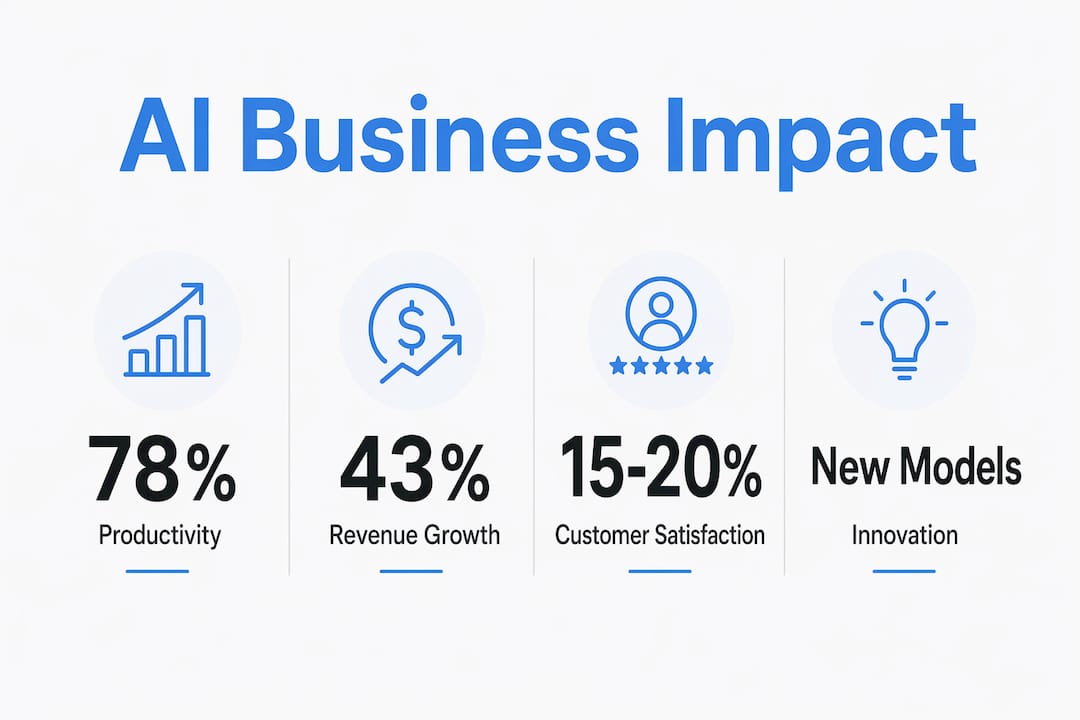
| Business Outcome | Reported Impact |
|---|---|
| Productivity improvement | 78% of US businesses report gains |
| Revenue growth | 43% of US businesses report increase |
| Customer satisfaction | 15–20% improvement with AI-enabled strategies |
| Revenue from customer AI | 5–8% increase |
| Cost-to-serve reduction | 20–30% decrease |
Beyond efficiency, the most durable competitive advantage comes from proprietary intelligence. Building proprietary intelligence with unique data, encoded workflows, and learning systems creates a competitive AI advantage that generic tools cannot replicate. A company that trains models on its own customer data, encodes its own operational knowledge, and builds feedback loops into its products creates a moat that grows wider as the system learns.
AI also enables entirely new business models. Predictive maintenance as a service, dynamic pricing engines, and AI-generated personalization at scale are not incremental improvements to existing products. They are new value propositions that only become possible when AI is embedded in the core product architecture.
What organizational changes are essential for AI transformation?
Workflow redesign is the single most important factor in realizing AI's full value. Most organizations only realize limited AI financial gains by embedding AI in existing workflows. Greater gains come from redesigning workflows around human-AI collaboration. That finding from McKinsey reframes the entire implementation question: the technology is not the constraint. The organizational design is.
Employee competencies mediate the impact of digitalization and technology adoption speed on AI-driven business model transformation. Workforce skills are not a soft consideration. They are the mechanism through which AI investment converts into business outcomes. Organizations that deploy AI without investing in employee capability consistently underperform those that treat workforce development as part of the transformation program.
Leadership commitment at the top matters just as much. Achieving major AI transformation requires CEO-led, board-supported strategic commitment and redesign of workflows and organizational models over several years. This is not a project that a chief digital officer can own alone. Without CEO narrative and board accountability, AI programs fragment into disconnected pilots that never reach production scale.
- Audit current workflows before selecting AI use cases. Identify where human judgment is the bottleneck, not just where volume is high.
- Redesign around collaboration. Define which decisions AI makes, which decisions humans make, and how the handoff works in each workflow.
- Build governance early. Assign ownership for model accuracy, drift detection, and retraining schedules before the first model goes live.
- Invest in employee capability. Train teams on how to interpret AI outputs, override when necessary, and provide feedback that improves model quality.
- Set realistic timelines. Organizations typically see returns over 2–4 years, not the conventional 7–12 month ROI expectation applied to standard technology projects.
Pro Tip: Treat your first AI governance framework as a living document. Revisit it every quarter as models evolve and new use cases go live. Static governance fails dynamic systems.
What strategic steps should leaders take to deploy AI at scale?
Concentration beats breadth. The most effective AI transformation programs focus on a small number of domains where AI changes the underlying economics of the business, rather than running dozens of pilots that never scale. A logistics company that rebuilds its routing and demand forecasting around AI creates a structural cost advantage. The same company running 30 small AI experiments creates noise.
- Invest in proprietary data infrastructure. Generic AI models trained on public data deliver generic results. The AI impact on business performance compounds when models train on your specific customer behavior, operational history, and product data.
- Phase workflow redesign deliberately. Start with one end-to-end workflow, measure the outcome, then expand. Redesigning everything at once creates change management failure.
- Build learning systems, not static deployments. AI models that do not retrain on new data degrade. Build feedback loops into every production deployment from day one.
- Maintain a long-term perspective. AI transformation is a multi-year program. Leaders who measure success at 12 months will defund programs before they reach the inflection point where returns accelerate.
- Develop organizational AI literacy. Business leaders need to recognize AI value beyond traditional ROI metrics, including qualitative improvements in decision speed, capability, and risk reduction.
The benefits of AI for companies that commit to this level of depth are not incremental. They are structural. Organizations that build proprietary intelligence, redesign workflows, and govern AI outputs continuously create advantages that are genuinely difficult for competitors to replicate quickly. That is the commercial case for treating AI transformation as a board-level priority rather than an IT initiative.
For teams building AI-powered products, understanding real productivity gains from AI at the workflow level provides a useful benchmark for setting internal targets and communicating value to stakeholders.
Key Takeaways
AI transformation delivers its greatest value when organizations redesign workflows around human-AI collaboration, invest in proprietary data, and govern probabilistic outputs continuously rather than treating AI as a plug-in to existing processes.
| Point | Details |
|---|---|
| Workflow redesign is the breakthrough | Embedding AI in legacy processes yields limited gains; rebuilding workflows around AI-human collaboration unlocks major returns. |
| Business outcomes are measurable | 78% of US businesses report productivity gains and 43% report revenue growth from AI adoption. |
| Governance is non-negotiable | Probabilistic AI outputs require continuous monitoring, drift detection, and model retraining as permanent operational functions. |
| Workforce capability drives results | Employee competencies mediate how effectively AI investment converts into business model transformation. |
| Proprietary intelligence compounds | Unique data, encoded workflows, and learning systems create competitive advantages that generic AI tools cannot replicate. |
Where most AI transformation programs actually break down
The research is clear, but the practice is harder than it looks. I have watched organizations invest heavily in AI tooling, announce transformation programs with real executive support, and still fail to move the needle. The pattern is almost always the same: the technology works, but the workflow around it does not change.
The uncomfortable truth is that most AI programs are add-ons. A model gets deployed alongside an existing process. Employees use its output when it confirms what they already thought and ignore it when it does not. The feedback loop never closes. The model never improves. The ROI never materializes. And leadership concludes that AI did not deliver, when the real problem was that the organization never redesigned the work.
The second failure mode is timeline mismatch. AI transformation returns come over 2–4 years. Most organizations evaluate technology investments at 12 months. That gap kills programs that would have succeeded if given time to reach the redesign phase where returns accelerate.
What actually works is treating AI transformation the way you would treat a new business model launch: with CEO ownership, multi-year commitment, dedicated governance, and a willingness to change how work gets done at a fundamental level. The organizations building real competitive moats through AI are not the ones with the most pilots. They are the ones that picked two or three domains, went deep, and built proprietary intelligence that compounds. That is the standard worth holding yourself to.
— Kevin
Mlflow for AI observability and governance at scale
Deploying AI at scale requires more than a good model. It requires visibility into how that model behaves in production, and the governance infrastructure to catch problems before they affect business outcomes.
Mlflow provides production-grade AI observability through deep tracing of agentic reasoning, automated evaluation using LLM-as-a-Judge frameworks, and a centralized AI Gateway for secure prompt management across providers. For teams moving from experimental prototypes to production AI agents, Mlflow standardizes evaluation and serving so that every deployment is transparent, auditable, and governable. If your organization is building the kind of AI transformation program described in this article, Mlflow's AI workflow tools give your team the observability and control that serious production deployments require.
FAQ
What is the role of AI in digital transformation?
AI's role in digital transformation is to extend automation into cognitive, judgment-based tasks such as prediction, content generation, and autonomous execution. This moves organizations beyond digitizing existing processes into fundamentally redesigning how work gets done.
How does AI impact business performance?
AI impact on business is measurable: 78% of US businesses report productivity improvements and 43% report revenue growth from AI adoption. Customer-facing AI strategies also reduce cost-to-serve by 20–30%.
Why do most AI transformation programs underperform?
Most programs underperform because organizations embed AI in existing workflows rather than redesigning those workflows around human-AI collaboration. McKinsey research confirms that workflow redesign, not AI deployment alone, is the source of major financial gains.
How long does AI transformation take to show returns?
AI transformation typically delivers returns over 2–4 years, not the 7–12 month window applied to standard technology projects. Organizations that defund programs at the 12-month mark consistently miss the inflection point where returns accelerate.
What governance does AI transformation require?
AI transformation requires continuous model monitoring, drift detection, and retraining schedules as permanent operational functions. Unlike deterministic software, AI outputs are probabilistic and degrade without active governance.