What Is LLMOps? A Guide for AI Practitioners

If you've deployed a traditional ML model and assumed the same playbook applies to large language models, you've probably already felt the gap. What is LLMOps? It's the specialized operational discipline that fills that gap. LLMOps adapts the core principles of MLOps to address the unique challenges of running LLMs in production, including prompt sensitivity, token costs, and hallucination risk. It's not just a renamed version of what you already know. It's a genuinely different set of practices built for a genuinely different class of models.
Table of Contents
- Key takeaways
- What LLMOps means and why it's different from MLOps
- Core components of the LLMOps lifecycle
- Best practices for effective LLMOps implementation
- Challenges and common pitfalls in LLMOps
- LLMOps trends shaping 2026 and beyond
- My take on mastering LLMOps for real deployments
- How MLflow supports your LLMOps practice
- FAQ
Key takeaways
| Point | Details |
|---|---|
| LLMOps differs from MLOps | LLMs require prompt versioning, token cost management, and language quality monitoring that traditional ML workflows don't address. |
| Lifecycle has nine phases | A mature LLMOps platform covers everything from prompt management and evaluation to incident response and continuous monitoring. |
| Prompts are configuration | Treat prompts like versioned software artifacts to maintain behavior control and reproducibility across deployments. |
| Observability is non-negotiable | Production failures often trace back to pipeline and retrieval gaps, not the model itself, making end-to-end tracing critical. |
| Evaluation requires new metrics | LLMs need safety and language quality assessments, not just numeric accuracy scores familiar from classical ML. |
What LLMOps means and why it's different from MLOps
At its core, LLMOps covers the tools, processes, and workflows you use to develop, deploy, monitor, and maintain large language model applications in production. Think of it as the operational layer between your LLM experiment and a reliable, production-grade system that your users can depend on.
The confusion with MLOps is understandable. Both disciplines cover lifecycle management, deployment, and monitoring. But the similarities end there. Traditional ML models output a fixed prediction: a probability, a class label, a numeric score. LLMs produce free-form natural language, and that output changes based on how you phrase the input, what context you provide, and which version of the base model you're hitting. That variability demands a completely different approach to evaluation and monitoring.
Here's a practical comparison to make the distinction concrete:
| Aspect | Traditional MLOps | LLMOps |
|---|---|---|
| Model output | Fixed prediction or score | Variable natural language text |
| Evaluation metrics | Accuracy, F1, AUC | Language quality, safety, user satisfaction |
| Cost driver | Compute for training/inference | Token usage per request |
| Key artifact | Trained model weights | Prompt templates + model weights |
| Primary risk | Data drift, accuracy degradation | Hallucination, safety violations, prompt injection |
| Monitoring focus | Statistical drift detection | Output quality, safety signals, latency per token |
LLMs generate variable natural language outputs that require continuous subjective quality and user satisfaction assessments. That subjectivity is exactly what makes LLMOps non-trivial. You can't just set a threshold on a scalar metric and call your monitoring done.
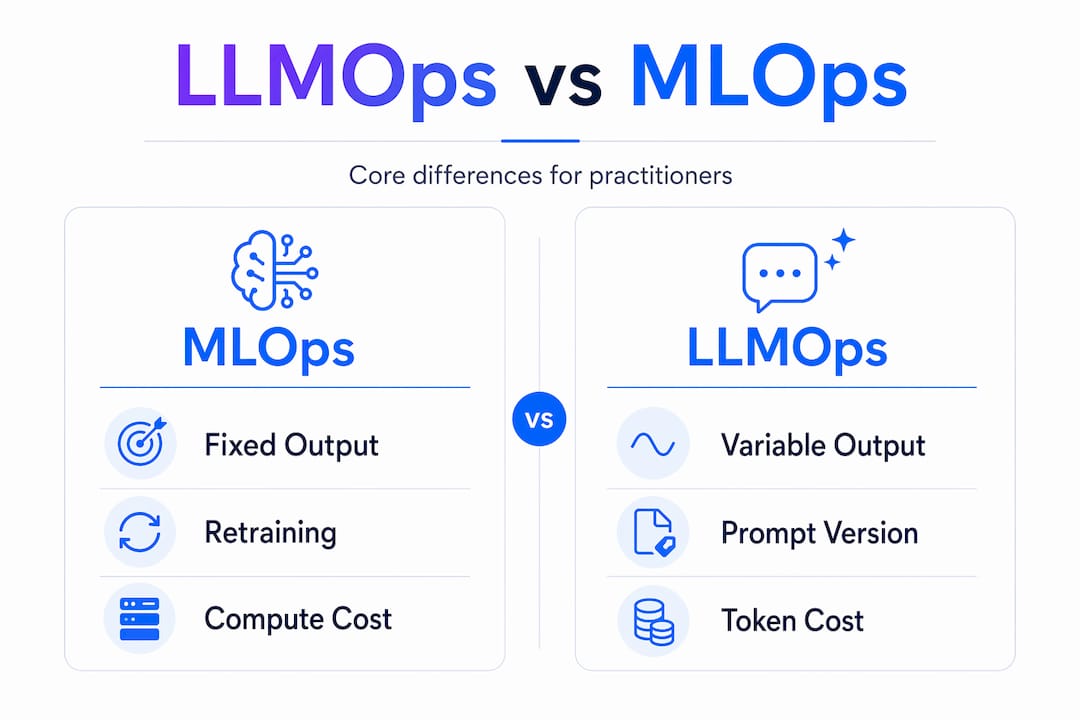
Cost structure is another major divergence. Token-based cost pricing replaces the compute-heavy retraining economics of traditional ML. In practice, this means every prompt redesign has a direct dollar implication, and optimizing for token efficiency becomes a first-class engineering concern alongside latency and accuracy.
Why the importance of LLMOps keeps growing
As organizations move beyond chatbot prototypes into production agents, RAG pipelines, and multi-step reasoning systems, the operational complexity scales fast. A single poorly managed prompt update can silently degrade outputs across thousands of user interactions before anyone notices. LLMOps gives you the scaffolding to catch that before it becomes a production incident.

Core components of the LLMOps lifecycle
A mature LLMOps platform doesn't just wrap your LLM in an API and call it done. According to a detailed breakdown of nine operational phases every production LLM system should cover, the lifecycle looks like this:
- Prompt management. Version, test, and deploy prompt templates as first-class configuration artifacts.
- Context and retrieval. Manage vector stores, retrieval pipelines, and chunking strategies for RAG systems.
- Tool and function execution. Orchestrate external API calls, database queries, and sub-agent invocations.
- Guardrails and safety filtering. Apply input and output filters to block unsafe, off-topic, or injected content.
- Evaluation pipelines. Run automated scoring using LLM-as-a-Judge frameworks or human-in-the-loop review.
- Continuous monitoring. Track hallucination rates, latency, cost per query, and safety signal drift over time.
- Feedback integration. Capture user thumbs-up/thumbs-down signals and route them into your evaluation pipeline.
- Incident response. Define runbooks for prompt rollbacks, traffic rerouting, and escalation when quality drops.
- Governance and audit logging. Maintain records of model versions, prompt versions, and evaluation snapshots for compliance.
Each phase builds on the last. Skipping prompt versioning makes incident response nearly impossible. Missing evaluation pipelines means you're flying blind on hallucination rates. The phases aren't optional checkboxes. They're interdependent.
Pro Tip: Start with phases 1, 6, and 8 if you're operationalizing your first LLM application. Prompt management, monitoring, and incident response give you the most operational leverage before you invest in the full lifecycle.
Continuous evaluation deserves special attention here. Integrating evaluation pipelines and user feedback loops is what separates teams that iterate confidently from teams that push updates and hope for the best. User feedback is signal. Treat it as a data stream, not an afterthought.
Best practices for effective LLMOps implementation
Knowing what the phases are is one thing. Knowing how to execute them without accumulating technical debt is another. These practices separate teams with stable LLM systems from those constantly firefighting production issues.
- Version your prompts like code. Treating prompt artifacts with code-like rigor enables reproducibility and operational safety. Store prompts in version control, tag releases, and never modify production prompts without a staging test.
- Automate your evaluation suite. Manual review doesn't scale. Use LLM-as-a-Judge techniques to score outputs automatically across dimensions like factual accuracy, tone, safety, and task completion.
- Monitor the full request path, not just the model. Most production failures happen in the retrieval pipeline, the tool execution layer, or the prompt assembly logic. Instrument every step with structured traces.
- Set cost alerts at the query level. Token costs accumulate silently. Set per-query cost thresholds and alert on anomalies before they become budget overruns.
- Build rollback into your deployment process. Prompt rollbacks should be as fast and reliable as code rollbacks. If a new prompt version degrades quality, you need a one-click path back.
Pro Tip: Use LLM observability tooling that captures the full trace of each request, including retrieved documents, tool calls, and intermediate reasoning steps. Surface-level output logging won't tell you why a response went wrong.
One framework that helps operationalize these practices is treating your LLM application as a pipeline product, not a model product. The model is one node. Your prompt logic, retrieval strategy, and output filters are equally important nodes. All of them need the same operational rigor.
Challenges and common pitfalls in LLMOps
Even teams with strong MLOps experience run into LLM-specific traps. Here are the ones that most commonly derail production deployments.
- Hallucination without detection. Hallucination detection requires specialized monitoring because the model will confidently produce plausible-sounding incorrect information. Without automated fact-checking or retrieval grounding validation, these errors reach users silently.
- Output variability masking regression. Because LLM outputs are non-deterministic, a regression in quality can look like normal variance. You need statistical baselines and evaluation scoring to detect signal from noise.
- Observability gaps beyond the model. Production LLM failures often trace to pipeline and observability gaps rather than the model weights themselves. If your tracing doesn't cover the retrieval layer and tool execution, you're debugging blind.
- Prompt drift over time. Base models get updated. Your prompt that performed well against GPT-4 Turbo in Q1 may produce degraded outputs against a new model version in Q3. Continuous regression testing against prompt versions is the only safeguard.
- No incident response runbook. When quality degrades at 2 AM, the absence of a clear escalation path and rollback procedure turns a manageable incident into an extended outage. Define your runbooks before you need them.
The core pattern across all these pitfalls is the same. LLMOps platforms must integrate prompt version control, context retrieval, tool execution, and guardrails within a unified observability framework to respond effectively to incidents. Piecemeal tooling makes this nearly impossible.
LLMOps trends shaping 2026 and beyond
The LLMOps discipline is maturing fast, and a few trends are defining where best practices are heading.
- Automated prompt optimization. Teams are moving from manual prompt tuning to automated search over prompt variations using evaluation metrics as the objective function.
- Multi-model routing and A/B testing. Production systems increasingly route requests across multiple providers and model sizes based on cost, latency, and task type. This requires governance at the routing layer, not just the model layer.
- LLM-as-a-Judge adoption. LLMs need new evaluation metrics focused on language quality and safety rather than numeric accuracy. LLM-as-a-Judge frameworks are becoming the standard mechanism for scalable automated evaluation.
- Security and red-teaming as standard practice. Prompt injection, jailbreaks, and data exfiltration via retrieval are real attack surfaces. Security testing is moving from optional to required in production LLM deployments.
- Convergence with DevOps toolchains. LLMOps tooling is integrating with CI/CD pipelines, infrastructure-as-code platforms, and observability stacks that engineering teams already operate, reducing the adoption barrier significantly.
My take on mastering LLMOps for real deployments
I've watched teams with excellent MLOps processes hit a wall the moment they tried applying that same discipline to LLM applications. The instinct to reuse what works is natural, but it creates blind spots. The biggest one I've seen is treating the prompt as an afterthought rather than the most operationally critical artifact in the system.
In my experience, the teams that ship reliable LLM applications aren't necessarily using the best models. They're the ones that treat every prompt change as a mini deployment, complete with evaluation, staging, and a rollback plan. The model is almost secondary. Your prompt logic, retrieval quality, and output monitoring are where production stability actually lives.
I've also seen firsthand how observability gaps cause extended incidents. A team I worked with spent days debugging degraded outputs before realizing the issue wasn't the model at all. It was a silent change in their vector store chunking strategy that degraded retrieval quality. End-to-end tracing through the full request path would have surfaced that in minutes.
The cultural shift matters as much as the tooling. LLMOps requires engineers, data scientists, and product owners to share ownership of prompt behavior and output quality. It's not a handoff model. It's a continuous collaboration. The teams that embrace that early build the operational maturity to scale confidently.
— Kevin
How MLflow supports your LLMOps practice
MLflow is purpose-built for the operational realities described throughout this article. It provides production-grade LLM lifecycle management covering prompt versioning, automated evaluation using LLM-as-a-Judge frameworks, deep tracing of agentic reasoning, and a centralized AI Gateway for cross-provider governance. Whether you're running a single RAG pipeline or a complex multi-agent system, MLflow gives you the observability and evaluation infrastructure to move from prototype to production with confidence. Explore the full GenAI engineering platform to see how MLflow fits into your LLMOps stack.
FAQ
What does LLMOps mean?
LLMOps stands for Large Language Model Operations. It refers to the set of practices, tools, and workflows used to develop, deploy, monitor, and maintain LLM-powered applications in production environments.
How does LLMOps differ from MLOps?
LLMOps addresses challenges specific to large language models, including prompt versioning, token cost management, hallucination detection, and language quality evaluation. Traditional MLOps focuses on numeric model metrics and compute-based cost structures that don't apply to LLMs.
What are the core components of an LLMOps framework?
A mature LLMOps framework includes prompt management, retrieval pipeline orchestration, automated evaluation, continuous monitoring, safety guardrails, user feedback integration, and incident response runbooks covering all nine phases of the production lifecycle.
Why is observability so critical in LLMOps?
Production LLM failures frequently originate in the retrieval layer, tool execution, or prompt assembly logic rather than the model itself. End-to-end tracing across the full request path is the only way to diagnose and resolve these failures quickly.
How do you evaluate LLM outputs in production?
LLM outputs require evaluation metrics focused on language quality, safety, and task completion rather than numeric accuracy. LLM-as-a-Judge frameworks automate this scoring at scale, enabling continuous evaluation without manual review bottlenecks.