What Is an AI Agent? A 2026 Professional Guide

Most people who encounter the phrase "AI agent" picture a chatbot with a snappier personality. That mental model is incomplete, and it leads to real misunderstandings about what this technology can actually do. Understanding what is an AI agent means recognizing a fundamentally different category of software: a system that perceives its environment, reasons through goals, and takes multi-step actions without waiting for you to tell it what to do next. This guide gives you the precise definition, the architecture behind the behavior, and the practical context to understand why AI agents are reshaping how work gets done.
Table of Contents
- Key Takeaways
- What is an AI agent: the core definition
- Types and real-world examples of AI agents
- How AI agents work: architecture and technology
- Applications across industries
- AI agents vs. chatbots and traditional AI tools
- My honest take on where AI agents actually stand
- Build and manage AI agents with MLflow
- FAQ
Key Takeaways
| Point | Details |
|---|---|
| Agents act, not just answer | AI agents operate in a continuous perceive-reason-act loop to complete goals autonomously. |
| Tools and memory separate agents from chatbots | Agents use external APIs, maintain state, and plan across multiple steps. |
| Five core types exist | From simple reflex agents to self-modifying learning agents, each serves distinct use cases. |
| Production agents require software engineering | Durable state, event-driven workflows, and delegation patterns matter as much as the AI model. |
| Human-in-the-loop remains standard | Even advanced agents often require approval gates for high-stakes decisions. |
What is an AI agent: the core definition
AI agents are defined as semi- or fully autonomous software systems that perceive their environment, reason about goals, and execute multi-step tasks using external tools without step-by-step human guidance. That last part is the key distinction. You do not babysit the agent through each step. You assign it a goal, and it figures out the path.
The behavior follows a four-stage loop:
- Perceive: The agent collects input from its environment. This could be a user message, a database query result, a file, an API response, or a sensor reading.
- Reason: It processes that input using a model, often a large language model (LLM), to determine the most appropriate action given its goal.
- Act: It executes that action. This might mean calling an API, writing code, browsing the web, sending an email, or delegating to a sub-agent.
- Observe: It receives the result of its action and feeds that back into the next reasoning step. The loop continues until the goal is reached.
This is what separates the definition of AI agents from the chatbots people use daily. A chatbot waits for your next prompt and responds. An agent decides its own next step.
Pro Tip: When evaluating whether something qualifies as a true AI agent, ask one question: does it decide what to do next, or does it wait for a human to tell it? If it waits, it is a tool. If it decides, it is an agent.
Agents also maintain state. They remember context across steps, use memory to inform future decisions, and can persist across sessions. They access external tools through APIs. They can spawn sub-agents to parallelize workloads. These properties, autonomy, goal-directedness, planning, memory, and tool use, together form what most practitioners mean by agentic AI.

Types and real-world examples of AI agents
Not every AI agent works the same way. The field has developed five recognized categories, each representing a different level of sophistication.
| Agent Type | Core Behavior | Real-World Example |
|---|---|---|
| Simple reflex | Reacts to current input using fixed rules | Thermostat, spam filter |
| Model-based | Maintains internal world model to track state | Autonomous vehicle navigation |
| Goal-based | Plans actions to achieve a defined objective | Trip-planning AI assistant |
| Utility-based | Optimizes for a preference function across possible outcomes | Recommendation engines |
| Learning agent | Improves performance over time from experience | AlphaGo, modern AI coding assistants |
Beyond these categories, specific AI agents examples illustrate the real scope of what this technology can accomplish:
- Digital assistants as agents: Alexa has evolved well past responding to voice commands. It now manages multi-step home automation workflows, coordinates across third-party device APIs, and maintains preferences over time. That is agent behavior.
- Scientific agents: DeepMind's AlphaEvolve demonstrates what is possible when agents operate in technical domains. The system improved quantum circuits with 10x lower error rates and increased natural disaster risk prediction accuracy by 5% across 20 categories. Grid optimization accuracy jumped from 14% to 88% under agent-driven design.
- Self-modifying agents: The Ouroboros project pushes the frontier further. This agent rewrites its own code autonomously, executing 30 or more self-directed evolution cycles in 24 hours while maintaining continuous identity across restarts through a multi-model internal review process.
These AI agents examples are not hypothetical. They are running today in research labs, enterprise software stacks, and consumer products.
How AI agents work: architecture and technology
Understanding how do AI agents work requires looking at the engineering beneath the behavior, not just the surface-level interactions.
-
Continuous observation and decision-making. At runtime, the agent continuously collects observations from its environment and feeds them into its reasoning layer. The LLM processes these observations in context with the agent's goal, the tools available to it, and any memory retrieved from prior steps. It then generates the next action.
-
Specialized prompts and focused state. The most effective AI agents maintain a focused state and execute complex, stateful workflows rather than simply adding loops around LLMs. Prompts are not generic. They are engineered for the agent's specific task domain, often using a prompt registry to version-control and govern what the agent sees at each stage.
-
Durable state and event-driven dormancy. Production agents handling long-running tasks, think multi-day procurement workflows or week-long scientific experiment cycles, need to pause without losing context. Long-running agents succeed using event-driven dormancy gates, state transition checkpoints, and workload delegation between specialized sub-agents. An agent can sleep for days and wake precisely on an external trigger, such as a webhook from an approval system, without wasting compute.
-
Multi-agent collaboration. Complex workflows often exceed what a single agent can handle reliably. Production systems use explicit state schemas and multi-agent delegation, with communication handled in structured formats like JSON to prevent infinite delegation loops and to keep coordination deterministic.
-
Reliability by design. Building agents that actually work in production is primarily a software engineering challenge. Durable memory schemas, structured inter-agent communication, observability tooling, and failure recovery logic matter as much as the underlying model.
Pro Tip: If you are building an agent for production, instrument it with tracing from day one. Knowing exactly which tool calls the agent made, what it reasoned between steps, and where it failed is the difference between a system you can debug and a black box you can only restart.
Applications across industries
AI agent technology is moving from proof-of-concept to deployed infrastructure across many sectors. Here is where the functions of AI agents are having the most measurable impact today:
- Business workflow automation: Agents handle multi-step processes like contract review, invoice reconciliation, and procurement approvals without requiring a human to manage each step. The benefits of AI agents in productivity-focused environments include significant reductions in task completion time and error rates.
- Customer service: Agents resolve complex support tickets by querying internal knowledge bases, checking order systems, and executing refunds, all within a single conversation, without escalation to a human for routine cases.
- Scientific research: From drug discovery to materials science, agents run experiment loops, analyze results, and propose next steps autonomously. AlphaEvolve's improvements to real-world scientific problems demonstrate what this looks like at scale.
- Content creation pipelines: Agents draft, review, fact-check, and format content by coordinating multiple sub-agents specialized in each task. This is an example of how agentic orchestration produces outputs no single model could manage efficiently alone.
- AI agents in robotics: Physical agents perceive environments through sensors, reason about obstacles and objectives, and execute motor actions. Autonomous vehicles and warehouse robots are the most widely deployed examples.
The limits are real too. Agents are rarely 100% autonomous in high-stakes environments. Financial decisions, code deployments, and sensitive data handling typically require human-in-the-loop approval gates. Designing for that interaction is part of responsible agent deployment, not a failure of the technology.
AI agents vs. chatbots and traditional AI tools
This comparison comes up constantly, and it deserves a precise answer.
| Feature | Traditional chatbot | AI agent |
|---|---|---|
| Interaction model | Responds to each prompt individually | Acts across multiple steps toward a goal |
| Autonomy | None. Waits for user input | High. Decides next actions independently |
| Tool use | Rarely, if ever | Core capability: APIs, databases, code execution |
| Memory | Session-limited or none | Persistent state across sessions |
| Scope | Single-turn Q&A | Multi-turn, multi-day task completion |
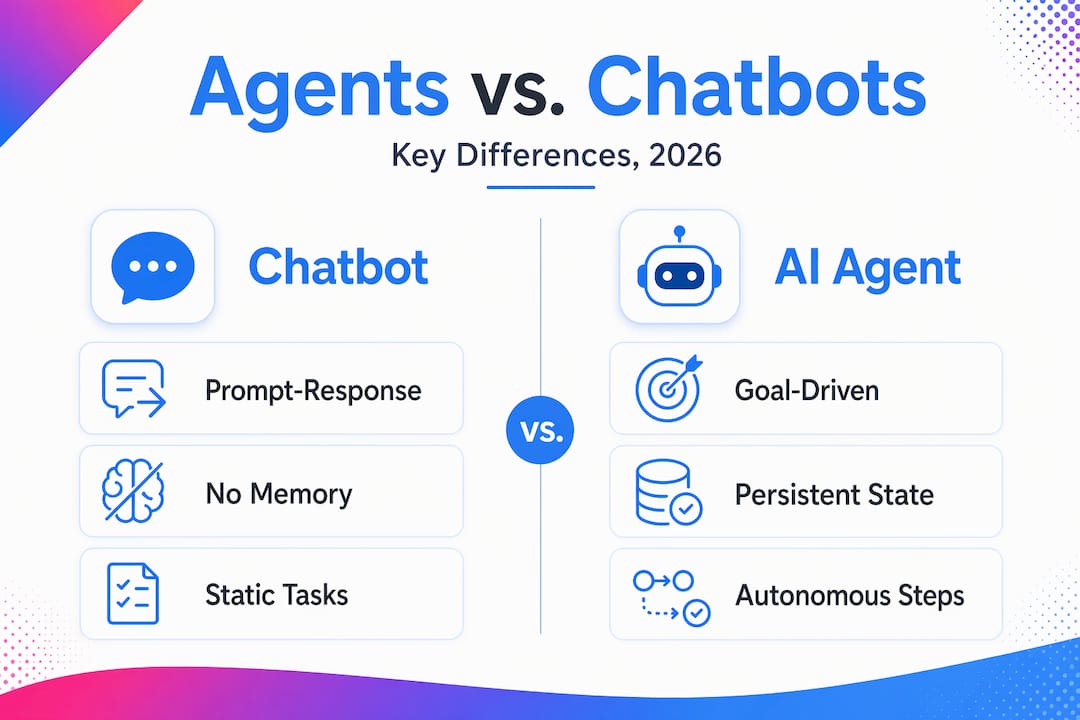
Traditional AI tools like classifiers, recommendation models, or simple rule-based bots operate within fixed boundaries. They produce outputs but do not pursue objectives. A chatbot answers your question. An agent completes your task.
What about popular systems like ChatGPT? In its base form, ChatGPT is a conversational AI, not an agent. When you enable it with tools like code execution, web search, and persistent memory with an objective-driven instruction set, it begins to operate in agentic mode. The model does not change. The architecture around it does.
Pro Tip: Use the presence of a goal, tool access, and autonomous step-sequencing as your three-part test for any system claiming to be an AI agent. If it can not pursue a goal across multiple tool calls without prompting, it is not truly agentic.
My honest take on where AI agents actually stand
I have been close to production AI agent deployments long enough to say this clearly: most of the pain teams experience has nothing to do with the intelligence of the underlying model. It has to do with the software.
State management breaks. Agents get stuck in reasoning loops. Multi-agent delegation produces cascading failures when one sub-agent returns an unexpected format. These are not AI problems in the philosophical sense. They are distributed systems problems with an LLM in the middle.
What I have seen work consistently is treating agents as stateful microservices first and AI systems second. That means explicit schemas for state transitions, structured communication between agents, and observability at every layer. Teams that add tracing and agent monitoring early catch failure modes that would otherwise surface only in production, usually at the worst possible moment.
The hype around autonomous agents is real, and some of it is deserved. But the professionals who build reliable agents are not the ones most excited about the autonomy. They are the ones most disciplined about the engineering.
The future of AI agents is not a single omnipotent system. It is networks of specialized agents with clear communication contracts, observable behavior, and well-defined escalation paths to humans. That architecture is already emerging, and building for it now puts you ahead of teams that are still treating agents as fancy prompt wrappers.
— Kevin
Build and manage AI agents with MLflow
If you are moving from understanding AI agents to actually building and running them, the platform you choose matters enormously. MLflow was built specifically for this challenge.
MLflow's agent and LLM engineering platform gives teams production-grade tooling for every stage of the agent lifecycle. That includes deep tracing of agentic reasoning so you can see exactly what your agent did and why, automated evaluation using LLM-as-a-Judge frameworks, and a centralized AI Gateway for secure prompt management and cross-provider governance. Whether you are building a single-agent workflow or orchestrating a multi-agent system at scale, MLflow provides the observability and evaluation infrastructure to move from prototype to production with confidence. Explore the MLflow Cookbook for practical, hands-on guides to get started.
FAQ
What is an AI agent in simple terms?
An AI agent is a software system that perceives its environment, sets or receives a goal, and takes a sequence of actions to achieve that goal without requiring human guidance at each step. It reasons, acts, and adjusts based on what it observes.
How do AI agents differ from chatbots?
Chatbots respond to individual prompts one at a time. AI agents decide their own next actions, use external tools, maintain memory, and pursue goals across multiple steps without waiting for user input between each action.
What are some real-world examples of AI agents?
AlphaEvolve by DeepMind improved quantum circuit design and natural disaster risk prediction. Alexa manages multi-step smart home workflows. Enterprise agents handle end-to-end procurement, customer service resolution, and content pipelines autonomously.
Are AI agents fully autonomous?
In practice, most production AI agents include human-in-the-loop approval gates for high-stakes decisions. Full autonomy is technically possible but rarely deployed without oversight in financial, legal, or sensitive operational contexts.
What technology powers AI agents?
Most modern AI agents are built on large language models as their reasoning core, combined with tool-calling APIs, durable state management systems, and orchestration frameworks that coordinate multi-step and multi-agent workflows.