Integrating AI into Enterprise Workflows: 2026 Guide

Enterprise AI integration is the practice of embedding AI capabilities directly into core business systems so those systems make decisions, process data, and execute tasks without constant human intervention. This is distinct from traditional automation, which follows fixed rules. AI workflow integration involves context-aware intelligence that adapts in real time. The World Economic Forum estimates that generative AI and AI agents can automate 60–70% of employee time in banking and insurance when properly integrated. That figure signals a structural shift in how enterprise work gets done, not a marginal efficiency gain. Integrating AI into enterprise workflows requires architectural planning, governance design, and deliberate workflow redesign. Mlflow is one platform built specifically to manage this complexity at production scale.
What does integrating AI into enterprise workflows actually require?
Most enterprise teams underestimate what has to be true before a single AI model goes live. The prerequisite work is not glamorous, but skipping it is the primary reason pilots fail to reach production.
Data readiness and system connectivity
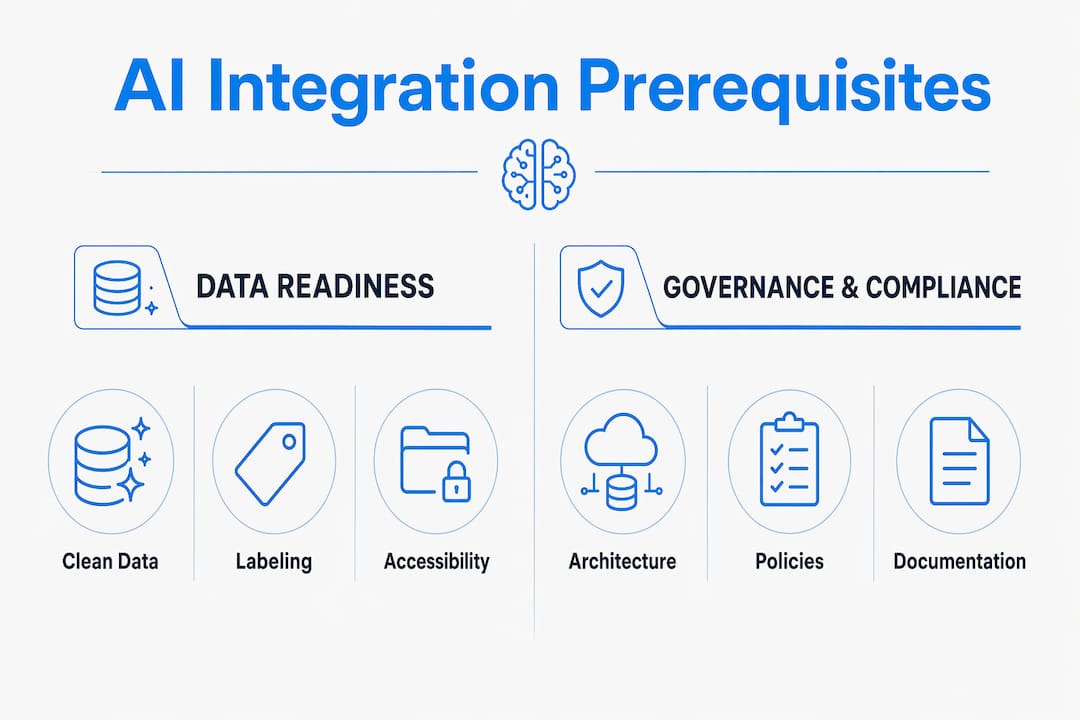
AI models are only as useful as the data they can access. Your data must be clean, labeled, and accessible through APIs or event streams. Disconnected data silos, inconsistent schemas, and missing metadata all create failure points before the model ever runs. Audit your data pipelines first.

System connectivity is equally critical. AI agents need to read from and write to existing enterprise systems, whether that is a CRM, ERP, or document management platform. Without reliable API endpoints and low-latency connections, even a well-trained model produces outputs that cannot be acted on.
Governance and compliance frameworks
Governance cannot be retrofitted after deployment. Embedding governance into architecture from the start means defining access controls, audit logging, and model versioning before the first workflow goes live. Compliance requirements in regulated industries, such as financial services or healthcare, add additional constraints around data residency and explainability.
Pro Tip: Define your AI governance policy as a written document before selecting any model or vendor. Teams that do this reduce compliance rework by a significant margin during deployment.
The table below summarizes the four prerequisite categories every enterprise team must assess before beginning AI workflow integration.
| Prerequisite | What to assess |
|---|---|
| Data quality | Completeness, consistency, and accessibility of training and operational data |
| System architecture | API availability, latency tolerance, and integration points with existing platforms |
| Governance framework | Access controls, audit trails, model versioning, and compliance requirements |
| Workflow design | Whether current processes can support autonomous AI agents or need redesign |
Which integration patterns enable effective AI workflow embedding?
Four primary integration patterns exist for embedding AI into enterprise workflows: direct API integration, Retrieval-Augmented Generation (RAG), event-driven asynchronous pipelines, and agentic workflows. Each carries distinct tradeoffs in latency, cost, and complexity.
Direct API integration connects an AI model to a workflow via synchronous API calls. It works well for low-volume, real-time tasks like document classification or sentiment scoring. Latency is predictable, and the architecture is simple to audit.
Retrieval-Augmented Generation (RAG) pairs a language model with a live knowledge base. The model retrieves relevant documents at inference time before generating a response. RAG is the right pattern for knowledge-intensive applications like internal search, compliance Q&A, or customer support, where accuracy depends on current information rather than training data alone.
Event-driven asynchronous pipelines decouple AI processing from the triggering event. A workflow publishes an event, the AI model processes it in the background, and results are returned when ready. This pattern handles high-volume batch tasks, such as invoice processing or log analysis, without blocking downstream systems.
Agentic workflows are the most complex pattern. An AI agent executes multi-step tasks across multiple enterprise systems, making decisions at each step. Mlflow is purpose-built for this pattern, providing production-grade agent orchestration with deep tracing and automated evaluation.
| Pattern | Latency | Cost | Complexity | Best use case |
|---|---|---|---|---|
| Direct API | Low | Low | Low | Real-time classification, scoring |
| RAG | Medium | Medium | Medium | Knowledge retrieval, Q&A |
| Event-driven async | High | Low | Medium | Batch processing, log analysis |
| Agentic workflows | Variable | High | High | Multi-step automation, decision chains |
Pro Tip: Start with direct API integration or RAG for your first production deployment. Agentic workflows deliver the highest value but require mature governance and monitoring infrastructure to run safely.
How do you execute AI workflow integration step by step?
Pilot-to-production failure most often results from sequencing and governance gaps, not from technology limitations. A structured execution plan closes those gaps before they become expensive.
Step 1: Document existing workflows and define success metrics. Map every manual handoff, decision point, and data input in the target workflow. Assign a measurable KPI to each automation opportunity, such as processing time, error rate, or cost per transaction. Without baseline metrics, you cannot prove the integration worked.
Step 2: Run a scoped pilot. Select one workflow segment with clear boundaries and low risk. Deploy the AI model in shadow mode first, where it runs in parallel with the human process but does not control outputs. Compare results against your baseline metrics before switching to live operation.
Step 3: Monitor performance with operational KPIs. Track resolution rate, error rate, escalation frequency, and user satisfaction from day one. These four metrics reveal whether the integration is performing, degrading, or drifting from expected behavior. Anecdotal feedback is not a substitute for operational data.
Step 4: Embed human-in-the-loop controls at critical junctures. Human oversight built into workflow architecture prevents cost overruns and AI hallucinations in high-stakes decisions. Identify the specific steps where a human must review or approve AI output before it triggers downstream actions. Design those checkpoints into the system, not as an afterthought.
Step 5: Scale with governance embedded. Expand the integration to additional workflow segments only after the pilot meets its KPIs. Carry the same governance controls, audit logging, and monitoring configuration into each new deployment. Governance that works at pilot scale must be architecture-level, not manually applied per deployment.
- Assign a dedicated integration owner who bridges the technical and business teams.
- Version every model and prompt change so you can roll back without disrupting live workflows.
- Schedule quarterly reviews of model performance against current operational data.
- Communicate changes to affected teams before go-live, not after.
What common challenges arise during AI workflow integration?
Legacy workflows designed for manual handoffs are the most common obstacle to successful AI integration. These processes were built around human reading speed, approval cycles, and sequential steps. AI agents need event-driven architectures with parallel processing and fast data access. Forcing an AI agent into a manually sequenced workflow produces bottlenecks that negate the performance gains.
A second failure mode is confusing AI integration with traditional robotic process automation (RPA). RPA executes fixed rule-based scripts. AI workflow integration, by contrast, involves models that interpret context, handle ambiguity, and adapt outputs based on new data. Teams that treat them as equivalent underinvest in data quality and governance, then wonder why the model underperforms.
Governance oversights are the silent killer of AI integration projects. Model drift, access control gaps, and missing audit trails do not cause immediate failures. They accumulate quietly until a compliance audit or a high-profile error forces a costly rebuild.
Technical bottlenecks also appear at scale. Latency spikes under load, API rate limits from upstream systems, and schema changes in source data all break integrations that worked fine in the pilot. Build circuit breakers and fallback logic into every integration point from the start.
Continuous evaluation using operational data is the most reliable way to catch these issues early. Operational metrics tell you what is actually happening in production. Periodic manual reviews tell you what someone thinks is happening. The two rarely agree.
Pro Tip: When a workflow integration underperforms, check the workflow design before tuning the model. Process redesign fixes more integration failures than model adjustments do.
Key Takeaways
Successful AI workflow integration depends on workflow redesign and embedded governance, not on model selection alone.
| Point | Details |
|---|---|
| Redesign workflows first | Legacy manual processes block AI agents; redesign for event-driven, parallel architectures before deploying. |
| Govern from the start | Embed access controls, audit logging, and model versioning before the first workflow goes live. |
| Match pattern to use case | Choose direct API, RAG, async pipelines, or agentic workflows based on latency, volume, and risk. |
| Pilot with real metrics | Run shadow-mode pilots against baseline KPIs before switching AI to live operation. |
| Monitor operationally | Track resolution rate, error rate, escalation, and user satisfaction continuously, not just at launch. |
Why I think most enterprise AI projects fail before they start
I have watched enterprise teams spend months selecting models and zero weeks redesigning the workflows those models will run inside. That sequencing error is the single most predictable cause of failed AI integration projects. The model is rarely the problem. The process it inherits almost always is.
The deeper issue is that most organizations still treat AI integration as a technology deployment. It is not. It is an operational transformation that happens to use technology. When you deploy an AI agent into a workflow built for human approval cycles and weekly batch runs, you are not accelerating the process. You are digitizing its inefficiencies.
What actually works is starting with the workflow and working backward to the model. Document every decision point. Identify where human judgment is genuinely required versus where it is a legacy habit. Then design the AI agent around the redesigned process, not the original one. Mlflow's agent lifecycle management framework is built for exactly this kind of intentional deployment, where tracing and evaluation are first-class citizens from day one.
Governance deserves the same treatment. Teams that bolt on audit trails and access controls after deployment spend twice as much time maintaining them. Teams that build governance into the AI platform architecture from the start spend that time shipping improvements instead.
The enterprises that get this right share one trait: they measure outcomes obsessively and adjust quickly. They do not wait for the annual review to find out the model drifted. They know by tuesday.
— Kevin
Mlflow for production AI workflow integration
Mlflow is an open-source platform built for teams that need to move AI agents from prototype to production without losing visibility or control.
Mlflow provides deep tracing of agentic reasoning, so you can see exactly what an agent did and why at every step of a workflow. Its LLM-as-a-Judge evaluation framework automates quality assessment across complex multi-step workflows, replacing manual spot-checks with continuous, systematic evaluation. The centralized AI Gateway manages prompt versioning and cross-provider governance in one place. For teams building production-grade AI workflows, Mlflow gives you the observability and governance infrastructure that enterprise deployment actually requires.
FAQ
What is enterprise AI workflow integration?
Enterprise AI workflow integration is the practice of embedding AI models and agents directly into business processes so they execute tasks, make decisions, and adapt outputs without constant human intervention. It differs from traditional automation by handling ambiguity and context, not just fixed rules.
How long does an enterprise AI integration typically take?
Timeline varies by workflow complexity and infrastructure readiness. A scoped pilot with clear metrics can reach shadow-mode operation in four to eight weeks. Full production deployment with governance controls typically takes three to six months.
What is the most common reason AI workflow integrations fail?
Sequencing and governance gaps cause most pilot-to-production failures, not technology limitations. Teams that skip workflow redesign and defer governance setup consistently see integrations stall or regress after launch.
What is Retrieval-Augmented Generation (RAG) and when should I use it?
RAG pairs a language model with a live knowledge base, retrieving relevant documents at inference time before generating a response. Use RAG when accuracy depends on current information, such as compliance Q&A, internal search, or customer support.
How do I measure whether an AI workflow integration is working?
Track four operational KPIs continuously: resolution rate, error rate, escalation frequency, and user satisfaction. These metrics reveal actual production performance and catch model drift before it becomes a business problem.