The Role of Kubernetes in AI Serving: 2026 Guide

Kubernetes is defined as the container orchestration platform that forms the infrastructure backbone of modern AI serving architectures. The role of Kubernetes in AI serving goes far beyond simple container management. It provides GPU-aware scheduling, declarative model lifecycle control, and autoscaling that responds to real inference traffic. The 2026 CNCF Annual Survey found that 66% of organizations running generative AI inference use Kubernetes, driven by the maturation of Dynamic Resource Allocation (DRA) and native gang scheduling. That number reflects a clear industry consensus: for multi-GPU, multi-model, and multi-team environments, Kubernetes is the substrate of choice. Tools like KServe, KEDA, and Karpenter have made Kubernetes for AI deployment a production-grade reality, not just an architectural aspiration.
What is the role of Kubernetes in AI serving?
Kubernetes manages AI serving workloads by treating GPU resources, model replicas, and inference traffic as first-class scheduling concerns. Before Kubernetes matured for AI, teams cobbled together ad hoc container solutions that lacked quota enforcement, topology awareness, and declarative rollback. The shift to Kubernetes-native tools like KServe, Kueue, and vLLM-backed runtimes represents a structural change in how the industry thinks about model serving infrastructure.
The core value Kubernetes delivers to AI serving teams breaks down into four areas:
- GPU resource management: Kubernetes schedules GPU pods with fine-grained attribute control through DRA, replacing older device plugin APIs that treated GPUs as opaque integers.
- Declarative model lifecycle: KServe's
InferenceServiceresource lets you define model serving configurations in YAML, enabling version-controlled deployments and GitOps workflows. - Autoscaling: Horizontal Pod Autoscaler (HPA) and KEDA handle load-based and event-driven scaling, including scale-to-zero for idle inference endpoints.
- Multi-tenancy: Kueue enforces quota boundaries across teams sharing the same GPU cluster, preventing resource starvation without manual intervention.
Each of these capabilities addresses a specific failure mode that teams hit when they try to serve AI models at scale without proper orchestration.
How does Kubernetes manage GPU resources for AI workloads?
GPU scheduling is where Kubernetes has made the most significant progress for AI serving. The older device plugin model exposed GPUs as simple countable resources. DRA replaces that model with structured attribute exposure, letting schedulers make decisions based on GPU memory, interconnect topology, and compute capability.

Native gang scheduling is equally important. Distributed inference jobs, like multi-node tensor-parallel deployments, require all pods to start simultaneously or not at all. Without gang scheduling, partial pod starts waste GPU allocations and block other workloads. Kubernetes now supports atomic pod group scheduling natively, which removes a major operational headache for teams running large language model inference.
Kueue and the KAI Scheduler extend this further:
- Kueue provides queue-based admission control with quota enforcement per team or namespace. It holds pending workloads until resources are available, preventing cluster oversubscription.
- KAI Scheduler adds topology-aware placement, routing pods to GPU nodes that share NVLink or InfiniBand interconnects for lower latency between devices.
- Gang scheduling integration in both tools ensures distributed training and inference pods land together, not scattered across incompatible nodes.
The practical result is that a shared GPU cluster can serve multiple teams without any single team monopolizing resources or causing cascading failures.
Pro Tip: Enable topology-aware scheduling in Kueue by annotating your workload with the correct topologySpreadConstraints. Pods placed on nodes sharing NVLink can see 3x to 5x lower inter-GPU communication latency compared to pods spread across separate network switches.
What is the Kubernetes-native AI serving stack?
KServe and llm-d form a composable system that separates model lifecycle management from inference runtime scheduling. This separation matters because lifecycle concerns (versioning, rollback, traffic splitting) evolve at a different pace than runtime concerns (cache locality, phase-aware GPU scheduling). Coupling them in a single component creates brittle systems that are hard to update independently.
KServe's InferenceService resource handles the lifecycle side. You declare the model URI, runtime, resource requirements, and scaling policy in a single YAML manifest. KServe then manages the serving pods, routes traffic, and exposes a standardized inference endpoint. This declarative approach integrates directly with GitOps workflows.
llm-d handles the runtime side. It routes inference requests based on KV cache locality and GPU phase awareness, reducing redundant computation across requests. For generative AI workloads where prefill and decode phases have different compute profiles, this routing intelligence produces measurable throughput gains.
The two deployment modes in KServe create a meaningful tradeoff:
- Knative mode: Enables automatic scale-to-zero but introduces Knative as a dependency and limits compatibility with standard Kubernetes monitoring stacks.
- RawDeployment mode: Disables scale-to-zero but gains full HPA, Prometheus, and cluster autoscaler compatibility, making it the better choice for production serving where observability matters more than idle cost savings.
For teams using ArgoCD to manage KServe deployments, configuring ignoreDifferences on InferenceService resources is non-negotiable. Without it, ArgoCD detects controller status writes as configuration drift and triggers continuous synchronization loops that destabilize your cluster.
Pro Tip: In your ArgoCD Application manifest, add ignoreDifferences targeting the status subresource of InferenceService. This prevents ArgoCD from treating normal controller reconciliation as out-of-sync drift and eliminates unnecessary sync cycles.
How does autoscaling work for AI model serving on Kubernetes?
Autoscaling for AI serving on Kubernetes requires layering three distinct mechanisms. No single tool handles the full picture from idle cluster to peak GPU utilization.
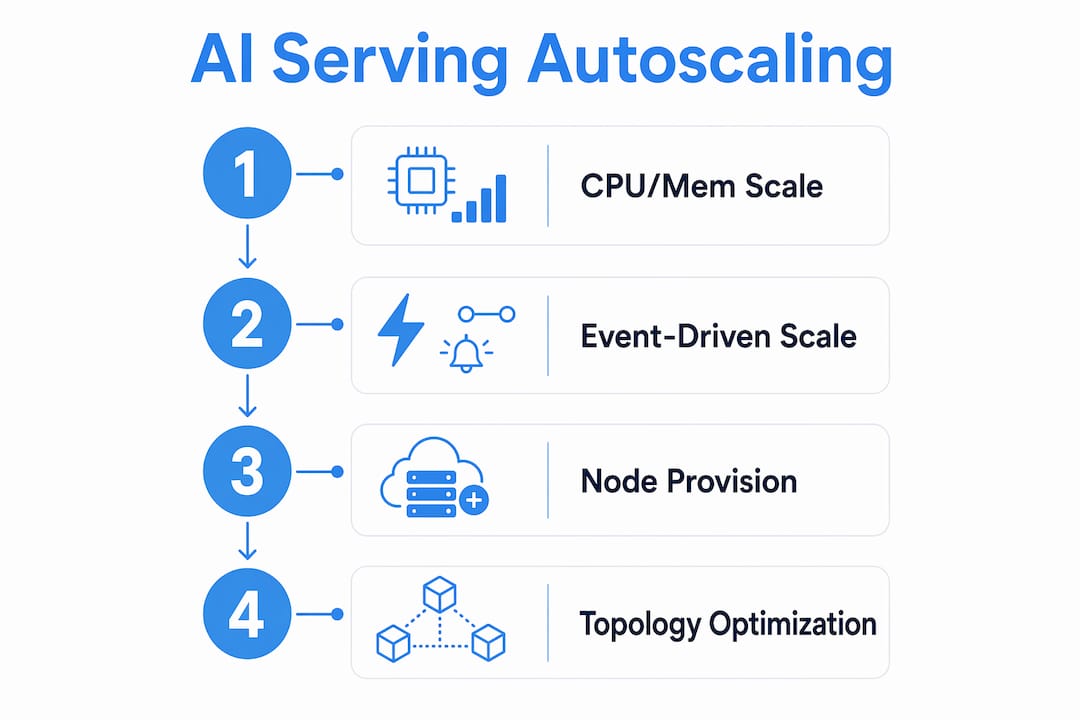
HPA scales inference pods based on CPU or memory utilization. For GPU inference, CPU metrics are a poor proxy for actual load. A model serving endpoint can be GPU-saturated while CPU remains low, causing HPA to under-scale. Teams address this by exposing custom metrics like requests-per-second or GPU utilization through Prometheus and feeding those into HPA's external metrics API.
KEDA solves the scale-to-zero problem. KEDA scales inference pods to zero during inactivity and triggers scale-up based on queue depth, HTTP request rate, or custom event sources. For generative AI endpoints that see bursty traffic patterns, KEDA's event-driven model fits better than HPA's polling-based approach.
| Mechanism | Trigger | Scale-to-zero | Best for |
|---|---|---|---|
| HPA | CPU/memory or custom metrics | No | Steady, predictable inference load |
| KEDA | Events, queues, HTTP rate | Yes | Bursty or intermittent inference traffic |
| Cluster Autoscaler | Pending pods | Node level | Homogeneous node groups |
| Karpenter | Pending pods | Node level | Mixed GPU instance types |
Karpenter provisions GPU nodes faster and more precisely than the traditional Cluster Autoscaler. It selects the optimal instance type per workload request rather than scaling a pre-defined node group. For teams running mixed GPU workloads, this bin-packing intelligence reduces wasted capacity significantly.
Pro Tip: Set KEDA's cooldownPeriod to at least 300 seconds for GPU inference deployments. GPU node provisioning takes 2 to 4 minutes, so aggressive cooldown periods cause repeated scale-down and scale-up cycles that waste provisioning time and increase latency for end users.
When should you choose Kubernetes for AI serving?
Kubernetes is not the right answer for every AI serving scenario. The operational complexity it introduces requires a team with Kubernetes expertise, and that expertise has real costs. For managing AI model servers at modest scale with a single model and no GPU sharing requirements, a managed cloud endpoint service delivers faster time-to-production with less overhead.
Kubernetes earns its complexity cost in these specific situations:
- Multi-team GPU sharing: Kueue's quota enforcement lets multiple teams share a GPU cluster without manual resource partitioning or billing disputes.
- Multi-model deployments: Running dozens of models on shared infrastructure requires the scheduling intelligence and namespace isolation that Kubernetes provides natively.
- Multi-cloud portability: Kubernetes abstracts away cloud provider specifics, letting you move serving workloads between AWS, GCP, and Azure without rewriting deployment configurations.
- Complex rollback requirements: KServe's traffic splitting and canary deployment features give you fine-grained control over model version transitions that managed services rarely match.
The maturity threshold matters too. Teams that have not yet built Kubernetes operational expertise should not start with a GPU-heavy AI serving cluster. The CNCF projects like KServe and DRA have reached production readiness, but operating them well still requires understanding pod scheduling, resource quotas, and network policies. For scaling AI model serving beyond a handful of endpoints, that investment pays off. Below that threshold, simpler managed services are the pragmatic choice.
Key Takeaways
Kubernetes delivers production-grade AI serving through GPU-aware scheduling, declarative lifecycle management with KServe, and layered autoscaling using KEDA and Karpenter.
| Point | Details |
|---|---|
| Kubernetes adoption for AI | 66% of organizations running generative AI inference use Kubernetes as of the 2026 CNCF survey. |
| GPU scheduling maturity | DRA and gang scheduling via Kueue remove the major friction points for multi-GPU AI workloads. |
| KServe and llm-d separation | Decoupling lifecycle management from runtime scheduling improves governance and independent component evolution. |
| Autoscaling layers | HPA, KEDA, and Karpenter each handle a different scaling dimension; all three are needed for full coverage. |
| When Kubernetes fits | Multi-team GPU sharing, multi-model deployments, and multi-cloud portability justify Kubernetes complexity. |
Why I think most teams adopt Kubernetes for AI serving too early
The 66% adoption figure is real, but it masks a quieter truth: a significant portion of those deployments are running at a scale where a managed cloud endpoint would have been faster, cheaper, and easier to maintain. I have seen teams spend three months building Kubernetes GPU infrastructure for a single model that serves a few hundred requests per day. That is not a Kubernetes problem. That is a scope problem.
The teams that get genuine value from Kubernetes for AI serving share one trait: they are managing complexity that no managed service can abstract away. Multiple models, multiple teams, multiple clouds, or inference workloads that require topology-aware GPU placement. When those conditions exist, Kubernetes pays for itself quickly. When they do not, you are paying the operational tax without collecting the benefit.
My advice is to adopt incrementally. Start with KServe and Kueue on a small cluster. Get comfortable with InferenceService manifests and quota enforcement before adding KEDA and Karpenter. Document every configuration decision. The teams that struggle most with Kubernetes AI serving are the ones who stood up a full production stack on day one and then could not explain why a pod was pending.
The 2026 tooling is genuinely good. KServe, llm-d, and DRA represent a real turning point. But good tooling does not replace operational discipline. Automate your GitOps pipeline, instrument your endpoints with Prometheus, and treat your serving configuration as code from day one.
— Kevin
Mlflow adds observability to your Kubernetes AI serving stack
Kubernetes handles orchestration. What it does not handle is understanding what your models are actually doing once they are running.
Mlflow fills that gap with production-grade LLM tracing and observability that captures agentic reasoning, token usage, and latency at every step of an inference chain. For teams running KServe endpoints at scale, Mlflow's AI observability platform provides the audit trail and performance visibility that Kubernetes metrics alone cannot deliver. Mlflow's LLM-as-a-Judge evaluation framework lets you continuously assess model output quality without manual review, closing the loop between deployment and reliability. When your serving infrastructure is Kubernetes-native, your evaluation and observability layer should be too.
FAQ
What is Kubernetes used for in AI model serving?
Kubernetes orchestrates containerized AI model serving workloads by managing GPU scheduling, pod autoscaling, and declarative model lifecycle through tools like KServe and Kueue. It provides the infrastructure layer that handles resource allocation, traffic routing, and multi-tenant isolation for inference at scale.
How does KEDA improve AI serving on Kubernetes?
KEDA enables event-driven autoscaling that scales inference pods to zero during inactivity and triggers scale-up based on queue depth or HTTP request rate. This makes it far more effective than HPA for bursty generative AI workloads where CPU metrics do not reflect actual GPU load.
What is KServe and why does it matter for AI deployment?
KServe is a Kubernetes-native model serving platform that uses the InferenceService custom resource to manage model lifecycle, traffic splitting, and autoscaling declaratively. It separates lifecycle governance from inference runtime execution, enabling GitOps workflows and independent component upgrades.
When should teams use Karpenter instead of Cluster Autoscaler?
Karpenter is the better choice for AI serving clusters with mixed GPU instance types because it provisions the optimal node type per workload rather than scaling a fixed node group. This reduces wasted GPU capacity and speeds up node provisioning compared to the traditional Cluster Autoscaler.
Is Kubernetes always the right choice for AI model serving?
Kubernetes adds clear value for multi-team GPU sharing, multi-model deployments, and multi-cloud portability, but managed cloud endpoints are simpler and faster for single-model, low-traffic use cases. The operational complexity of Kubernetes is only justified when the workload complexity demands it.