The Role of Open Source in Enterprise AI in 2026

Open source AI is defined as the practice of building, sharing, and deploying AI models and frameworks under licenses that allow inspection, modification, and redistribution of source code, weights, and training configurations. The role of open source in enterprise AI has shifted from experimental curiosity to production standard. Open-source AI adoption in large organizations has reached 89%, with deployments showing 25% higher ROI compared to closed-source stacks. That gap is not incidental. It reflects a structural advantage: enterprises that own their inference stack control their costs, their compliance posture, and their competitive differentiation. Platforms like MLflow and toolkits like Microsoft's Agent Governance Toolkit are the operational infrastructure making that ownership real.
Why open source is becoming the default for enterprise AI deployments
The economics are the first driver, but not the only one. Open source AI shifts competitive advantage away from the model itself and toward the platform and ecosystem built around it. That insight from Andreessen Horowitz reframes how enterprise architects should think about build-versus-buy decisions. Paying a proprietary vendor for model access means renting capability. Building on open weights means owning it.

The financial case compounds over time. Proprietary API costs scale linearly with usage. Open source inference, once deployed on your own infrastructure, scales at marginal cost. For enterprises running millions of inference calls per month across customer support, document processing, and internal automation, that difference is material.
Beyond cost, three strategic drivers are accelerating adoption:
- Technical sovereignty. You control the model version, the fine-tuning data, and the deployment environment. No vendor can deprecate your production model overnight.
- Supply chain transparency. Open weights and open code allow security teams to audit what is actually running, not just what a vendor claims is running.
- Avoiding vendor lock-in. Proprietary AI stacks create dependency on pricing, API contracts, and roadmap decisions you cannot influence.
The primary inference path for open source AI rose from 23% to 67% in a single year. That is not a trend. That is a market restructuring.
Pro Tip: When evaluating open source AI frameworks, prioritize those with active governance communities and published security advisories. A model with 50,000 GitHub stars and no CVE history is a stronger production candidate than a newer model with no disclosed vulnerability record at all.
Open source vs. proprietary AI: what enterprises actually need to compare
The comparison between open source and proprietary AI is not simply about cost or capability. It is about which model of control fits your organization's risk tolerance, regulatory environment, and engineering capacity.
| Dimension | Open Source AI | Proprietary AI |
|---|---|---|
| Time to first deployment | Longer (requires infra setup) | Faster (API-first, minimal setup) |
| Total cost at scale | Lower (marginal inference cost) | Higher (per-token or per-call pricing) |
| Transparency and auditability | Full (weights, code, architecture) | Limited (black box outputs) |
| Customization and fine-tuning | Unrestricted | Restricted or unavailable |
| Vendor dependency | None | High |
| Compliance documentation | Self-generated, auditable | Vendor-supplied, often opaque |
| Support and ecosystem maturity | Community plus commercial options | Vendor SLA |
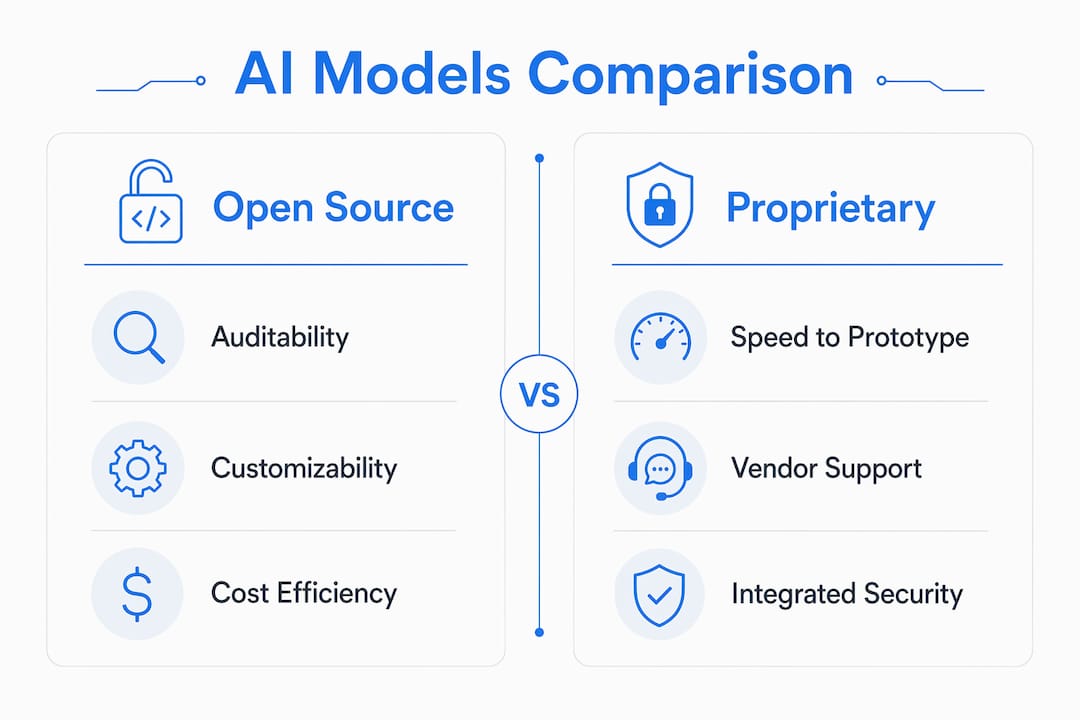
Proprietary AI wins on speed to prototype. If your team needs a working demo in 48 hours, a well-documented API beats standing up your own inference cluster. That advantage erodes quickly once you move toward production at scale.
Open source AI wins on every dimension that matters for long-term enterprise operations: auditability, modifiability, cost predictability, and regulatory defensibility. Red Hat frames this directly: open standards and vendor-neutrality are what move AI from experimentation to reliable enterprise systems. That framing matters because reliability is not a feature. It is a prerequisite for production.
The practical implication: most mature enterprises are running hybrid architectures. Proprietary APIs handle low-stakes, high-velocity tasks where speed matters more than auditability. Open source models handle regulated workflows, sensitive data processing, and any use case where you need to explain the model's decision to a regulator or a customer.
How do compliance and governance work in open source enterprise AI?
Governance is where many enterprise AI programs stall. Open source gives you transparency, but transparency alone does not satisfy a compliance questionnaire. You need runtime controls layered on top of model openness.
The EU AI Act enforces penalties up to €35 million or 7% of annual turnover for prohibited AI practices, with phased obligations running through August 2027. That timeline is active now. Enterprises deploying AI agents in customer-facing or high-risk decision contexts need documented risk management systems, not just open model weights.
The Microsoft AI Agent Governance Toolkit addresses this directly. Released in March 2026, it provides runtime policy enforcement, zero-trust identity management, and sandboxing that covers all 10 OWASP agentic risk categories. The key insight from that toolkit is that governance teams should treat model openness as one layer among many controls, not as a compliance solution by itself.
Effective compliance architecture for open source enterprise AI requires:
- Runtime enforcement. Sandboxing agent actions, enforcing identity-based access, and logging all model decisions with timestamps.
- Supply chain documentation. OWASP's SBOM-VEX-Taint-Analysis automates signed vulnerability exploitability exchange documents, reducing false positives and generating audit-grade evidence for each component in your AI stack.
- Human-in-the-loop approvals. For high-severity vulnerability claims, human approval is mandatory before a vulnerability is marked exploitable. Those decisions are signed and timestamped using tools like cosign and CycloneDX.
- Risk integration. OECD.AI notes that open-weight model transparency improves risk evaluation but requires embedding benefit and risk assessments into your enterprise risk management framework to address malicious use potential.
Pro Tip: Do not wait for your legal team to request compliance documentation. Build SBOM generation and VEX signing into your CI/CD pipeline from day one. Retroactive supply chain documentation is significantly harder to produce and significantly less credible to auditors.
Understanding AI model access control at the runtime level is the practical complement to model-level transparency. Both are required for a defensible compliance posture.
How do you operationalize open source AI in enterprise environments?
Moving from a proof of concept to a production open source AI deployment requires solving four distinct problems: infrastructure, integration, monitoring, and team readiness. Most enterprise AI programs underinvest in the last two.
Here is a practical sequence for operationalizing open source AI:
- Define your use cases by data sensitivity. Customer support automation, document classification, and internal knowledge retrieval have different data handling requirements. Map each use case to a risk tier before selecting a model.
- Select vendor-neutral infrastructure. Open source AI is production-grade when deployed on vendor-neutral, transparent architectures. Kubernetes-based inference clusters with standardized serving APIs give you portability across cloud providers.
- Instrument from the start. Deploy AI observability tooling before your first production request. Latency, token usage, error rates, and model drift are metrics you need from day one, not after your first incident.
- Standardize your evaluation pipeline. Use LLM-as-a-Judge frameworks to automate quality evaluation across model versions. This is what separates teams that iterate confidently from teams that deploy and hope.
- Build a shared development workspace. Collaborative AI workspaces that centralize experiment tracking, model versioning, and deployment artifacts reduce the coordination overhead that kills enterprise AI velocity.
The infrastructure and scalability requirements deserve specific attention. Open source inference at enterprise scale means GPU cluster management, model quantization decisions, and batching strategies. These are engineering problems, not AI problems. Your MLOps team needs to own them explicitly.
| Use Case | Recommended Open Source Approach | Key Metric to Monitor |
|---|---|---|
| Customer support automation | Fine-tuned open-weight LLM with RAG | Response accuracy, escalation rate |
| Document processing | Specialized extraction model plus pipeline | Extraction precision, processing latency |
| Internal knowledge retrieval | Embedding model plus vector store | Retrieval relevance, query latency |
| Code generation assistance | Code-specific open-weight model | Acceptance rate, security scan pass rate |
MLflow's AI Gateway provides the cross-provider governance layer that makes multi-model enterprise deployments manageable. Centralizing prompt management and routing through a single gateway gives you cost visibility, rate limiting, and audit logging without requiring each team to build those controls independently.
Key takeaways
Open source AI gives enterprises the transparency, control, and cost structure that proprietary models cannot match at production scale, but governance and runtime controls are what convert that openness into compliance.
| Point | Details |
|---|---|
| Adoption is past the tipping point | 89% of large organizations use open source AI, with 25% higher ROI than closed-source stacks. |
| Cost advantage compounds at scale | Open source inference costs are marginal once deployed; proprietary API costs scale linearly with usage. |
| Governance requires layered controls | Model transparency alone does not satisfy compliance. Runtime enforcement, SBOM documentation, and audit logs are all required. |
| EU AI Act deadlines are active | Penalties reach €35 million or 7% of turnover. Phased obligations run through August 2027. |
| Vendor-neutral platforms accelerate delivery | Tools like MLflow standardize lifecycle management, evaluation, and deployment across open source models. |
Why the open source AI debate is already settled for serious enterprises
I have watched the open source versus proprietary AI debate play out across dozens of enterprise contexts over the past several years, and my honest assessment is this: the debate is functionally over for any organization operating at scale in a regulated industry.
The teams still evaluating proprietary-only AI stacks are almost always optimizing for the wrong variable. They are measuring time to first demo, not total cost of ownership over three years. They are measuring vendor support SLAs, not the actual cost of being unable to audit a model decision when a regulator asks. The enterprises that moved early on open source AI are not just saving money. They are building institutional knowledge about model behavior, inference infrastructure, and evaluation methodology that their proprietary-dependent competitors simply do not have.
The compliance angle is where I see the most underestimation. The EU AI Act is not a future problem. It is a current operational requirement for any enterprise with European customers or operations. Open source AI, paired with proper runtime governance using tools like the Microsoft Agent Governance Toolkit and OWASP's supply chain frameworks, gives you a more defensible compliance posture than most proprietary vendors can provide. You can show an auditor exactly what is running, exactly what changed, and exactly who approved it.
My practical advice for enterprise decision-makers: stop treating open source AI as the budget option and start treating it as the control option. The cost savings are real, but the strategic value is in the auditability, the portability, and the ability to build compound institutional advantage over time. The organizations that will lead in AI over the next decade are the ones building on open foundations today.
— Kevin
How MLflow helps enterprises build on open source AI
MLflow is the open source platform purpose-built for the full lifecycle of enterprise AI, from experiment tracking through production agent deployment. We built MLflow to solve exactly the problems that make open source AI hard at scale: model versioning, evaluation standardization, observability, and cross-provider governance. The MLflow AI platform gives your teams a vendor-neutral foundation that works with the open source models you choose, not the ones a vendor wants to sell you. With production-grade LLM tracing, automated LLM-as-a-Judge evaluation, and a centralized AI Gateway for secure prompt management, MLflow turns open source AI from a promising experiment into a governed, auditable production system. Explore the full platform and see how your team can move faster with more control.
FAQ
What is the role of open source in enterprise AI?
Open source AI provides enterprises with modifiable, auditable, and cost-efficient AI frameworks that support scalable deployment without vendor lock-in. It gives organizations full control over model versions, inference infrastructure, and compliance documentation.
How does open source AI compare to proprietary AI for enterprises?
Open source AI offers lower total cost at scale, full transparency, and unrestricted customization, while proprietary AI offers faster initial setup and vendor-managed support. Most mature enterprises run hybrid architectures that use each approach where it fits best.
What governance tools work with open source enterprise AI?
The Microsoft AI Agent Governance Toolkit provides runtime policy enforcement covering all 10 OWASP agentic risks, while OWASP's SBOM-VEX-Taint-Analysis automates supply chain vulnerability documentation. Both integrate with open source AI deployments to satisfy compliance requirements.
How does the EU AI Act affect open source AI deployments?
The EU AI Act enforces penalties up to €35 million or 7% of annual turnover for prohibited AI practices, with obligations phased through August 2027. Open source AI deployments in high-risk categories require documented risk management systems and audit trails regardless of model licensing.
What platform supports open source AI lifecycle management for enterprises?
MLflow is a vendor-neutral open source platform that manages the full AI lifecycle including experiment tracking, model evaluation, observability, and agent deployment. It integrates with open source models and governance tools to support compliant enterprise AI operations.