Top LLM Observability Tools in 2026: A Pro Guide

Choosing the right observability platform for your LLM deployments has become one of the most consequential infrastructure decisions an AI team can make. The top LLM observability tools in 2026 have matured significantly, but the gap between teams using production-grade monitoring and those flying blind is widening fast. 73% of enterprises require AI agent monitoring in production, yet 63.4% cite a lack of adequate observability tooling as a major barrier. This guide cuts through the noise and gives you the detailed breakdown you need to choose wisely.
Table of Contents
- Key takeaways
- What to look for in top LLM observability tools in 2026
- 1. MLflow
- 2. LangSmith
- 3. Arize Phoenix
- 4. Langfuse
- 5. Helicone
- 6. AgentOps
- 7. TruLens
- 8. Braintrust
- 9. Portkey
- 10. Comet Opik
- Head-to-head comparison of top tools
- How to choose the right LLM observability tool for your team
- My honest take on where LLM observability is heading
- See MLflow's observability platform in action
- FAQ
Key takeaways
| Point | Details |
|---|---|
| MLflow leads in 2026 | MLflow offers end-to-end agent observability with prompt versioning, trace replay, and LLM-as-a-Judge evaluation in one platform. |
| Trace-level replay is non-negotiable | Traditional logs cannot reproduce non-deterministic LLM failures; span-based trace replay is now a baseline requirement. |
| Behavioral plus reasoning monitoring | Combining both analysis types increases threat detection accuracy by 35% compared to behavior monitoring alone. |
| Open-source vs. SaaS trade-offs matter | Self-hosted tools give data control; SaaS platforms reduce ops overhead. Match the model to your team's maturity. |
| Pilot before committing | Run a two-week pilot on a single agent workflow before rolling out any observability platform organization-wide. |
What to look for in top LLM observability tools in 2026
Not every monitoring tool built for traditional software translates cleanly to LLM production environments. The non-deterministic nature of large language models demands a different set of capabilities entirely.
Here are the features that separate adequate tools from genuinely useful ones:
- Distributed tracing with span hierarchies. Distributed tracing spans wrapping LLM calls, tool invocations, retrievals, and internal reasoning steps are foundational. Without this, you cannot reconstruct what an agent actually did during a multi-step task.
- Trace-level replay for debugging. Traditional log-based debugging is insufficient for LLMs. You need exact reproduction of call sequences and tool invocations to diagnose failures in non-deterministic systems.
- Behavioral and reasoning monitoring together. Analyzing only what an agent did misses why it did it. Combining both layers delivers a 35% boost in detection accuracy and is 4x more likely to catch nuanced attacks in autonomous agent deployments.
- Prompt versioning and A/B testing. Minor prompt wording changes in production can silently degrade quality or trigger unauthorized tool usage. Versioning and controlled rollout are not optional features.
- Latency profiling and cost controls. Per-call token cost tracking, latency breakdowns by model and retrieval step, and configurable circuit breakers protect both your budget and your SLAs.
- OpenTelemetry-based SDKs. Practitioners recommend using OpenTelemetry SDKs over manual monkey-patching or mocks for reliable streaming trace reconstruction, especially as your agent codebase evolves.
- Ecosystem integrations. Native support for LangChain, LlamaIndex, OpenAI, Anthropic, and your existing ML stack reduces friction at every layer of the deployment pipeline.
Pro Tip: Before evaluating any tool, map out your agent's call graph on paper first. Knowing exactly which spans you need to capture will tell you immediately whether a given SDK covers your architecture or leaves gaps.
1. MLflow
MLflow is our top pick for 2026, and the gap between it and the field has grown considerably over the past year. As a comprehensive LLM observability platform, MLflow captures inputs, outputs, prompt versions, and step-by-step execution traces across the full agent workflow lifecycle.

What sets MLflow apart is the depth of its end-to-end coverage. You get production-grade tracing of agentic reasoning, automated evaluation using LLM-as-a-Judge frameworks, and a centralized AI Gateway for secure prompt management and cross-provider governance. These are not bolt-on features. They are first-class citizens in the platform architecture.
Key capabilities that matter in production:
- Prompt versioning and A/B testing. MLflow's prompt A/B testing in production lets you compare prompt variants under real traffic conditions without deploying a separate experimentation framework.
- LLM-as-a-Judge evaluation. The built-in evaluation framework supports hallucination detection, groundedness scoring, and custom rubrics. You can run automated quality gates before promoting a new model or prompt version.
- Deep agent tracing. Every sub-agent call, tool invocation, and retrieval step is captured as a structured span. Trace replay lets you reproduce exact failure sequences without guessing.
- Open-source foundation with enterprise support. The core platform is Apache 2.0 licensed, which means no vendor lock-in and full auditability of the tracing logic itself.
- Broad ecosystem compatibility. MLflow integrates natively with LangChain, LlamaIndex, OpenAI, Anthropic, and Hugging Face, so it slots into existing stacks without requiring a full rewrite.
Pro Tip: Use MLflow's agent evaluation framework to set automated quality thresholds on your traces. Tie these thresholds to your CI/CD pipeline so that a prompt regression blocks deployment before it reaches production.
The open-source community and enterprise backing together create an ecosystem that no single-purpose tool can match. For teams managing complex GenAI workflows at scale, MLflow is the most complete solution available.
2. LangSmith
LangSmith is the natural choice for teams already deep in the LangChain ecosystem. It provides tight integration with LangChain primitives and offers a polished UI for trace inspection, dataset management, and evaluation runs. The platform excels at prompt playground workflows where you want to iterate quickly and compare outputs across model versions. Its main limitation is that it is most useful within the LangChain world. Teams running heterogeneous agent stacks with custom orchestration will find the integration surface narrower than MLflow's.
3. Arize Phoenix
Arize Phoenix targets teams doing serious retrieval-augmented generation work. Its RAG debugging features are among the best available, with built-in support for embedding drift detection, retrieval relevance scoring, and document-level attribution. If your primary challenge is understanding why your retrieval pipeline is returning poor context rather than why your agent is misbehaving, Phoenix deserves a close look. It also offers a local open-source mode, which makes it accessible for teams that cannot send traces to a third-party cloud.
4. Langfuse
Langfuse has positioned itself as the self-hosted analytics platform for teams with strict data residency requirements. Version 4 introduced OpenTelemetry-based tracing for local LLMs without requiring mocks or monkey-patching, which is a meaningful improvement for teams running Ollama or other local inference setups. The platform covers session tracking, cost analytics, and user-level feedback collection. Its open-source license and Docker-based deployment make it a strong fit for European enterprises navigating GDPR constraints.
5. Helicone
Helicone takes a deliberately lightweight approach. It operates as a proxy layer in front of your LLM API calls, which means instrumentation is a single endpoint change rather than an SDK integration. This makes it exceptionally fast to deploy. You get request logging, cost tracking, rate limiting, and caching out of the box. For teams that need basic 2026 LLM performance tracking without the overhead of a full observability platform, Helicone covers the fundamentals well. It is not designed for deep agent reasoning analysis, but for straightforward API monitoring it is hard to beat for speed of setup.
6. AgentOps
AgentOps focuses specifically on autonomous AI agent monitoring, which makes it one of the more specialized tools on this list. It tracks agent session lifecycles, records every tool call and decision point, and provides replay capabilities for multi-agent workflows. The platform also includes cost attribution at the agent level, so you can identify which agents in a multi-agent system are consuming disproportionate resources. Teams building with CrewAI or AutoGen will find native integrations that reduce instrumentation time significantly.
7. TruLens
TruLens is evaluation-first by design. Rather than prioritizing real-time monitoring, it focuses on structured feedback collection and quality scoring across LLM pipelines. Its TruLens Eval framework supports groundedness, context relevance, and answer relevance metrics out of the box. For teams that need to run systematic quality audits on RAG pipelines before and after model updates, TruLens provides a rigorous framework. It pairs well with MLflow when you want evaluation results stored alongside your experiment tracking data.
8. Braintrust
Braintrust occupies a similar evaluation-focused niche but adds a collaborative dataset management layer. Teams can curate golden datasets, run evals against them on a schedule, and track score regressions over time in a shared workspace. The platform is particularly strong for teams where product managers and domain experts need to participate in quality review alongside engineers. Its scoring interface is accessible enough for non-technical stakeholders while still exposing the raw trace data that engineers need.
9. Portkey
Portkey functions as an AI gateway with observability layered on top. It supports multi-provider routing, fallback logic, and load balancing across OpenAI, Anthropic, Cohere, and others, all with unified logging. For teams managing AI networking challenges in decentralized systems, Portkey's provider-agnostic architecture reduces the complexity of monitoring calls across multiple LLM backends. It is particularly useful in cost optimization scenarios where you want to route requests to cheaper models for lower-stakes tasks automatically.
10. Comet Opik
Comet's LLM observability offering, Opik, extends the company's existing experiment tracking heritage into the GenAI space. It supports trace logging, prompt management, and evaluation scoring with a familiar interface for teams already using Comet for traditional ML experiments. The integration story is strongest for teams that want a single platform spanning classical ML model tracking and LLM observability without maintaining two separate systems.
Head-to-head comparison of top tools
| Tool | Open Source | Best For | Prompt Versioning | Agent Tracing | Pricing Model |
|---|---|---|---|---|---|
| MLflow | Yes | End-to-end GenAI lifecycle | Yes | Deep, with replay | Free / Enterprise |
| LangSmith | No | LangChain-native teams | Yes | Good | Usage-based SaaS |
| Arize Phoenix | Yes (local) | RAG debugging | Limited | Moderate | Free / Cloud SaaS |
| Langfuse | Yes | Self-hosted analytics | Yes | Moderate | Free / Cloud SaaS |
| Helicone | No | Lightweight API monitoring | No | Minimal | Usage-based SaaS |
| AgentOps | No | Autonomous agent sessions | Limited | Strong | Usage-based SaaS |
| TruLens | Yes | Evaluation auditing | No | Moderate | Free |
| Braintrust | No | Collaborative eval datasets | Limited | Moderate | Usage-based SaaS |
| Portkey | No | Multi-provider gateway | No | Minimal | Usage-based SaaS |
| Comet Opik | Partial | ML + LLM unified tracking | Yes | Moderate | Free / Enterprise |
The table makes one pattern clear: MLflow is the only tool that combines open-source licensing, deep agent tracing with replay, prompt versioning, and automated evaluation in a single platform. Every other tool either specializes in one dimension or requires a commercial SaaS dependency.
How to choose the right LLM observability tool for your team
The best AI observability solutions in 2026 are only as useful as your team's ability to act on what they surface. Start by honestly assessing where your monitoring maturity sits today.
If you are moving from zero observability to basic logging, a lightweight proxy like Helicone gets you cost and latency visibility in under an hour. If you are running multi-step agent workflows in production and need to debug non-deterministic failures, you need trace-level replay and span hierarchies from day one. That narrows the field considerably.
A few practical considerations:
- Data residency. If your organization has strict data governance requirements, self-hosted tools like MLflow or Langfuse are the only viable options. Sending production traces to a third-party SaaS may violate compliance requirements.
- Stack compatibility. Check whether the tool's SDK covers every framework in your agent stack before committing. A tracing gap in one sub-agent can make the entire trace unreliable.
- Team size and ops capacity. Self-hosted platforms give you full control but require someone to maintain the infrastructure. Smaller teams often do better starting with a managed SaaS option and migrating later.
- Emerging AI-native observability. AI-native observability platforms now incorporate autonomous SRE agents that proactively diagnose and remediate production issues. Tracking this category is worth your time even if you are not ready to adopt it yet.
Pro Tip: Run a two-week pilot on a single, well-understood agent workflow before rolling out observability organization-wide. Instrument one workflow end-to-end, identify at least three traces that would have been impossible to debug without the tool, and use those examples to build internal buy-in for broader adoption.
My honest take on where LLM observability is heading
I've spent considerable time working with teams that deployed LLMs confidently and then discovered, months later, that silent regressions had been degrading output quality the entire time. The common thread is always the same: they trusted staging environments too much and underestimated how much production traffic reveals about agent behavior.
The tools that impress me most in 2026 are the ones that treat non-deterministic agent behavior as the primary design constraint rather than an edge case. MLflow stands out here because its architecture was built around the full GenAI lifecycle. It does not feel like a traditional ML tracking tool with LLM features bolted on. The prompt versioning, trace replay, and LLM-as-a-Judge evaluation work together in a way that genuinely changes how you debug production agents.
What I find underappreciated is the security angle. Combining behavioral analysis with reasoning trace analysis is not just a debugging technique. It is a security posture. The fact that reasoning analysis adds 35% accuracy over behavior monitoring alone should be enough to make every team running autonomous agents reconsider their current setup.
My advice: invest in observability before you think you need it. The cost of retrofitting trace instrumentation into a production agent system is always higher than the cost of building it in from the start.
— Kevin
See MLflow's observability platform in action
If the criteria and comparisons above point toward a platform that handles the full GenAI lifecycle without forcing you to stitch together three separate tools, MLflow is worth exploring directly.
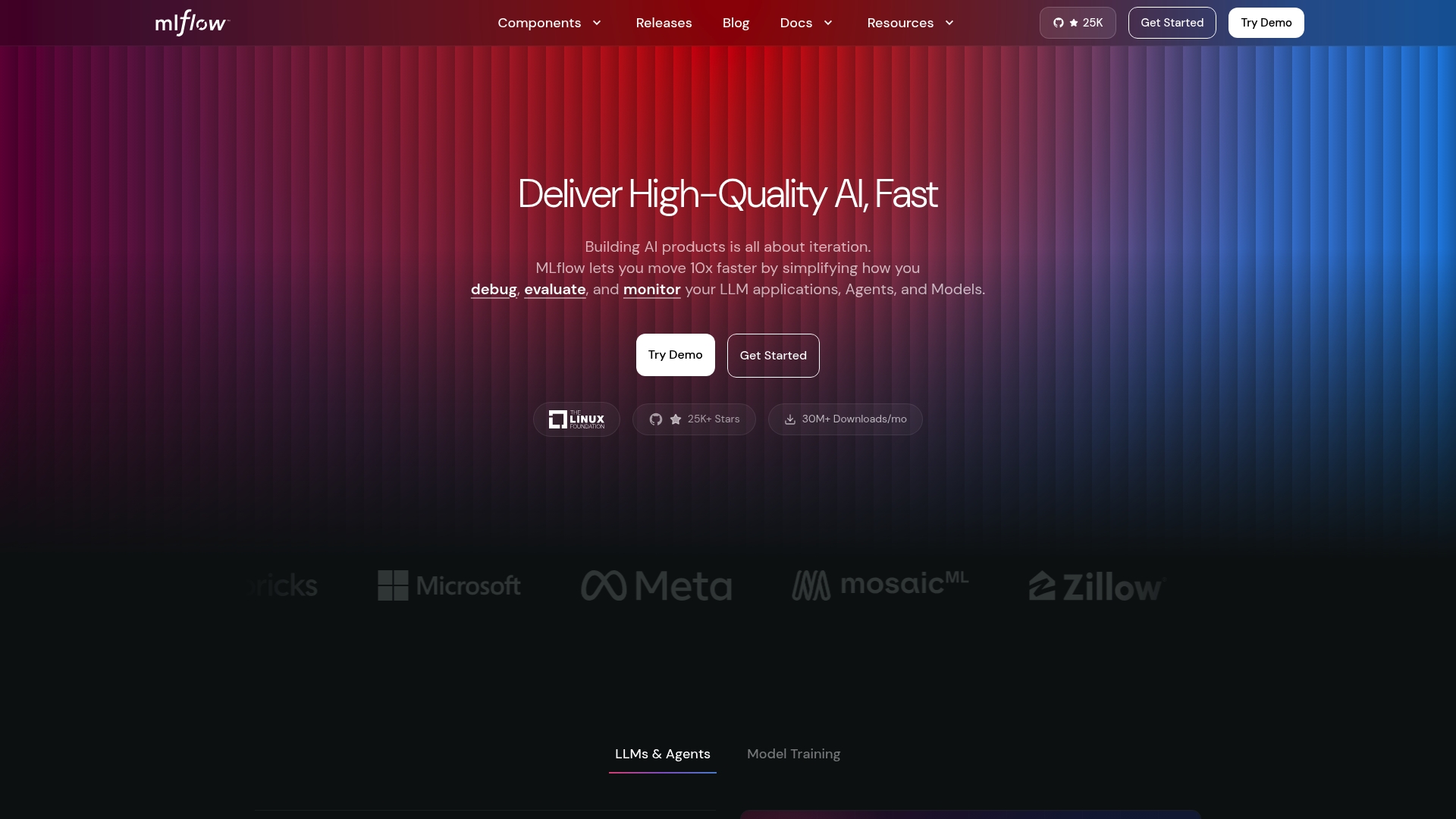
MLflow's LLM and agent observability features cover distributed tracing, prompt versioning, automated evaluation, and trace replay in a single open-source platform. The Apache 2.0 license means you can self-host with full auditability, and the enterprise tier adds managed infrastructure and priority support for teams operating at scale. You can also explore the broader MLflow AI platform to see how observability connects to evaluation, prompt engineering, and agent deployment in one integrated workflow. The community is active, the documentation is thorough, and getting your first traces instrumented takes less time than you might expect.
FAQ
What are the top LLM observability tools in 2026?
MLflow leads the field for end-to-end GenAI lifecycle management, followed by LangSmith for LangChain teams, Arize Phoenix for RAG debugging, Langfuse for self-hosted analytics, and AgentOps for autonomous agent monitoring.
How do I monitor LLM outputs in production?
Use a platform with distributed span-based tracing that captures inputs, outputs, tool calls, and retrieval steps. MLflow and Langfuse both support production-level prompt monitoring with version control to catch silent regressions.
What is the difference between LLM monitoring and LLM observability?
Monitoring tracks predefined metrics like latency and cost. Observability goes further by capturing the full execution trace of an agent workflow, enabling you to reconstruct and debug any failure, including non-deterministic ones that logs alone cannot explain.
Is open-source LLM observability good enough for production?
Yes, for most teams. MLflow's open-source tier covers tracing, evaluation, and prompt versioning at production scale. The main reason to consider an enterprise tier is managed infrastructure, SLA guarantees, or compliance reporting requirements.
Why is staging environment testing not enough for LLM agents?
Because LLM behavior is non-deterministic, minor prompt changes in production can silently degrade quality or trigger unauthorized tool usage in ways that staging environments cannot replicate. Production-level monitoring is the only reliable safety net.