Multi-Region AI Deployment: A Guide for Cloud Architects

Multi-region AI deployment means running inference and associated AI services — model endpoints, vector stores, feature pipelines, and gateways — across two or more geographic regions simultaneously. The industry term you'll see in provider docs is geographically distributed inference, though "multi-region AI deployment" has become the practical shorthand for the full architecture pattern.
Choose it when at least one of these conditions is true:
- Data residency requirements (GDPR, HIPAA, or the EU AI Act) prohibit processing user data outside a specific jurisdiction, and a single-region deployment cannot satisfy that constraint.
- Latency SLAs below 100ms for users distributed across continents, where a single region adds 150ms or more of network overhead.
- Contractual uptime of 99.99% or higher, where a regional cloud outage would breach your SLA without automatic failover.
The trade-off is real: multi-region deployments typically carry a significantly higher infrastructure cost than their single-region equivalents, plus meaningful operational overhead in model synchronization, observability, and compliance auditing. Mlflow's centralized model registry, LLM-as-a-Judge evaluation, and AI Gateway are designed specifically to reduce that operational burden across regions. AI Coding Guild's practitioner analysis makes the case plainly: most applications do not need multi-region, and teams should validate the justification before committing.
Key Takeaways
| Point | Details |
|---|---|
| Validate before committing | Confirm residency, latency, or uptime requirements exist before accepting the significant cost premium of multi-region. |
| Match pattern to driver | Use regional sharding for compliance, active-passive for DR, and active-active only when latency and uptime both require it. |
| Deploy observability first | Instrument per-region latency, error rates, and model output drift before routing production traffic to a new region. |
| Treat parity as a hard gate | Never promote a model to all regions simultaneously; use per-region validation gates to prevent silent output divergence. |
| Mlflow for unified control | Mlflow's model registry, LLM-as-a-Judge evaluation, and AI Gateway reduce the operational overhead of cross-region promotion and compliance auditing. |
Table of Contents
- Why do AI systems need multiple regions?
- What architecture patterns work best for AI systems?
- How should you replicate models and data across regions?
- How do you route requests and handle failover across regions?
- Step-by-step checklist for deploying AI across regions
- How do you monitor model parity and test across regions?
- What does multi-region AI actually cost?
- How do Azure, AWS, and GCP handle multi-region AI?
- How Mlflow reduces risk in multi-region deployments
- The operational reality most teams learn the hard way
- Mlflow makes multi-region AI deployments tractable
- Sources
Why do AI systems need multiple regions?
Four drivers push teams toward a multi-region AI strategy, and understanding which one applies to your product determines both the architecture pattern and the acceptable cost ceiling.
Availability and disaster recovery is the most common stated reason, but it's often the weakest justification on its own. A well-designed single-region deployment with multi-AZ redundancy handles most failure scenarios. Multi-region becomes necessary only when a full regional cloud outage would violate your SLA — a scenario that is rare but catastrophic when it occurs. A global support assistant serving enterprise customers across the U.S. and Europe, for example, cannot afford a four-hour outage window even if the probability is low.
Latency and performance is the driver with the clearest engineering signal. If your P95 inference latency from a U.S.-East endpoint to users in Singapore or Frankfurt exceeds your product's threshold, a regional endpoint in APAC or EU-West is the correct fix. A CDN can cache static assets, but it cannot cache a live LLM inference call. Financial trading systems and real-time agent pipelines are the canonical cases here.
Data residency and compliance is the driver that must be treated as a hard constraint from day one. GDPR requires that EU personal data not be processed outside the EU without adequate safeguards. The EU AI Act adds further requirements for high-risk AI systems. Healthcare inference pipelines in the U.S. face HIPAA's data-handling rules. Generic API routing often cannot guarantee processing location for these regimes — you need region-pinned endpoints and verifiable audit trails.
Regulatory SLAs apply to financial services, government contracts, and critical infrastructure, where uptime and geographic processing requirements are written into contracts or regulations rather than chosen by the engineering team.
Before committing to multi-region, run this decision checklist:
- Are more than 20% of your users located more than 150ms of network latency from your current region?
- Does any applicable regulation prohibit cross-border data processing for your use case?
- Is your contractual uptime requirement above 99.9%?
- Does your team have the operational capacity to manage model sync, per-region CI/CD, and cross-region observability?
If you answer "no" to all four, a CDN plus single-region with multi-AZ redundancy is almost certainly the right call. Multi-region to hedge against traffic spikes is a particularly common misuse — horizontal scaling within a region handles that more cheaply.
What architecture patterns work best for AI systems?
Five patterns cover the realistic design space for AI deployment across regions. Each has a distinct availability, consistency, latency, and cost profile.
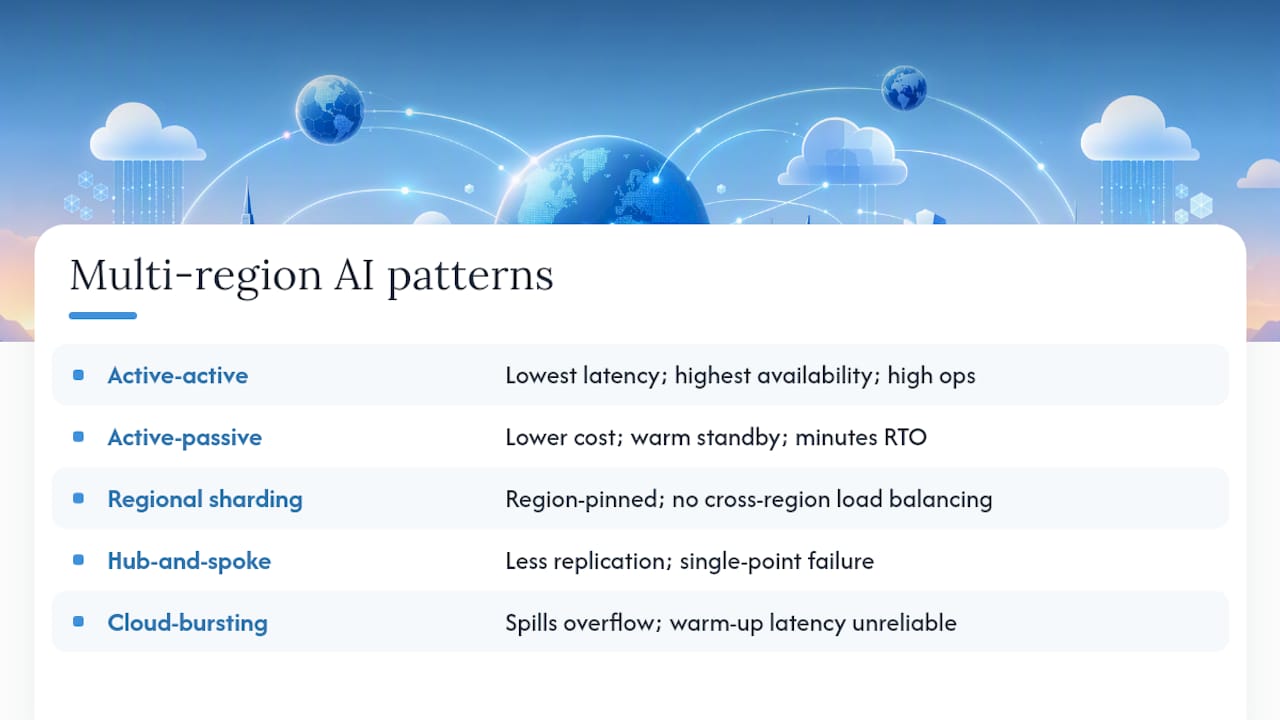
Active-active runs full inference capacity in every region simultaneously, with traffic load-balanced across all of them. Every region serves production traffic and can absorb the full load if another region fails. This pattern delivers the lowest latency and highest availability, but it requires conflict-resolution logic for any stateful data, full model replication across all regions, and the highest operational complexity. Agent fleets serving global enterprise customers are the primary use case. AgentMarketCap's engineering analysis recommends combining data-locality constraints with active-active and using Temporal on Kubernetes or durable queues for reliable cross-region orchestration.
Active-passive designates one region as primary and one or more as warm standbys. The passive region receives replicated data and model artifacts but serves no production traffic until failover. Recovery time objective (RTO) is typically measured in minutes rather than seconds. This pattern costs significantly less than active-active and suits teams that need DR coverage without the complexity of distributed state management.
Regional sharding (data-locality) assigns users to a specific region based on their data residency requirements and keeps them pinned there. EU users always hit the EU region; U.S. users always hit U.S.-East. There is no cross-region load balancing. This is the correct pattern when compliance is the primary driver, not latency or availability.
Hub-and-spoke runs a central control plane (model registry, evaluation, gateway policy) in one region and deploys lightweight inference endpoints in spoke regions. The hub handles orchestration; spokes handle inference. This reduces replication complexity but introduces a single point of failure in the hub unless the hub itself is multi-AZ.
Cloud-bursting keeps the primary deployment in one region and spills overflow traffic to a secondary region or provider during peak load. This is rarely the right choice for AI systems because model warm-up latency makes burst capacity unreliable for inference.
Pro Tip: Start with provider regional endpoints before building your own gateway. Most cloud providers offer regional LLM endpoints with built-in latency routing and failover. Introduce an in-region gateway only when you need cross-provider failover, residency pinning beyond what the provider guarantees, or unified policy enforcement across multiple model providers. AI-TLDR's staged adoption guidance describes this progression clearly.
For orchestration, the control-plane decision matters as much as the inference pattern. A single centralized gateway simplifies policy enforcement but adds cross-region latency for every request. Thin regional gateways reduce latency but require synchronized configuration. Provider regional endpoints are the lowest-friction starting point.
How should you replicate models and data across regions?
Replication strategy depends on what you're replicating. Model artifacts, feature stores, vector stores, user data, and telemetry each have different consistency requirements and compliance constraints.

| Replication Target | Recommended Strategy | Consistency Model | Key Trade-off |
|---|---|---|---|
| Model artifacts (weights, configs) | Central registry + regional cache; CI/CD-triggered sync | Eventual (promote after validation) | Stale model risk during rollout windows |
| Feature stores | Read replicas per region; primary in home region | Strong (primary) / Eventual (replicas) | Replication lag can cause stale feature reads |
| Vector stores | Per-region stores for residency; global store for shared knowledge | Eventual | Per-region stores reduce hit rates on smaller populations |
| User data | Region-pinned; no cross-region replication for residency-bound users | Strong (single region) | No failover for residency-bound users |
| Logs and telemetry | Aggregate to central store; tag with region and provider | Eventual | Egress cost for high-volume inference logs |
MongoDB Atlas's architecture documentation describes active-passive and active-active replication paradigms in detail, including the consistency trade-offs that apply directly to feature store and user data replication.
For model artifacts specifically, the most reliable pattern is a central model registry (Mlflow's registry works well here) that triggers regional promotion via CI/CD after per-region validation gates pass. Never promote a model to all regions simultaneously without per-region smoke tests — a bad quantization or a misconfigured serving container will surface differently across hardware SKUs.
Active-passive replication promotes simplicity: the passive region receives a continuous stream of replicated data but never writes independently, so there is no conflict resolution to manage. Active-active requires eventual consistency and a conflict resolution strategy for any mutable state. For most AI systems, user preferences and session state are the mutable data that causes problems; model weights are immutable once promoted.
Security controls apply uniformly: encrypt all artifacts at rest (AES-256) and in transit (TLS 1.3), use region-specific KMS keys where residency requires it, and never route residency-bound data through a region outside the permitted jurisdiction even for logging.
How do you route requests and handle failover across regions?
Routing primitives fall into four categories, and most production deployments combine two or three of them.

GeoDNS and latency-based DNS resolve a single hostname to the nearest healthy regional endpoint based on the client's IP geolocation or measured round-trip time. This is the lowest-complexity starting point. AWS Route 53 latency-based routing and Azure Traffic Manager's performance routing method both implement this pattern. Azure Traffic Manager's routing documentation covers performance, priority, and geographic routing methods — geographic routing is the correct choice when residency pinning is required, not performance routing.
Anycast routes packets to the nearest point of presence at the network layer. Cloudflare Workers and similar edge platforms use Anycast natively. For AI inference, Anycast is most useful at the edge proxy layer, not at the model endpoint layer.
Global load balancers operate at Layer 7 and can make routing decisions based on HTTP headers, path, and health check results. Azure Front Door provides global HTTP/HTTPS load balancing with SSL termination and automatic failover. AWS Global Accelerator and GCP's global load balancer offer equivalent capabilities.
Edge proxies and gateways (including LiteLLM deployed at the edge) add model-aware routing: they can select a provider or region based on model availability, cost, or latency, and implement circuit breakers when a regional endpoint degrades.
For failover, define your RTO and RPO before choosing a health check interval. A 30-second health check interval with a 3-failure threshold gives you roughly 90 seconds before traffic shifts — acceptable for active-passive DR, too slow for active-active SLA compliance. Test your failover path before you need it:
- Run synthetic health checks from each region to every other region.
- Simulate a regional failure in staging by blocking traffic at the load balancer level.
- Verify that residency-pinned users do NOT fail over to an out-of-jurisdiction region — this is a legal boundary, not a UX preference.
- Measure actual RTO under load, not just in an idle environment.
For residency-bound users, the failover decision is a legal one. If EU data cannot leave the EU, a U.S. failover region is not an option regardless of availability. Design your passive region within the same jurisdiction.
Step-by-step checklist for deploying AI across regions
Follow this sequence. Each step has a verification gate before you proceed.
-
Validate the need. Confirm at least one of the four drivers (residency, latency SLA, uptime SLA, regulatory mandate) applies. Document the specific requirement and the metric that proves single-region cannot satisfy it.
-
Select your architecture pattern. Choose active-active, active-passive, regional sharding, or hub-and-spoke based on the primary driver. Document the RTO/RPO targets and the consistency model you'll accept.
-
Provision networking. Create VPCs or VNets in each target region. Configure VNet peering (Azure) or VPC peering (AWS/GCP) for private cross-region connectivity. Set up Private Link or PrivateEndpoints for model provider traffic so inference calls never traverse the public internet.
-
Configure DNS and global routing. Set up latency-based or geographic DNS routing. For Azure, configure Traffic Manager or Front Door. For AWS, configure Route 53 with latency or geolocation routing policies. Define health check endpoints for each regional deployment.
-
Deploy regional inference endpoints. Provision model endpoints in each region. For SageMaker, create regional endpoint configurations. For Azure AI, deploy to the target region's resource group. For GCP Vertex AI, select the regional endpoint. Validate that each endpoint returns correct responses before enabling routing.
-
Deploy vector stores and feature stores. Provision per-region vector stores if residency requires it, or configure read replicas from a primary store. Verify replication lag is within acceptable bounds for your use case.
-
Configure storage replication. Enable cross-region replication for model artifact storage (S3 CRR, Azure Blob geo-replication, GCS multi-region buckets). Verify that replication is complete before promoting a new model version.
-
Set up monitoring and alerting. Deploy per-region observability (latency P50/P95/P99, error rates, throughput). Configure cross-region dashboards. Set alert thresholds before enabling production traffic.
-
Run validation and canary rollout. Send 1–5% of production traffic to the new region. Compare outputs against the primary region using automated parity tests. Promote to full traffic only after parity is confirmed. For IaC references, the Azure AI docs GitHub repository contains Bicep examples for multi-region search deployments.
How do you monitor model parity and test across regions?
Observability in a multi-region AI deployment has to go beyond infrastructure metrics. You need signals that tell you whether the model is behaving consistently across regions, not just whether the endpoint is up.
Key signals to instrument per region:
- Inference latency: P50, P95, and P99 broken down by region and model version. A P99 spike in one region that doesn't appear in another is often a hardware or container configuration issue, not a network problem.
- Error rates: 4xx (client errors, often prompt-related) and 5xx (server errors, often capacity or model-loading issues) per region.
- Model output drift: Compare token distributions, response length distributions, and embedding similarity scores across regions for the same prompt set. Divergence signals a model version mismatch or a quantization difference.
- Per-region cost telemetry: Token consumption and compute cost per region, tagged by model version and request type.
Pro Tip: Tag every inference request with the serving region and model version at the gateway layer, not at the application layer. This makes logs, billing records, and compliance traces auditable without requiring application-level changes. Mlflow's AI observability features support region-tagged tracing natively.
The testing playbook for model parity works in three layers. First, run a fixed synthetic prompt suite against every region after each deployment and compare outputs using an automated LLM-as-a-Judge evaluation. Third, run periodic cross-region consistency checks on a weekly cadence using a held-out evaluation set. Mlflow's automated LLM-as-a-Judge framework handles the second and third layers well, producing per-region evaluation scores that surface parity gaps before they reach users. For deeper context on observing multi-agent systems, Mlflow's engineering blog covers tracing agentic reasoning across distributed deployments.
When a parity gap appears, the most common causes are: a model version that promoted to one region but not another, a quantization difference between regional hardware SKUs, or a prompt template that was updated in one region's serving configuration but not replicated. Per-region blue-green deployments with validation gates catch the first two; configuration-as-code with CI/CD sync catches the third.
What does multi-region AI actually cost?
Cost is where multi-region deployments most often surprise teams. The infrastructure bill is visible; the operational overhead is not.
| Cost Driver | Active-Active | Active-Passive | Notes |
|---|---|---|---|
| Compute (inference endpoints) | 2x+ baseline | 1.3x baseline | Passive region runs at reduced capacity |
| Cross-region data egress | High (all regions) | Low (replication only) | Egress rates vary by provider and region pair |
| Storage replication | 2x+ storage cost | 2x storage cost | Depends on artifact size and replication frequency |
| CI/CD and monitoring | Moderate increase | Small increase | Per-region pipelines and dashboards |
| Operational staffing | Significant | Moderate | On-call coverage, incident response, parity audits |
AgentMarketCap's analysis of multi-region agent deployments puts a significant infrastructure premium above a single-region baseline, with additional engineering time required for orchestration, circuit breakers, and parity validation.
The staffing cost is the one teams consistently underestimate. Running active-active across three regions requires on-call engineers who understand the full distributed system, not just the model. A parity incident at 2 AM requires someone who can read cross-region traces, compare model versions, and roll back a regional deployment without taking down the others.
Cost-control tactics that work in practice:
- Use tiered model sizing: run a smaller, faster model in secondary regions for latency-sensitive paths and reserve the full model for complex requests routed to the primary region.
- Cache aggressively at the regional level. Per-region caches built on smaller traffic populations have lower hit rates than a single large cache, so tune TTLs carefully and monitor hit rates per region.
- Use read replicas for feature data rather than full active-active replication for non-critical features.
- Shape traffic so that non-latency-sensitive batch workloads run only in the primary region.
The decision threshold: if the cost of a regional outage (SLA penalties, lost revenue, compliance fines) exceeds the a significant infrastructure premium over a 12-month horizon, active-active is justified. Otherwise, active-passive gives you most of the DR benefit at a fraction of the cost.
How do Azure, AWS, and GCP handle multi-region AI?
Each major cloud provider has a distinct set of primitives for multi-region AI deployment. Here's where to start with each.
Azure offers the most integrated path for AI Search specifically. Azure AI Search supports synchronized indexes across multiple regions, routing users to the nearest healthy replica automatically. For inference, combine Azure AI Studio regional deployments with Front Door for global load balancing and Traffic Manager for geographic routing. The Azure AI docs GitHub repository contains Bicep templates for multi-region search patterns.
AWS has the most mature CI/CD story for model endpoints. SageMaker supports multi-region endpoint deployment through CodePipeline, with cross-region artifact replication via S3 Cross-Region Replication. The AWS SageMaker multi-region CI/CD pattern covers the full pipeline: build once, replicate artifacts, deploy sequentially, validate per region. For durability, SQS FIFO queues provide cross-region message durability for agent task queues.
GCP uses regional endpoints on Vertex AI, with read-replica strategies for Spanner and Bigtable backing feature stores. GCP's global load balancer handles Anycast-based routing natively, making it straightforward to add regional endpoints without DNS changes.
LiteLLM deserves a specific mention for teams running open-source or multi-provider inference. Deployed as a regional gateway, LiteLLM provides a unified OpenAI-compatible API in front of multiple providers and models, with built-in fallback chains, rate limiting, and cost tracking. You can run a LiteLLM instance per region and route to it via your global load balancer, giving you provider-agnostic failover without rewriting application code. This fits the staged adoption path AI-TLDR describes: start with provider regional endpoints, introduce LiteLLM as a regional gateway when you need cross-provider failover, and add a centralized control plane when policy enforcement becomes complex.
For teams evaluating how their AI endpoints appear across different AI search surfaces, tools like AI search visibility testing can surface differences in how models respond to your content across providers — a useful complement to cross-region parity testing.
How Mlflow reduces risk in multi-region deployments
Mlflow addresses the operational complexity of multi-region AI at the platform level, covering the three areas where teams most often struggle: model promotion, cross-region evaluation, and observability.
The Mlflow model registry supports staged promotion workflows that map directly to multi-region rollouts. You register a model version, run automated evaluation in a staging environment, and promote to each region only after validation gates pass. This prevents the most common parity failure: a model that promotes to production in one region before its evaluation is complete in another.
Mlflow's LLM-as-a-Judge evaluation framework runs automated cross-region parity tests against a fixed prompt suite, producing per-region scores that make divergence visible before it affects users. The AI Gateway handles cross-provider routing and policy enforcement from a central control plane, so you can enforce rate limits, cost caps, and provider fallback chains without duplicating configuration across regions.
For observability, Mlflow's deep tracing of agentic reasoning captures the full reasoning chain per request, tagged with region and provider. This makes compliance auditing tractable: you can produce a complete audit trail for any inference request, showing which region processed it, which model version served it, and what the full reasoning chain looked like.
Key integration points in the deployment checklist:
- Insert Mlflow's model registry at step 5 (model registry and CI/CD preparation) as the promotion gating mechanism.
- Use Mlflow's evaluation framework at step 10 (canary validation) to run automated parity tests before full traffic promotion.
- Deploy Mlflow's AI Gateway as the regional gateway layer when you need cross-provider routing and unified policy enforcement.
- Use Mlflow's production observability cookbook for implementation patterns that apply directly to multi-region deployments.
The operational reality most teams learn the hard way
The failure mode we see most often is not a regional outage. It's a silent parity gap: two regions returning meaningfully different outputs for the same prompt because a model version promoted to one region 48 hours before the other, and nobody noticed until a user reported inconsistent behavior.
The fix is straightforward in principle but requires discipline in practice. Treat model promotion as a distributed transaction: either all target regions pass their validation gates and promote together, or none of them do. A rollout that succeeds in us-east-1 but hasn't been validated in eu-west-1 is not a partial success — it's a parity incident waiting to happen.
One practical tactic that reduces early risk significantly: before going active-active, run your secondary region in shadow mode for two weeks. Route a copy of production traffic to it, collect outputs, and compare them against the primary region using automated evaluation. You'll surface hardware differences, configuration drift, and model version mismatches in a controlled environment rather than under production pressure.
On team readiness: do not go active-active until you have at least two engineers who can independently diagnose and resolve a cross-region incident. The operational complexity of distributed inference is qualitatively different from single-region operations, and on-call coverage that works for a monolith will not work for a three-region active-active deployment.
Mlflow makes multi-region AI deployments tractable
Running AI across regions without a unified observability and evaluation layer means flying blind. You get infrastructure metrics but no visibility into whether your models are actually behaving consistently, which provider is serving which request, or whether a compliance boundary was crossed.
Mlflow's AI platform gives you the full stack: a centralized model registry with staged regional promotion, automated LLM-as-a-Judge evaluation that runs parity checks across regions, deep agentic tracing tagged by region and provider, and an AI Gateway that enforces routing policy and provider fallback chains from a single control plane. It's open-source, production-grade, and built for the teams running the most complex GenAI workloads. Start with the agent and LLM engineering docs to see how the evaluation and gateway features map to your deployment checklist.
Sources
The following references are the primary sources for the technical patterns, provider guidance, and cost estimates in this article.
- Multi-Region Deployment Paradigm - Atlas Architecture
- Multi-Region AI Agent Deployment Engineering in 2026: Active-Active vs Active-Passive Patterns for Global Fleets | AgentMarketCap
- Multi-Region LLM Deployment: Failover & Data Residency | AI/TLDR
- Multi-Region Deployment: When You Actually Need It | AI Coding Guild