What Is Online Evaluation in ML: A 2026 Guide

Online evaluation in machine learning is defined as the continuous, automated process of scoring model outputs against real-world production traffic after deployment, providing unbiased interventional estimates of true model performance. Unlike offline testing on static datasets, online evaluation captures what actually happens when real users interact with your model. This distinction matters enormously for production AI systems, where user behavior, network effects, and long-horizon outcomes routinely invalidate pre-deployment assumptions. Techniques like A/B testing, multi-armed bandits, and LLM-as-a-Judge scoring form the core toolkit for online machine learning assessment in 2026. Mlflow supports this workflow with production-grade tracing, automated scoring, and AI observability built for modern GenAI and agent deployments.
What is online evaluation in ML, and why does it matter?
Online evaluation is the practice of measuring a deployed model's performance on live, randomized production traffic rather than on historical logs. The industry term for this practice is interventional evaluation, because you intervene in the system by assigning users to model variants and directly measuring the resulting outcomes. This contrasts with observational evaluation, which infers performance from logged data collected under a previous policy.
The core value of online evaluation is causal validity. Offline evaluation relies on logged observational datasets that are often biased by the decisions of the old policy. Online evaluation uses randomized traffic assignment to answer causal questions: does this new model actually produce better outcomes, or does it just look better on historical data?
For LLM and agent systems, this gap is especially wide. A retrieval model may score well on a curated benchmark but fail silently when users ask questions the benchmark never anticipated. Online evaluation catches those failures in production, where they actually matter.
What are the main techniques used in online evaluation for ML?
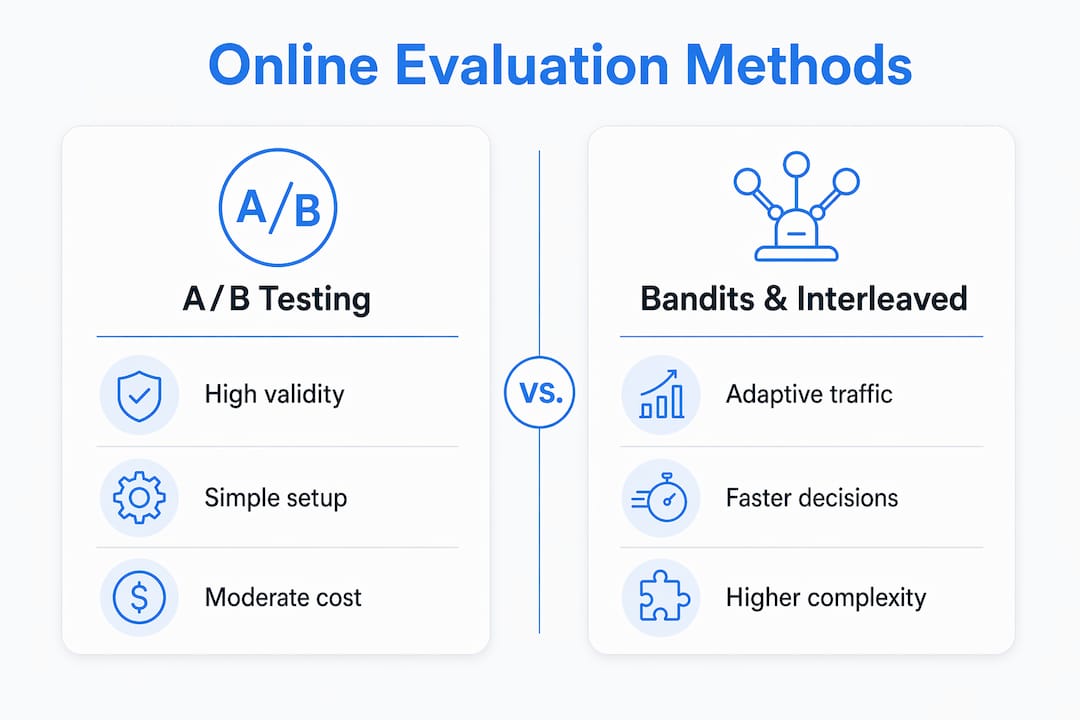
Three methods dominate online evaluation practice: A/B testing, multi-armed bandits, and interleaved ranking experiments. Each trades off differently on bias, speed, cost, and complexity.

A/B testing assigns users randomly to a control group (existing model) and a treatment group (new model). You measure a direct reward signal, such as click rate, task completion, or user rating, and compare the two groups. A/B testing is the gold standard for causal inference because randomization eliminates confounding. The tradeoff is time: you need sufficient traffic to reach statistical power before drawing conclusions.
Multi-armed bandits adapt traffic allocation dynamically. Instead of a fixed 50/50 split, bandit algorithms like Thompson Sampling or Upper Confidence Bound shift more traffic toward the better-performing variant as evidence accumulates. This reduces regret (the cost of showing users a worse model) but introduces correlation between assignment and outcome, which complicates causal interpretation.
Interleaved ranking is specific to ranking and recommendation systems. Both models produce ranked lists, which are merged and shown to a single user. The model whose items get more clicks wins. Interleaved experiments detect quality differences with far less traffic than A/B tests, but they require a ranking context and careful debiasing.
| Method | Causal validity | Speed to decision | Cost | Complexity |
|---|---|---|---|---|
| A/B testing | High | Slow | Medium | Low |
| Multi-armed bandit | Medium | Fast | Medium | High |
| Interleaved ranking | Medium | Very fast | Low | High |
Sampling between 1–10% of production traffic is standard practice for managing evaluation cost without sacrificing statistical power. That sampling rate keeps compute bills predictable while still surfacing meaningful signal.
Pro Tip: Start with 5% sampling and a fixed A/B split for your first online evaluation. Once you understand your traffic variance and effect sizes, graduate to adaptive methods like bandits.
How does online evaluation differ from offline evaluation?
The fundamental difference is data source. Offline evaluation uses a static, curated dataset collected under a previous policy. Online evaluation uses live, randomized traffic generated by the current experiment. That difference in data source creates a difference in what each method can validly measure.
Offline evaluation is observationally inferred and biased unless three assumptions hold: overlap (the old policy tried all relevant actions), no confounders (nothing else changed), and a correct reward model (your proxy metric actually reflects user value). When those assumptions break, offline estimates mislead you. Doubly robust estimators improve offline accuracy, but they cannot rescue the method when the old policy never explored new actions.
Online evaluation is unbiased by design because randomization handles confounding. The cost is higher: you expose real users to an unproven model, you need live infrastructure, and you wait for traffic to accumulate.
| Dimension | Offline evaluation | Online evaluation |
|---|---|---|
| Data source | Historical logs | Live randomized traffic |
| Causal validity | Conditional on assumptions | Unbiased by design |
| Cost | Low | Medium to high |
| Speed | Fast | Slow to medium |
| Risk to users | None | Exposure to worse model |
| Best for | Screening and regression | Deployment decisions |
Online evaluation is mandatory when your model explores new actions not covered by old logs, when network effects mean one user's experience affects another's, or when outcomes play out over weeks rather than hours. Recommendation systems, conversational agents, and pricing models all fall into this category.
Pro Tip: Use offline evaluation as a screening gate. Reject clearly bad models before they reach production. Reserve online tests for candidates that pass offline screening, since online tests are expensive and expose users to risk.
How do you implement online evaluation in AI and ML workflows?
A production online evaluation pipeline has four components: trace logging, sampling, asynchronous scoring, and dashboard aggregation. Getting all four right is what separates a mature evaluation program from ad hoc spot checks.
- Trace logging: Every model request and response gets logged with a unique trace ID, timestamp, and relevant context. For LLM and agent systems, this means capturing the full prompt, completion, tool calls, and any retrieved documents. Mlflow's production-grade tracing captures this data automatically for agentic workflows.
- Sampling: Pull 1–10% of traces into your evaluation queue. The exact rate depends on your traffic volume and the cost of your scoring method. High-traffic systems can use 1%; lower-traffic systems may need 10% to accumulate enough samples for statistical confidence.
- Asynchronous scoring: Apply your judge, whether an LLM judge, a heuristic rule, or a human rater, to sampled traces without blocking the user request. Evaluation runs asynchronously to avoid adding latency to the user experience. Mlflow's LLM-as-a-Judge framework automates this scoring step for GenAI outputs.
- Dashboard aggregation: Aggregate scores by model version, time window, and user segment. Set alerting thresholds so that a drop in quality score triggers an investigation before it becomes a user-facing incident.
Confirmed production failures detected online should be promoted back into your offline regression dataset. This closes the offline-online gap over time and makes your pre-deployment gate progressively more predictive. A failure that slips through once should never slip through again.
Cost control deserves explicit attention. Batch your scoring jobs to run during off-peak hours. Use cheaper, faster judges for routine scoring and reserve expensive LLM judges for flagged cases. Focus your highest-cost evaluation on the model outputs that matter most, such as those involving financial decisions or safety-critical responses.
What are the key challenges in online evaluation, and how can you manage them?
Online evaluation introduces risks and costs that offline testing does not. Understanding these challenges lets you design systems that capture the benefits while limiting the downsides.
- Exposure risk: Real users interact with an unproven model variant. Mitigate this by starting with a small treatment allocation (5% or less), setting automated kill switches that revert traffic if quality scores drop below a threshold, and excluding vulnerable user segments from experiments.
- Variance in estimates: Online metrics are noisy. Small sample sizes produce wide confidence intervals that make it hard to distinguish a real effect from random fluctuation. Increase statistical power by running experiments longer, increasing sample size, or using variance reduction techniques like CUPED (Controlled-experiment Using Pre-Experiment Data).
- Sampling representativeness: A 5% sample is only useful if it reflects the full distribution of user requests. Monitoring sample representativeness is critical. If your sampler over-represents certain query types, your quality scores will be biased toward those types.
- Compute cost: Scoring every sampled trace with a large LLM judge is expensive. Batching evaluations, using smaller distilled models for routine scoring, and applying selective evaluation to flagged cases all reduce cost without sacrificing coverage.
Pro Tip: Track the distribution of your sampled traces weekly. Compare it against the full traffic distribution using a statistical test like the Kolmogorov-Smirnov test. If the distributions diverge, your evaluation scores are no longer representative.
Asynchronous architecture is the single most important design decision for managing these challenges. By decoupling scoring from serving, you eliminate latency impact, gain flexibility to swap judges, and create a clean audit trail for every evaluation decision.
Key Takeaways
Online evaluation is the only method that provides causally valid, unbiased estimates of model performance on real user traffic, making it indispensable for production ML deployment decisions.
| Point | Details |
|---|---|
| Online evaluation is interventional | It uses randomized traffic assignment to answer causal questions, not observational inference from logs. |
| Sampling keeps costs manageable | Running judges on 1–10% of traces balances statistical power against compute cost. |
| Offline and online are complementary | Use offline screening to reject bad models early; use online tests to make final deployment calls. |
| Asynchronous pipelines are required | Scoring must run off the critical path to avoid adding latency to user requests. |
| Failures feed future offline tests | Promoting confirmed production failures into regression datasets closes the offline-online gap over time. |
Why I think teams underestimate online evaluation until it's too late
Most teams I have worked with treat online evaluation as a nice-to-have. They run thorough offline benchmarks, feel confident in their results, and ship. Then they discover that their model fails on a class of user queries that never appeared in the training or evaluation data. The offline benchmark looked great because it was built from the same distribution as the training data. The real world had other ideas.
The uncomfortable truth is that practitioners over-rely on offline evaluations despite fundamental limitations that only online testing can overcome. Offline evaluation is fast and cheap, which makes it seductive. But cheap evaluation that gives you the wrong answer is not actually cheap.
What I have found works in practice is treating offline and online evaluation as two stages of a single pipeline, not two separate philosophies. Offline screening eliminates the obvious failures. Online testing validates the survivors against real user behavior. The teams that do this well also close the loop: every failure caught online becomes a new offline test case. Over time, their offline benchmark gets better at predicting online performance, and the gap between the two narrows.
The future of this practice points toward tighter integration between evaluation and observability. Tools that trace every agent reasoning step, score outputs automatically, and surface quality regressions in real time will make online evaluation less of a special project and more of a continuous background process. That shift is already underway, and the teams building that infrastructure now will have a significant advantage.
— Kevin
How Mlflow supports online evaluation for ML and LLM systems
Mlflow is an open-source platform built for the full lifecycle of GenAI and LLM applications, and online evaluation is a first-class citizen in that lifecycle. The platform's AI observability tools provide deep tracing of agentic reasoning, capturing every prompt, completion, tool call, and retrieved document in production. That trace data feeds directly into sampling and scoring pipelines.
Mlflow's LLM-as-a-Judge evaluation framework automates asynchronous scoring of production outputs against configurable quality criteria. Teams can apply built-in judges or define custom rubrics using Mlflow's evaluation criteria resources. The Mlflow GenAI platform ties these capabilities together into a unified workflow, from agent engineering through deployment and continuous monitoring.
FAQ
What is online evaluation in ML?
Online evaluation in ML is the process of scoring a deployed model's outputs against live production traffic using randomized assignment to obtain unbiased, causal performance estimates. It is the standard method for validating model quality after deployment.
How does online evaluation differ from offline evaluation?
Offline evaluation uses static historical datasets and produces observationally inferred metrics that are biased unless strong assumptions hold. Online evaluation uses live randomized traffic and produces causally valid estimates by design.
What sampling rate should I use for online evaluation?
Most production teams sample between 1–10% of traffic for online evaluation. The right rate depends on your traffic volume, the cost of your scoring method, and the statistical power you need to detect meaningful quality differences.
When is online evaluation mandatory?
Online evaluation is mandatory when your model explores new actions not present in historical logs, when network effects make offline assumptions invalid, or when outcomes unfold over long time horizons that offline datasets cannot capture.
How do I control the cost of online evaluation?
Batch your scoring jobs, use smaller or distilled LLM judges for routine cases, and apply expensive scoring selectively to flagged or high-stakes outputs. Sampling 1–5% of traces rather than scoring all traffic is the most direct cost control lever.