Why Centralize AI Model Management for Enterprise Teams

Centralized AI model management is the practice of unifying model oversight, infrastructure, and governance within a single organizational framework to ensure consistency, efficiency, and compliance. Without this structure, AI teams accumulate what practitioners call "governance debt," where fragmented tools, scattered ownership, and duplicated compute costs compound faster than teams can address them. The EU AI Act and Gartner's projections about AI agent growth make this problem urgent: Fortune 500 companies will operate over 150,000 AI agents by 2028, and no team governs that scale without a central control plane. The question is not whether to centralize AI model management, but how to do it before fragmentation becomes irreversible.
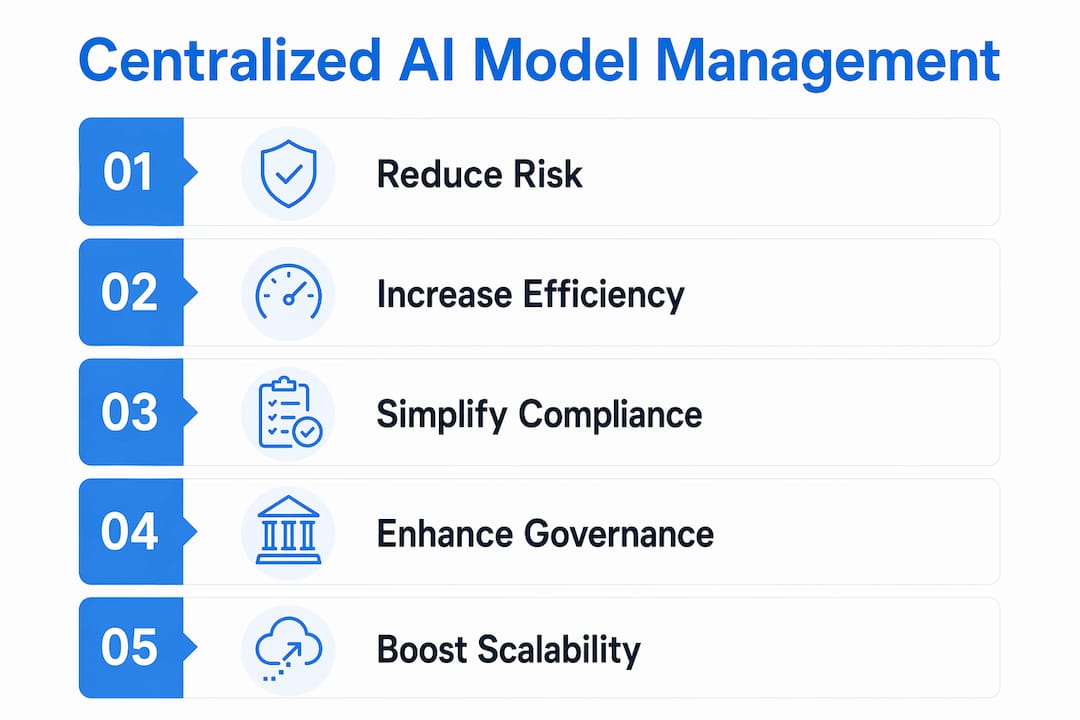
What are the main benefits of centralizing AI model management?
The core case for centralized AI model management rests on three compounding costs that fragmentation creates: duplicated infrastructure, governance debt, and context loss. 79% of enterprises report AI applications are created in silos, and 55% describe the resulting state as a chaotic free-for-all. That is not a minor inefficiency. It is an organizational failure mode that grows more expensive with every new model deployed.
Unified governance reduces risk
A centralized control plane gives leadership visibility into every model in production, including who owns it, what data it uses, and what its current lifecycle status is. Without that visibility, executives cannot make informed decisions about risk. Centralized registries and audit trails give leadership the control needed to govern AI assets at scale. Governance becomes a live operational function rather than a quarterly compliance exercise.
Efficiency gains from shared infrastructure
Fragmented AI teams each build their own compute clusters, data pipelines, and serving layers. The duplication is expensive and unnecessary. Centralized AI infrastructures unify compute, models, data pipelines, and governance for consistency and operational efficiency. Shared infrastructure also means shared policy enforcement, so a security update or access control change propagates everywhere at once instead of requiring manual updates across a dozen isolated environments.

The benefits of centralized AI management extend to model trust as well. When every model draws from a governed context layer with consistent metadata and lineage, the outputs become more predictable and auditable. Teams stop arguing about which version of a model is in production. They stop discovering that two business units trained nearly identical models on slightly different data. Centralization eliminates that class of problem entirely.
Key benefits at a glance:
- Reduced duplication: Shared compute, serving infrastructure, and data pipelines cut redundant spending.
- Consistent policy enforcement: Access controls, rate limits, and compliance rules apply uniformly across all models.
- Improved auditability: A single registry captures model versions, owners, and lifecycle status in one place.
- Context integrity: A governed semantic layer ensures models operate on consistent, well-defined data.
- Faster incident response: Centralized observability surfaces anomalies across all deployed models simultaneously.
How does centralizing AI model management address compliance challenges?
Compliance is the area where fragmented AI management fails most visibly. When model registries live inside individual deployment platforms, ownership and lifecycle status scatter across systems. Fragmented AI inventories across platforms create governance risks because ownership, lifecycle status, and trust evidence become scattered. A regulator asking "who approved this model for production?" should never receive the answer "we're not sure."
Audit trails built into the workflow
The standard mistake is treating audit trails as a compliance artifact rather than an operational tool. Governance must be technically built in rather than retrospectively applied. That means logging model decisions, tracking data lineage, and enforcing policies during development and inference, not only when an audit is scheduled. A centralized control plane makes this the default behavior rather than a manual step teams remember to perform inconsistently.
Organizational accountability requires real authority
MIT Sloan Management Review identifies a critical distinction that most governance frameworks miss:
"The key to AI governance is clear accountability with real authority to stop models, requiring organizational design independent from product teams."
That authority only functions when there is a central registry that maps every model to an owner, a use case, and a current status. Without that map, the person with nominal accountability cannot act because they cannot see the full picture. Clear organizational roles for AI governance require the technical infrastructure to back them up.
The EU AI Act adds regulatory weight to this organizational argument. High-risk AI systems require documented governance, traceable decision chains, and the ability to halt a model quickly. A team managing models across five disconnected platforms cannot produce that documentation reliably. A team using a unified registry can produce it in minutes.
Compliance requirements a centralized registry addresses:
- Documented model ownership and approval chains
- Version history with deployment timestamps
- Data lineage from training through inference
- Evidence of bias testing and performance thresholds
- Authority to deprecate or halt a model across all environments simultaneously
What technological components enable effective centralized AI model management?
Centralization is not a policy decision alone. It requires specific infrastructure layers working together. The architecture breaks into four functional components, each solving a distinct part of the governance and efficiency problem.
The four infrastructure layers
-
Centralized compute and serving layer. A shared cluster for model training, fine-tuning, and inference eliminates the per-team infrastructure sprawl that drives up costs. This layer also enforces hardware allocation policies, preventing any single team from monopolizing GPU resources.
-
Governed context layer. This encodes semantics, metadata, and data lineage so every model operates on a consistent, well-defined view of organizational data. Without it, two models answering the same business question may use different definitions of the same metric.
-
AI gateway. Centralized AI gateways manage model routing, rate limiting, cost control, and policy enforcement across all AI applications. Skipping this layer causes token cost growth and operational risk as usage scales. The gateway is the enforcement point where access controls and budget limits become real rather than theoretical.
-
Unified model registry. This captures use cases, lifecycle status, trust scores, and ownership for every model in the organization. A cross-platform authoritative registry is necessary for scalability because platform-local registries fragment governance the moment a model moves between environments.
| Infrastructure layer | Primary function | Governance benefit |
|---|---|---|
| Compute and serving | Shared training and inference | Unified resource allocation |
| Governed context layer | Metadata and lineage encoding | Consistent data semantics |
| AI gateway | Routing, rate limiting, cost control | Policy enforcement at access point |
| Unified model registry | Lifecycle and ownership tracking | Auditability across all environments |
Mlflow addresses all four layers through its AI platform capabilities, including a model registry, tracing infrastructure, and an AI gateway designed for cross-provider governance. Teams using Mlflow can register models with full metadata, track experiments, and enforce access policies without building custom tooling for each function.
Pro Tip: Start with the model registry before building out the gateway or context layer. A complete inventory of what models exist and who owns them is the prerequisite for every other governance function.
What are the nuances and challenges of adopting centralized AI model management?
Centralization creates a bottleneck risk that teams underestimate. When every model deployment requires central team approval, a small AI platform group can become the constraint that slows every business unit. This is the most common reason centralization efforts stall after initial success.
Hub-and-spoke models distribute deployment without losing governance
McKinsey notes that fully centralized models dominate for compliance, while hybrid hub-and-spoke models improve deployment speed at scale. The hub-and-spoke approach keeps governance, standards, and the registry centralized while giving domain teams the authority to deploy within approved guardrails. A financial services team can move quickly on a new credit-scoring model without waiting for central approval on every parameter change, as long as the model is registered, versioned, and compliant with the central policy framework.
Organizations progress through AI maturity stages, with full centralization appropriate at early stages for risk and compliance, evolving toward hybrid models as teams mature. Trying to skip directly to a federated model before governance foundations exist produces the same fragmentation problem that centralization was meant to solve.
| Operating model | Governance location | Deployment authority | Best fit |
|---|---|---|---|
| Fully centralized | Central AI team | Central AI team | Early maturity, high-risk domains |
| Hub-and-spoke | Central AI team | Domain teams within guardrails | Scaling organizations |
| Fully federated | Distributed | Domain teams | Mature, low-risk environments |
Common adoption pitfalls
The three pitfalls that derail centralization efforts most often are organizational rather than technical. First, teams build the registry but do not enforce its use, so models continue to be deployed outside it. Second, the central team lacks authority to halt a non-compliant model, making governance advisory rather than binding. Third, the platform is designed for the current scale rather than the next one, requiring a rebuild when agent counts grow.
Pro Tip: Design your central governance layer to be modular from day one. The registry, gateway, and context layer should be independently deployable so you can expand each component as your AI footprint grows without rebuilding the entire platform.
Key Takeaways
Centralized AI model management is the foundation of enterprise-scale AI governance, requiring a unified registry, AI gateway, and governed context layer to prevent fragmentation, duplication, and compliance failure.
| Point | Details |
|---|---|
| Centralization prevents governance debt | Fragmented AI silos create duplicated costs and scattered ownership that compound over time. |
| Audit trails must be built in | Governance logging during development and inference is more effective than retrospective compliance checks. |
| AI gateways enforce policy at scale | A centralized gateway controls routing, rate limits, and cost across all models simultaneously. |
| Hub-and-spoke balances speed and control | Hybrid models keep governance central while giving domain teams deployment authority within guardrails. |
| A unified registry is the prerequisite | Every other governance function depends on a complete, cross-platform inventory of models and owners. |
Why I think most teams centralize too late
The pattern I see repeatedly is teams that treat centralization as a future-state problem. They plan to centralize "once we have more models" or "once the team grows." By the time they act, they are managing 40 models across six platforms with no clear owner for a third of them and no audit trail for any of them. The cost of that cleanup is always higher than the cost of building the registry on day one.
The governance authority question is the one that surprises people most. You can build a perfect technical registry and still have zero governance if the central team cannot actually stop a non-compliant model from going to production. That authority has to be designed into the organizational structure, not assumed. I have watched technically excellent centralization efforts fail because the platform team had visibility but no power to act on what they saw.
The other thing worth saying plainly: the EU AI Act and similar regulations are not going away. Teams that build AI model governance infrastructure now will spend far less time on compliance remediation than teams that defer it. The regulatory pressure is a forcing function, but the operational benefits of centralization exist independent of any regulation. Faster incident response, lower infrastructure costs, and consistent model behavior are worth the investment on their own terms.
My advice for teams at early maturity stages is to start narrow. Pick the registry. Get every model in it. Assign an owner to each one. That single step gives you more governance leverage than any amount of policy documentation without the underlying inventory.
— Kevin
How Mlflow supports centralized AI model management
Mlflow is built for teams that need a production-grade centralized platform without building every component from scratch.
Mlflow's model registry and AI gateway give teams a unified control plane for tracking model versions, enforcing access policies, and managing cross-provider governance from a single interface. The AI observability layer provides deep tracing of agentic reasoning and LLM inference, so audit trails are active during production rather than reconstructed after the fact. For teams moving from experimental prototypes to production agents, Mlflow's GenAI platform handles orchestration, evaluation, and lifecycle management in one place. Centralization becomes a technical reality rather than an organizational aspiration.
FAQ
What is centralized AI model management?
Centralized AI model management is the practice of tracking, governing, and deploying all AI models through a unified registry, infrastructure, and policy framework rather than managing them separately within individual teams or platforms.
Why does AI model governance require a unified registry?
Platform-local registries fragment ownership and lifecycle data the moment a model moves between environments. A cross-platform registry is the only structure that maintains consistent accountability at scale.
How does an AI gateway support centralized management?
An AI gateway enforces routing rules, rate limits, cost controls, and access policies across all models simultaneously. Without it, token costs and policy violations scale with every new model deployment.
What is a hub-and-spoke AI operating model?
A hub-and-spoke model keeps governance and standards centralized while giving domain teams authority to deploy within approved guardrails. McKinsey identifies this as the structure that balances compliance with deployment speed at scale.
How does Mlflow support centralized AI model management?
Mlflow provides a model registry, AI gateway, and observability tracing that function as a centralized control plane for AI lifecycle management, covering everything from experiment tracking to production governance.