Can Jev replace your LLM judge? Evaluating quality, cost, and latency

LLM judges help you evaluate answers, compare prompts, and catch regressions. Every judgment also adds another model call. As your project grows, the cost and time spent judging become a headache.
Jev, a new model from TypeSafe, is built for structured decisions and claims faster and cheaper compared to normal LLMs respond in text, which makes it a candidate for LLM judge. We compared Jev with GPT 5.6, Claude, and DeepSeek on human-labeled technical QA examples, measuring human-judge agreement, cost, and latency.
Can Jev distinguish correct MLflow answers from answers containing factual or API errors, and how does it compare with these LLM judges?
1. What is Jev?
Jev is a unique model that does not generate text. A conventional LLM generates its verdict token by token. Jev, by contrast, produces only structured outputs from a fixed set of options, along with decision probabilities. TypeSafe calls it a System One model, borrowing the term from Daniel Kahneman's Thinking, Fast and Slow for decisions made quickly rather than through deliberate reasoning. This narrower interface lets Jev respond with much lower latency, at the cost of general text generation. See TypeSafe's launch post for details.
For example, give Jev a question about an MLflow API, a candidate answer, and the relevant documentation, then ask whether the answer is factually and technically correct using a question. Jev's Noul question type returns the probability of "yes," which your code can turn into a pass or fail. It also supports selecting a category with Choice and grading against ordered rubric levels with Score.
2. Why Jev is a candidate for judging
Many evaluations need a small decision about a large input. Does an answer use the right API? Does it respect the version in the user's question? Does an instruction contradict the supplied documentation?
These tasks fit Jev's interface . You can also ask several independent questions about the same state in one request. Its published price is $0.042 per million input tokens, with no charge for output tokens. That gives us a reason to test it for frequently repeated checks.
One caveat is that LLM judges often produces rationale as well, because we want to understand why a particular answer is marked bad. Jev cannot support that, instead, can only produce probability alongside the classification output.
3. Define an LLM judge with Jev
We'll test Jev with the following LLM judge prompt: is the answer factually and technically correct?. MLflow custom scorers can call an any external model and return its assessment. We'll wrap a Jev call in a scorer, retaining the probability, latency, and estimated cost alongside its verdict.
Install the packages and start an MLflow server:
uv add mlflow typesafe-sdk
uv run mlflow server --host 127.0.0.1 --port 5000
In the terminal where you'll run Python, configure the connection and your TypeSafe API key. Use one evaluation worker so requests run sequentially:
export MLFLOW_TRACKING_URI="http://127.0.0.1:5000"
export TYPESAFE_API_KEY="your-typesafe-api-key"
Then define the judge with the @scorer decorator and run it against the dataset. The following code also include benchmark instrumentation to measure cost and latency, which is not necessary for the judging itself.
from time import perf_counter

import mlflow
from mlflow.entities import Feedback
from mlflow.genai.scorers import scorer
from typesafe_sdk import Noul, RetryPolicy, TypeSafeClient

mlflow.set_experiment("jev-judge-comparison")
client = TypeSafeClient(
    model="jev-1.13.0", retry=RetryPolicy(max_retries=0), timeout=30
)
THRESHOLD = 0.5
INPUT_USD_PER_MILLION = 0.042
CRITERION = (
    "Is the candidate answer factually and technically correct for the question, "
    "using the supplied MLflow documentation and respecting any version specified "
    "in the question? Answer yes if there is no material factual or API error. "
    "Answer no if at least one claim or instruction is materially wrong or misleading. "
    "Do not penalize style or harmless omissions. An omission is material when it "
    "makes the requested technical answer misleading."
)


def judge_answer(question: str, context: str, answer: str) -> dict:
    started = perf_counter()
    response = client.system_one(
        state={"question": question, "context": context, "answer": answer},
        questions={"correct": Noul(instructions=CRITERION)},
    )
    latency_ms = (perf_counter() - started) * 1000
    probability = response.nouls["correct"].noul
    tokens = response.usage.input_tokens
    cost = None if tokens is None else tokens * INPUT_USD_PER_MILLION / 1_000_000
    return {
        "prediction": "correct" if probability >= THRESHOLD else "incorrect",
        "p_correct": probability,
        "model": response.model,
        "input_tokens": tokens,
        "latency_ms": latency_ms,
        "estimated_cost_usd": cost,
    }


@scorer
def jev_correctness(inputs: dict) -> Feedback:
    result = judge_answer(**inputs)
    return Feedback(
        value=result["prediction"] == "correct",
        metadata={**result, "threshold": THRESHOLD},
    )
jev_correctness evaluates a candidate answer stored with its question and documentation in inputs. It returns a Boolean assessment for use in MLflow evaluations. Next, we'll check how reliable those assessments are.
4. Measure initial quality, cost, and latency
We created 30 MLflow QA examples covering tracing, evaluation, prompts, datasets, and assessments. Each contains a question, a candidate answer, and an excerpt from the official MLflow documentation. A human reviewer labeled the examples so we can measure human-judge alignment. After the label correction described below, the reference contains 15 answers labeled Correct, 15 Incorrect.
Here is one of the incorrect answers for example:
{
    "inputs": {
        "question": (
            'My `@scorer` function is called `check_answer`, but it returns '
            '`Feedback(name="answer_quality", value=True)`. '
            'Which name appears as the metric?'
        ),
        "context": (
            "1. If the scorer returns one or more `Feedback` objects, then "
            "`Feedback.name` fields take precedence, if specified.\n"
            "2. For primitive return values or unnamed `Feedback`s, the "
            "function name (for the `@scorer` decorator) or the `Scorer.name` "
            "field (for the `Scorer` class) are used."
        ),
    },
    "outputs": (
            "The metric is named `check_answer`, because decorated scorers "
            "always use the Python function name. To show `answer_quality` "
            "in the results, rename the function to that name."
    ),
    # This field is not passed to the Jev judge.
    "expectations": {"human_correctness": "incorrect"},
}
mlflow.genai.evaluate(data=data, scorers=[judge_answer])
We also tested GPT-5.6 Terra and Luna, Claude Sonnet 4.6, Claude Opus 4.8, and DeepSeek-V4.1-Flash (deepseek-flash) the same inputs and correctness criterion. We explicitly disabled extended reasoning and limited output to 128 tokens, testing a configuration intended for quick pass/fail checks. Here is the result from the benchmark.
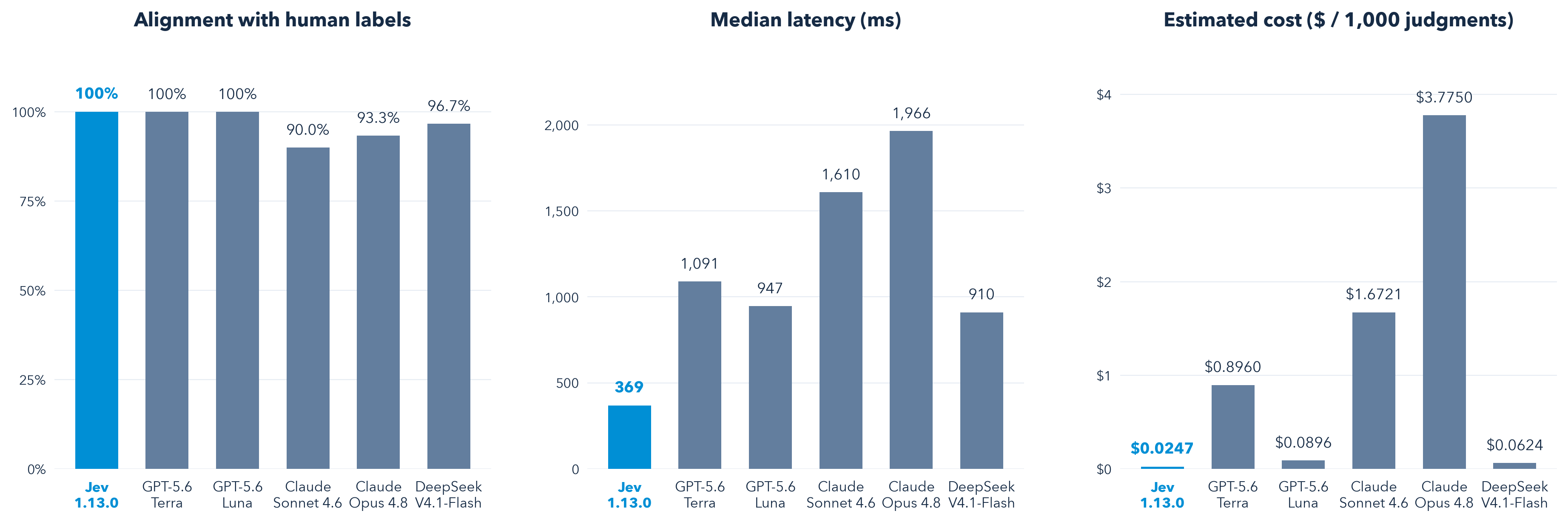
30 human-labeled QA examples. DeepSeek cost uses off-peak pricing.
| Judge | Agreement with human labels | Median latency | p95 latency | Estimated cost / 1,000 judgments |
|---|---|---|---|---|
| Jev 1.13.0 | 30/30 (100%) | 369 ms | 411 ms | $0.0247 |
| GPT-5.6 Terra | 30/30 (100%) | 1,091 ms | 1,924 ms | $0.8960 |
| GPT-5.6 Luna | 30/30 (100%) | 947 ms | 1,435 ms | $0.0896 |
| Claude Sonnet 4.6 | 27/30 (90.0%) | 1,610 ms | 3,546 ms | $1.6721 |
| Claude Opus 4.8 | 28/30 (93.3%) | 1,966 ms | 9,279 ms | $3.7750 |
| DeepSeek-V4.1-Flash | 29/30 (96.6%) | 910 ms | 1,188 ms | $0.0624 (off-peak) |
Jev, Terra, and Luna made identical decisions on all 30 examples. Jev had the lowest estimated cost and observed latency. Sonnet rejected one correct answer and accepted two incorrect answers. Opus also rejected an answer that correctly described session and tracing metadata. DeepSeek accepted one incorrect answer about output recording, same one as Claude mistook.
5. Decide when to use Jev and when to defer
For this dataset, Jev produced the compatible human-judge alignment score as Terra and Luna at lower cost and latency. Before adopting it, we still recommend collecting real answers and check the errors that matter to your application. Jev's probabilities also let you try sending uncertain cases to another evaluator.
Also the limitation of the lack of rationale can be important for iterating on the judge result. For example, if you are iterating on the agent quality during development phase, using normal text-based models would still be better. However, when it comes to large scale evaluation like online production monitoring, Jev could be a great option to balance quality and cost. When Jev flagged some answers as bad, you can still run the same judge with more expensive LLMs to generate human-readable rationale.
A binary Noul question also cannot abstain. When abstention matters, use a Choice question with an explicit unsure option, then route those cases to another judge or a human reviewer.
6. Try it on your evaluation dataset
Start with a criterion you already use, label a small set of answers, and run Jev alongside your current judge in MLflow. Inspect the disagreements as well as the cost and latency. Then test your choice on fresh examples before changing the evaluator that catches your regressions.
See the MLflow evaluation quickstart and custom scorer guide to adapt the example. Share what you learn with the MLflow community.