OpenTelemetry GenAI Semantic Conventions
OpenTelemetry Semantic Conventions for GenAI define a standard schema for describing AI and LLM telemetry, backed by the Cloud Native Computing Foundation (CNCF). The convention is adopted by many observability platforms and cloud services, including Google Cloud, AWS, Azure, Datadog, and more. By natively supporting this standard, MLflow ensures your AI observability data is never locked into a proprietary format and any compliant tool can produce or consume it.
Exporting Traces in GenAI Semconv Format
By default, MLflow exports traces using its internal mlflow.* attribute format. To export in the GenAI Semantic Convention format (gen_ai.*), set the MLFLOW_ENABLE_OTEL_GENAI_SEMCONV environment variable and configure the OTLP endpoint as the export destination.
import os

# Enable GenAI Semantic Convention format for OTLP export
os.environ["MLFLOW_ENABLE_OTEL_GENAI_SEMCONV"] = "true"
os.environ["OTEL_EXPORTER_OTLP_TRACES_ENDPOINT"] = "http://localhost:4317/v1/traces"
When enabled, MLflow translates span attributes at export time. This allows other OTel-compatible backends to understand the trace data and display it in a human-readable format.
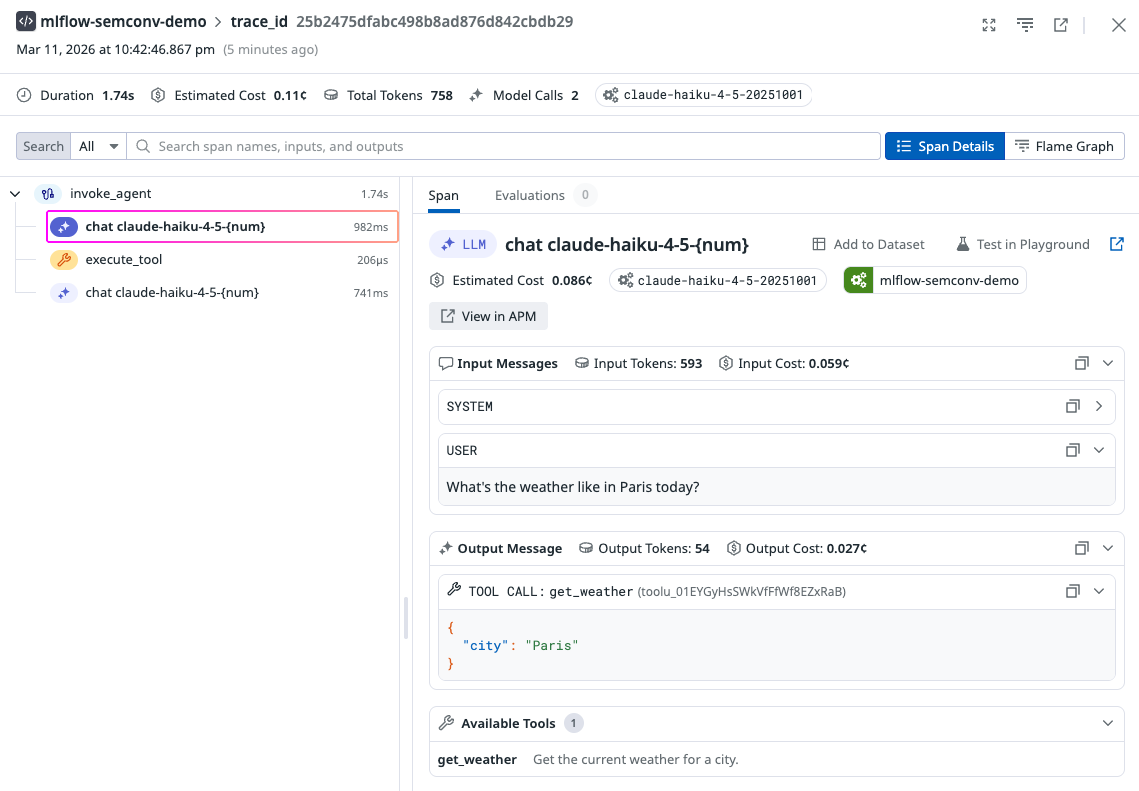
The following table summarizes the key mappings:
| MLflow Attribute | GenAI Semconv Attribute | Description |
|---|---|---|
mlflow.spanType | gen_ai.operation.name | Operation type (e.g., CHAT_MODEL → chat) |
mlflow.llm.model | gen_ai.request.model | Model name |
mlflow.llm.provider | gen_ai.provider.name | Provider (e.g., openai, anthropic) |
mlflow.chat.tokenUsage | gen_ai.usage.input_tokens / gen_ai.usage.output_tokens | Token counts |
mlflow.spanInputs | gen_ai.input.messages | Input messages |
mlflow.spanOutputs | gen_ai.output.messages | Output messages |
For the full mapping tables, see the Attribute Mapping Reference.
GenAI semconv export is available in MLflow 3.11 and above. Set MLFLOW_ENABLE_OTEL_GENAI_SEMCONV=true to enable it.
Ingesting GenAI Semconv Traces to MLflow
MLflow Server itself is OTel-compatible and exposes an OTLP endpoint at /v1/traces that automatically recognizes traces that use GenAI Semantic Convention attributes.You can send GenAI semconv-compliant traces to MLflow and they will be displayed as first-class citizens with proper span types, token counts, model info, and structured inputs/outputs.
See Collect OpenTelemetry Traces into MLflow for setup instructions.
Supported Frameworks
Message format conversion for GenAI semconv export is supported for the following providers and frameworks:
- OpenAI (Chat Completions and Responses API)
- Anthropic
- Google Gemini
- Amazon Bedrock
On the ingestion side, MLflow recognizes GenAI semconv traces from any compliant tool, including Google ADK, LiveKit Agents, Spring AI, and more.
Dual Export with GenAI Format
You can combine GenAI semconv export with dual export to send traces to both MLflow and an OpenTelemetry-compatible backend simultaneously. MLflow stores traces in its own format locally (for the MLflow UI) while exporting the GenAI semconv version to the OTLP endpoint. To enable dual export, set MLFLOW_TRACE_ENABLE_OTLP_DUAL_EXPORT=true.
import os

# Enable both GenAI semconv format and dual export
os.environ["MLFLOW_ENABLE_OTEL_GENAI_SEMCONV"] = "true"
os.environ["MLFLOW_TRACE_ENABLE_OTLP_DUAL_EXPORT"] = "true"

# Configure the MLflow tracking server URI and experiment ID
os.environ["MLFLOW_TRACKING_URI"] = "http://localhost:5000"
os.environ["MLFLOW_EXPERIMENT_ID"] = "123"

# Configure the other OpenTelemetry-compatible backend OTLP endpoint
os.environ["OTEL_EXPORTER_OTLP_TRACES_ENDPOINT"] = (
    "http://other-backend-otlp-endpoint:4317/v1/traces"
)